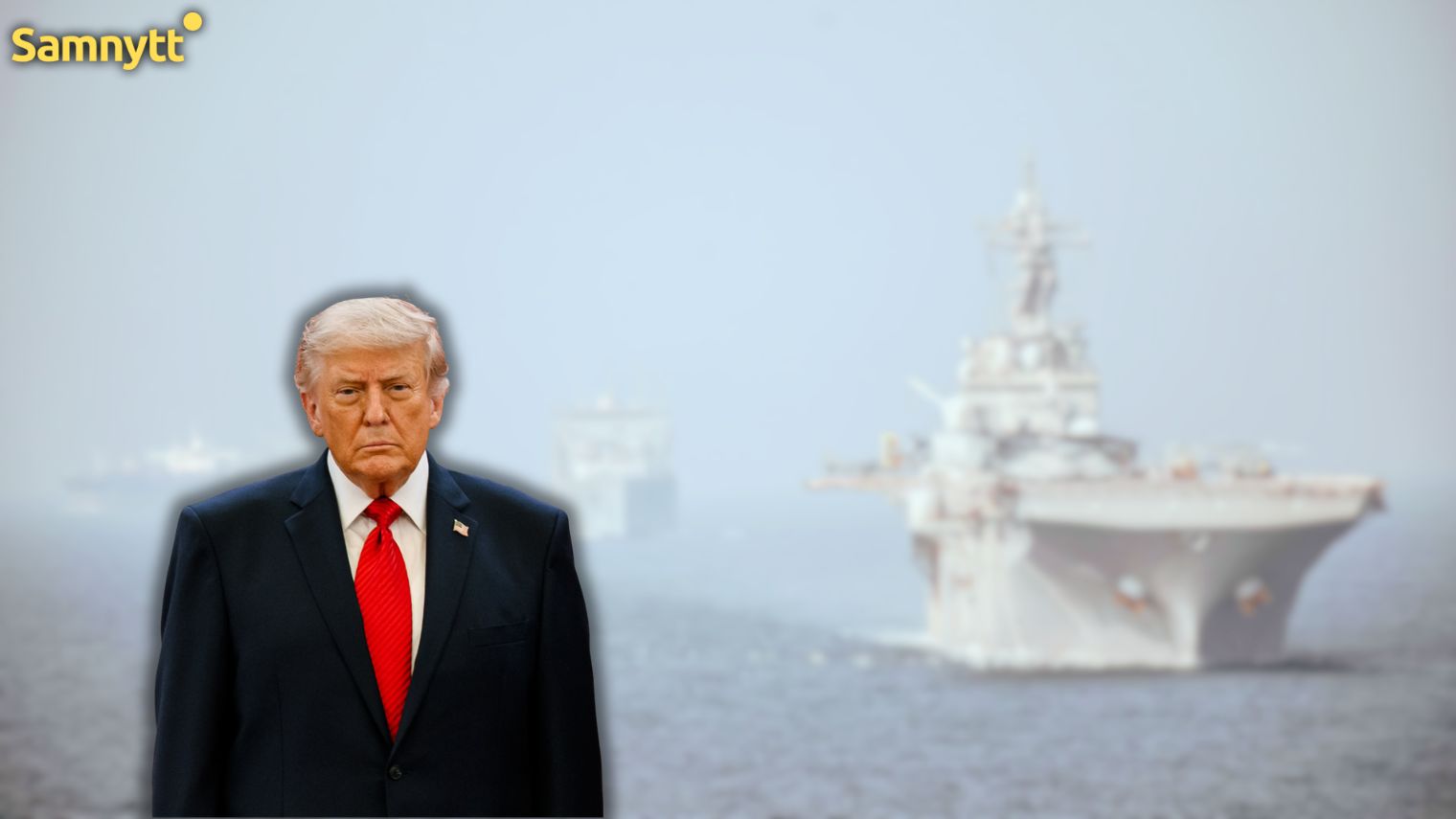
After months of war, missile attacks, and one of the most serious security crises in the Middle East in decades, U.S. President Donald Trump reports that the U.S. and Iran have now reached a peace agreement to end the conflict between the countries. A formal signing is expected to take place in Switzerland later this week.
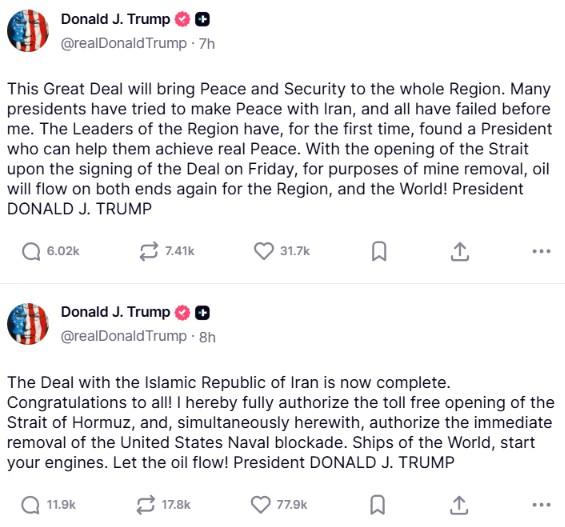
On Sunday, Trump announced that the agreement is “complete,” describing it as the endpoint of the approximately three and a half month-long war. According to the agreement, hostilities are to cease, the American blockade of Iranian ports will be lifted, and the strategically important Strait of Hormuz will reopen for international shipping.
The agreement has been brokered by Pakistan, supported by Qatar among others, and also includes a 60-day negotiation period during which the parties will attempt to resolve the remaining difficult issues—chiefly Iran’s nuclear program, the sanctions on the country, and the management of Iran’s stockpiles of enriched uranium.
SEE ALSO: Trump: USA has “ended the war” – Iran downplays the reports
Despite Trump’s triumphant tone, several key parts of the agreement remain unclear. No full text of the agreement has yet been made public, and both diplomats and analysts point out that the most controversial issues have been postponed. For example, uncertainty remains over how Iran’s nuclear activities will be limited, and what guarantees exist to keep the Strait of Hormuz open without conditions.
Meanwhile, Iran has signaled a certain degree of caution. As recently as last week, representatives of the Iranian Foreign Ministry said that no final decision had been made yet and that several issues remained unresolved.
“Let the oil flow,” Trump wrote on Truth Social:
Welcomed by World Leaders
The agreement has nonetheless been welcomed by much of the international community. UN Secretary-General António Guterres described the deal as an important step towards stability in the region. Sweden’s Foreign Minister Maria Malmer Stenergard (M) welcomed the news and called it a step in the right direction, while also emphasizing that it is now crucial to implement the agreement in practice.
Even before the agreement was made public, Malmer Stenergard had expressed cautious optimism following talks with several regional actors involved in the mediation. After visits to Qatar, Saudi Arabia, and the United Arab Emirates, she said that negotiations were at an intense stage and that the parties appeared “relatively close” to an initial agreement, even though the situation remained fragile.
Several Issues Remain
The peace agreement represents a significant political breakthrough for Trump, who came under heavy criticism this spring for the costs of the war and rising energy prices following the closure of the Strait of Hormuz. News of a deal immediately led to expectations of more stable oil supplies and falling energy prices on the world market.
At the same time, several difficult issues must be resolved before lasting peace can be secured. Israel has expressed concern that the agreement does not sufficiently limit Iran’s military capabilities, while critics in Washington argue that the U.S. has made major concessions without obtaining clear guarantees regarding Iran’s future conduct.
If the signing in Switzerland goes ahead as planned, it will be the largest diplomatic settlement between Washington and Tehran since the conflict broke out earlier this year, but the outcome of the next two months of negotiations is expected to determine whether the ceasefire truly turns into a permanent peace.
Fact
The war in the Strait of Hormuz began on February 28, when the US and Israel carried out major airstrikes against Iran. Iran responded with missile attacks against American and Israeli targets and by closing the Strait of Hormuz, one of the world’s most important shipping lanes for oil and gas.
In the spring, the conflict escalated into a regional war, with fighting between the US, Iran, Israel, and Iran-backed groups in Lebanon, among other places.
The US launched a military operation to reopen the strait, while Iran mined shipping lanes and attacked or stopped commercial vessels, leading to severe disruption in :censored:6:cdd6bbaa89: trade and rising energy prices.
SEE ALSO: Trump: The Strait of Hormuz is Open