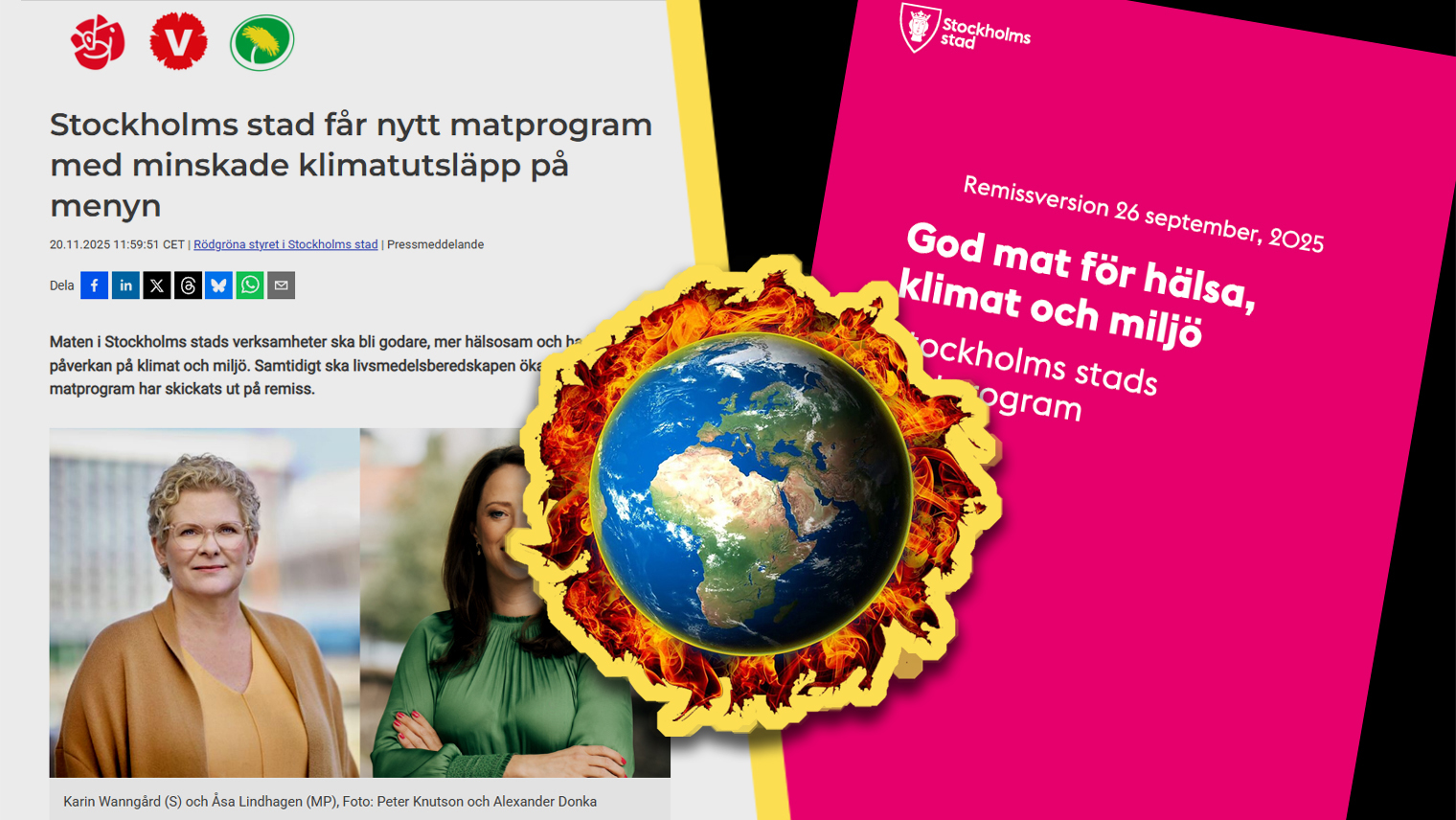
Stockholm’s red-green government wants to use public meals to control what people eat. Through targeted political procurement, meat is to be pushed aside, vegetables prioritized, and freedom of choice on the plate reduced. Schools and preschools are especially singled out to lead the change, but elderly care is also included in the shift. Critics see a growing dietary paternalism where children and the elderly become tools for symbolic climate politics.
It’s not just about food. It’s about control over everyday life. Stockholm city’s red-green government’s new food program states that emissions from the city’s procured food must be drastically reduced by 2030. The route is clear: less meat, more vegetables, and procurement designed so that what politicians want to see on the plate is also the only thing served. For those working in or dependent on public services, the result is less freedom of choice as political climate goals enter the lunchroom.
Schools and preschools to “lead the way”
According to the city’s food program, emissions from food purchased for city operations are to decrease by at least 40 percent by 2030 compared to 2013. The average climate impact from the procured food must then be no more than 1.25 kilos of carbon dioxide equivalents per kilo of food.
The document states that the share of plant-based foods in meals should increase while the share of meat should decrease. At the same time, all operations are required to contribute—but so-called pedagogical activities are to “lead the way and show the path.”
This means in practice that children in schools and preschools are prioritized as the groups who are to first get used to the dietary shift desired by politicians. The meal thus becomes not just a service, but also a tool for shaping future eating habits.
Procurement used to control the menu
No formal meat ban is introduced. But by controlling procurement, the municipality can in practice decide what actually ends up on the plate.
When climate goals, ecological demands, and special guidelines are built into procurement, the selection changes as well. It is no longer just demand or tradition that decides what is served in school cafeterias and retirement homes—but political priorities.
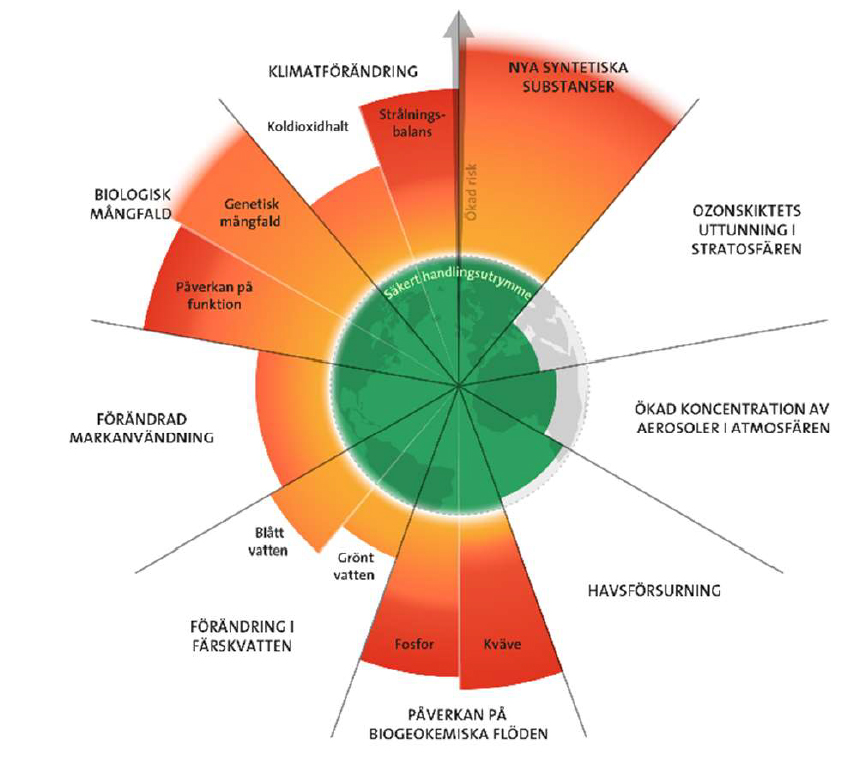
The city simultaneously sets a goal that at least 70 percent of food purchases should be organic and refers to various environmental guides to steer which ingredients are prioritized.
For critics, this is a clear example of how politics is shifting from legislation to procurement. By controlling purchases, public operations can be shaped without formally banning anything.
Elderly care included as well
The food program does not only apply to schools and preschools. Elderly care is also included in the guidelines.
This comes at a time when the issue of meals for the elderly is already politically charged. Earlier this year, Swedish Radio reported that over 30 municipalities have reduced or removed certain food items in elderly care, including salmon, Bregott butter, and flavored yogurt.
In Arboga, both Sunday roast and salmon, for instance, were removed from the menu. Pensioners interviewed responded strongly.
– I don’t want them to remove it entirely. We don’t have much else to look forward to, said 84-year-old Rut Bark to Swedish Radio.
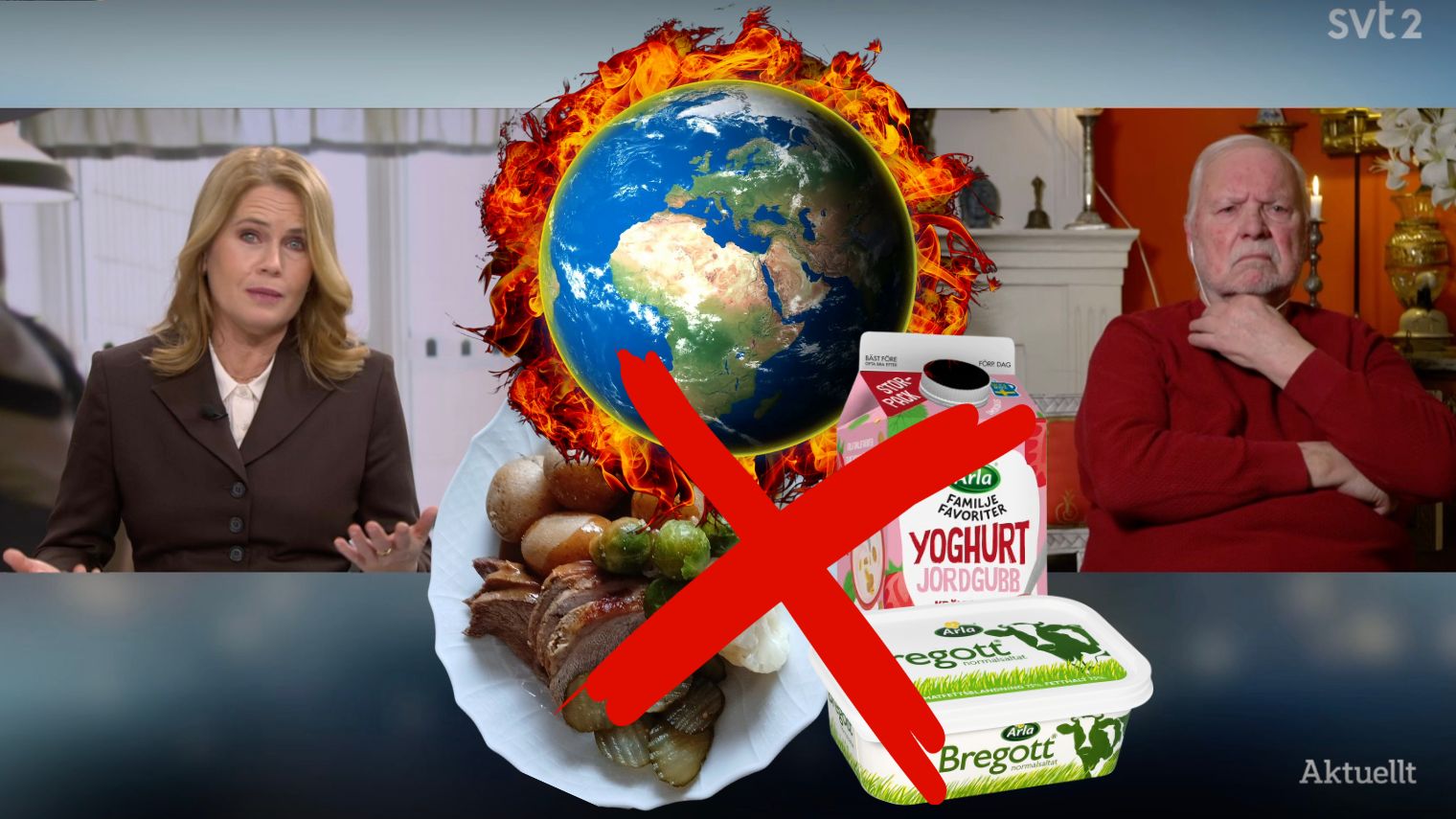
At the same time, the issue was discussed on SVT’s Aktuellt where anchor Nike Nylander brought up the possibility that meat reductions could be “good from a climate perspective.” Celebrity chef Leif Mannerström reacted strongly and pointed out that seniors simply want meat.
– Meat is what they want now. That can come with the next generation, Mannerström said during the broadcast.
READ ALSO: SVT move when pensioners lose food: ‘Good for the climate’
Controversial climate policy
The political dietary shift comes as the climate debate in Sweden remains disputed. Statistics from the Swedish Environmental Protection Agency show that Sweden’s reported greenhouse gas emissions amount to just over 47 million tons per year. At the same time, the authority also lists a significant carbon uptake in forests and land.
Former Vattenfall engineer Tomas Åbyhammar has pointed out that the uptake in land use and forestry often exceeds the emissions. If these are combined, the net is nearly zero, he claims.
READ ALSO: Former Vattenfall engineer: ‘Sweden has no climate emissions’
Critics therefore argue that extensive climate regulation of daily life—from fuel to eating habits—risks becoming symbolic politics in a country that already has very low emissions from a :censored:6:cdd6bbaa89: perspective.
Swedes want to keep eating meat
At the same time, polls show that meat is still a natural part of the diet for most Swedes. A survey by Novus commissioned by Svenskt Kött clarifies that over nine out of ten Swedes eat meat and want to keep doing so. Statistics from the Swedish Board of Agriculture also show that meat consumption increased somewhat in 2024 compared to the previous year.
Despite this, political initiatives at various levels continue to push development in the opposite direction, where public kitchens are used to reduce meat consumption against consumer wishes.
The EU wants us to eat insects
Alternative protein sources are increasingly discussed in the European food debate. In recent years, the EU has approved several insects as food, including mealworms and house crickets, after safety assessments. The products are already sold in some European countries and are sometimes highlighted as possible future protein sources.

Although the City of Stockholm does not propose anything like this in its meal program, critics see the development as part of the same trend—a politically driven shift away from traditional animal-based foods.
A new role for public meals
The red-green government in Stockholm itself describes the meal as a political tool to contribute to climate goals and influence the food system. For critics, this makes the issue controversial. When food in public institutions is no longer just about nutrition and service but also about party-political aims, its role changes.
The plate in the school cafeteria or care home becomes not just a meal—but also a political message about how citizens are expected to eat in the future.