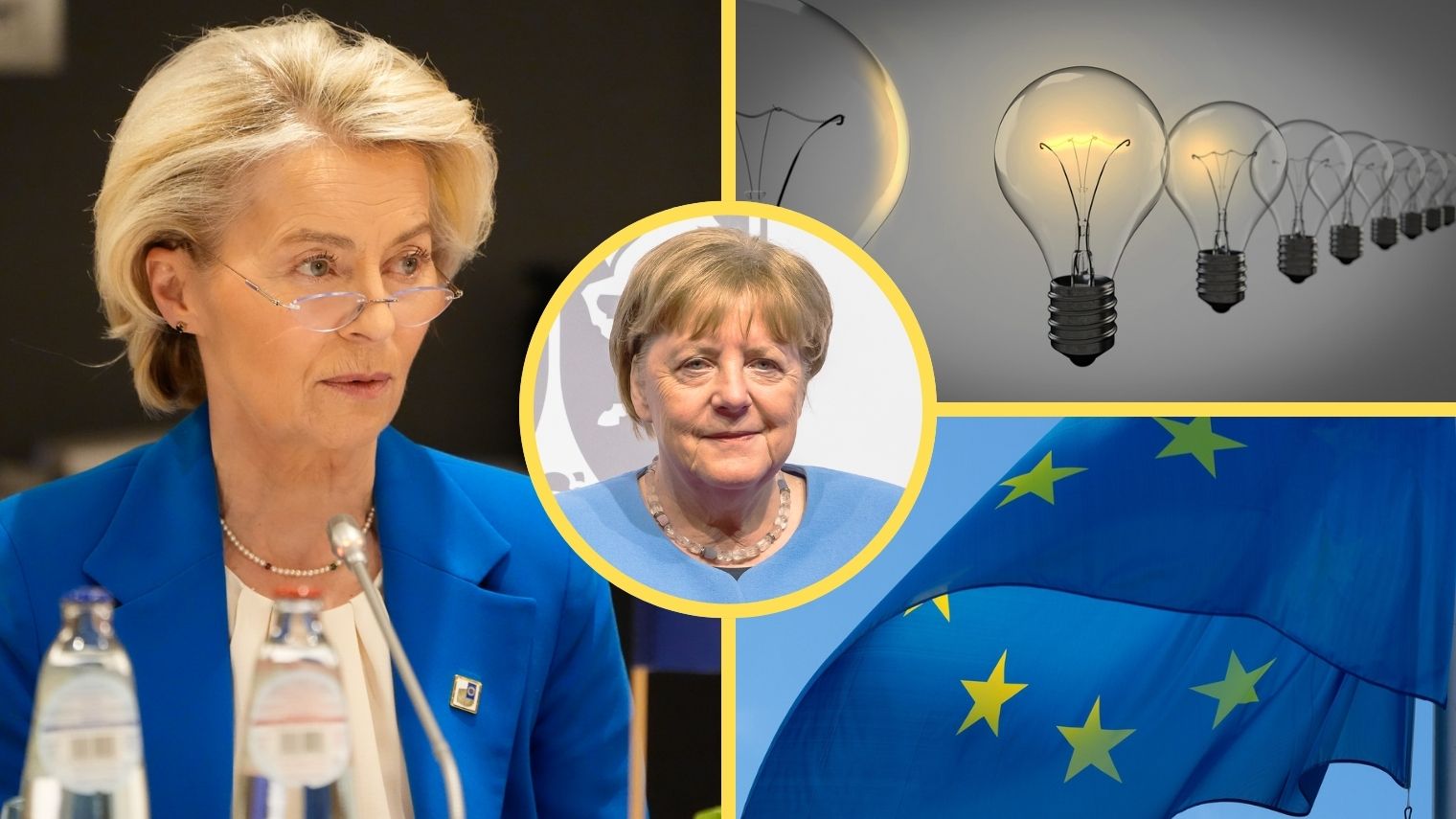
Shrinking Europe’s nuclear power sector was a strategic mistake. That is the message from European Commission President Ursula von der Leyen, who thus joins a growing chorus of voices who are only now beginning to realize that climate-extremist-driven political ravages have caused great harm.
In 1990, nuclear power accounted for around a third of Europe’s electricity, a share that has now fallen to 15 percent, drastically increasing dependence on oil and gas imports, the prices of which have soared in recent days.
Being “completely dependent on expensive and volatile imports” of fossil fuels puts Europe at a disadvantage compared to other regions, von der Leyen observed.
– This reduction in the share of nuclear power was a choice. I believe it was a strategic mistake by Europe to turn its back on a reliable and affordable source of low-emission energy.
READ ALSO: Merz: Mistake to Shut Down Nuclear Power
The decision to phase out nuclear power in Germany was made under then Chancellor Angela Merkel, with von der Leyen serving as a minister.
The EU budget does not directly finance nuclear energy projects since they lack unanimous support among its 27 member governments. However, in a sign of the EU’s growing acceptance of the technology, von der Leyen said the Commission would offer a guarantee of 200 million euros for private investment in innovative nuclear technology. The money will be drawn from the EU’s carbon market.
By 2030 at the latest, von der Leyen wants to see small modular reactors (SMR) across the EU and to harmonize regulations between member states.
Industrial Competitiveness
The EU has rapidly expanded renewable energy, but gas power plants still constitute a key part of its energy mix, and fossil fuels still dominate energy consumption in sectors like transport and heating.
The continued heavy dependence on imported oil and gas left European countries vulnerable to rising energy prices in 2022 when Russia curtailed gas deliveries after invading Ukraine.
In France, Europe’s largest nuclear energy producer, there is a strong argument that stable and low-carbon energy from nuclear power plants is the key to industrial competitiveness.
The People Behind the Shutdown
When Ursula von der Leyen made her new insights public on X, users quickly pointed out that she herself participated in the phase-out of nuclear power:
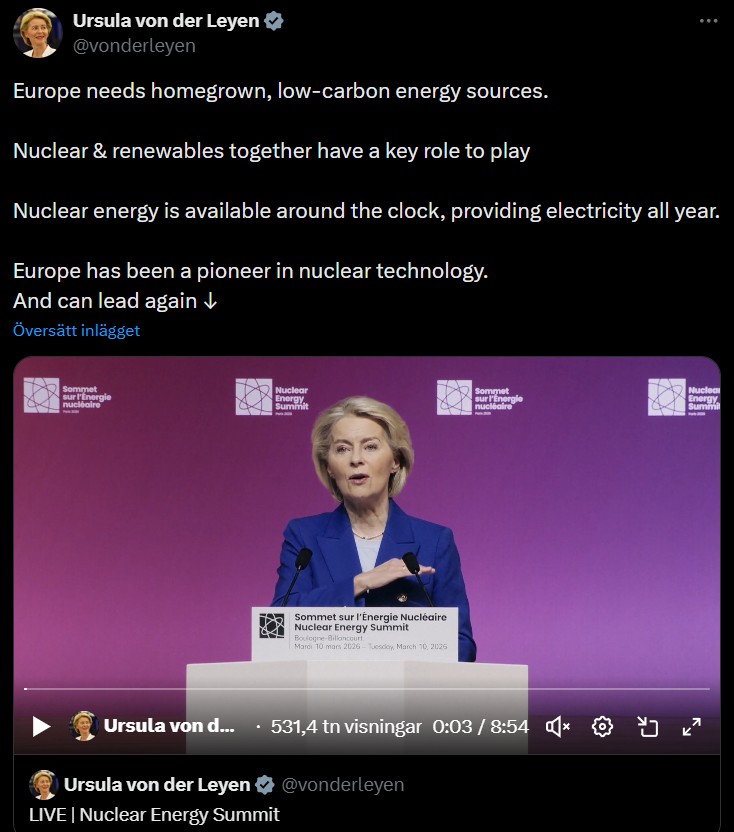
A short but efficient history lesson on how it all happened:
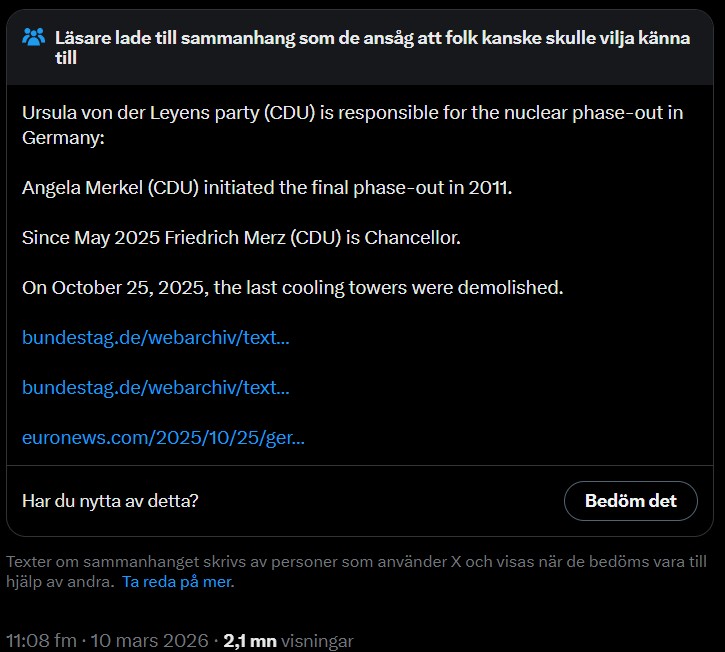
In a 2011 Bundestag speech, Chancellor Angela Merkel presented a five-point plan for carrying out the energy transition. Merkel cited the Fukushima accident as justification for the planned transition, calling it a “turning point for the world” and for herself personally.
According to an amendment to the Atomic Energy Act, the seven older nuclear power plants that were shut down during the three-month nuclear moratorium, plus the Krümmel plant (Schleswig-Holstein), would not be restarted, she also announced.
“A step-by-step plan exists for shutting down the remaining nuclear power plants. The last ones will be decommissioned by 2022 at the latest. The remaining electricity quotas from the plants that have been shut down will be transferred to the remaining ones. A separate law is intended to address the matter of final storage of nuclear waste.”
That same year, the Bundestag passed a resolution to phase out nuclear power.
READ ALSO: Shutdown of German Nuclear Power Based on Lies
In October 2025, Euronews reported on the demolition of two cooling towers from the former nuclear power plant in the Bavarian town of Gundremmingen.
As part of the country’s nuclear phase-out and in line with Germany’s then energy transition policy, the Gundremmingen nuclear power plant—alongside the Brokdorf and Grohnde plants—had already been decommissioned in December 2021.
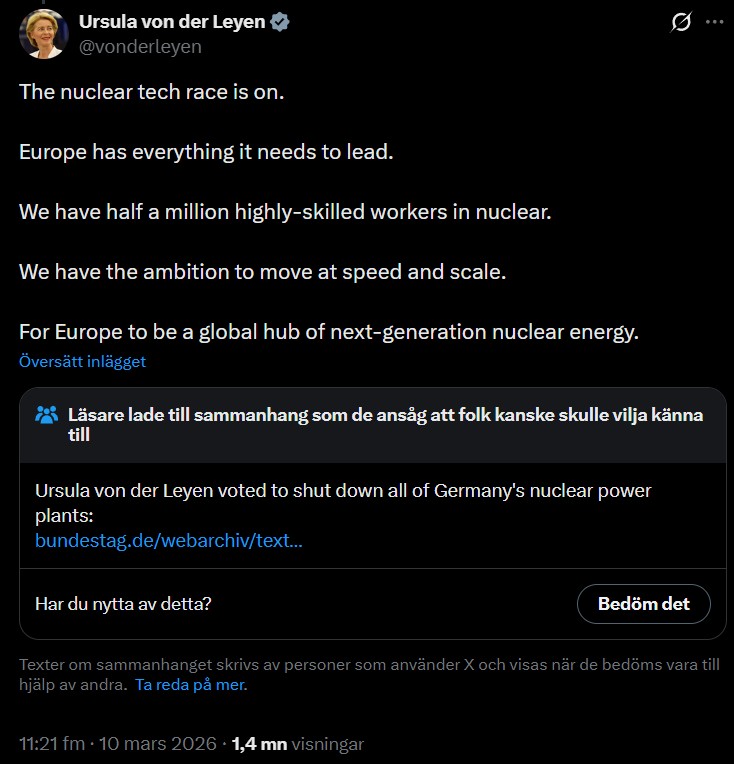
In a follow-up post, users also reminded of von der Leyen’s swift policy shifts:
The Same in Sweden
The parallels to Sweden are hard to ignore. Here it was the previous Social Democratic-led government together with the Green Party that destroyed Sweden’s previously stable electricity system, leading to soaring prices—and here too it has, in retrospect, been acknowledged as a mistake.
However, should the Green Party return to power, they have promised to put a stop to new nuclear power projects.