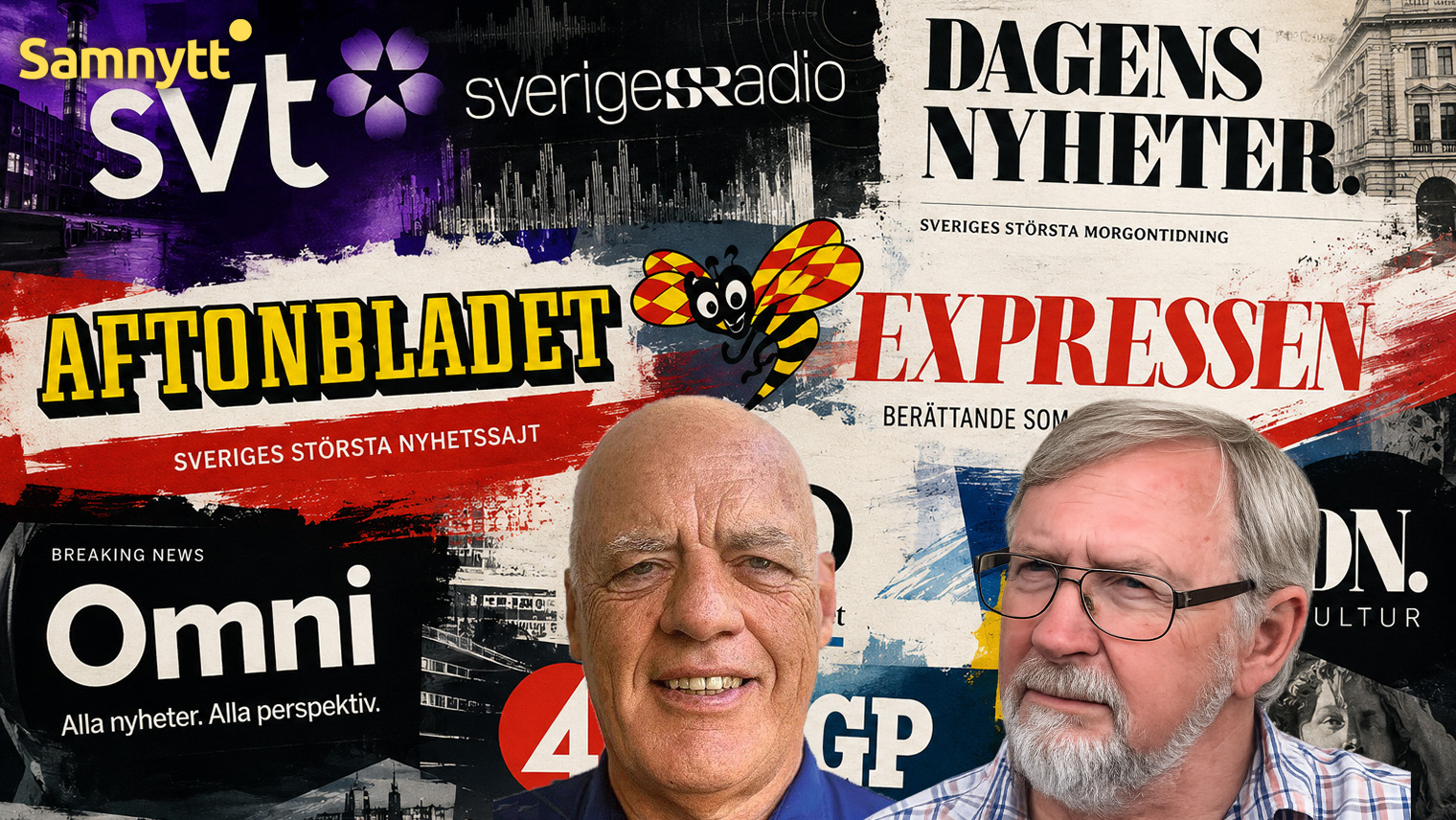
DEBATE • On the right side, there is a wide range of independent media and columnists (Samnytt, Nyheter Idag, Fria Tider, SwebbTV, Ledarsidorna, Nya Tider, Riks, Bulletin, Kvartal, Det Goda Samhället, and others) — around seventy actors. The activity is lively and extensive. On the left side, the supply of truly alternative outlets is considerably thinner: Dagens ETC, Flamman, Arbetaren, Internationalen, and a few smaller sites, often more integrated into the establishment (culture, academia, public service). The absence of a vibrant alternative left-wing media is, in our view, proof that the established media already fills this role for the left perspective.
In Sweden, established media are in practice defined as those actors that regularly receive state media support via the Media Support Board, as well as large commercial actors such as Dagens Nyheter. These have a privileged position with financial support, but which also creates dependence (the support can be reassessed or withdrawn if the content is deemed “inappropriate”). This creates an asymmetry against right-oriented independent media.
Asymmetry in the Media Landscape
According to Media Authority decisions for 2026, Dagens ETC receives over 13 million SEK in support, while Flamman and Arbetaren receive transitional support. Several independent right-leaning outlets, however, have been denied support on repeated occasions. This pattern risks reinforcing one-sidedness and creates a dependency where established outlets have greater security, while independent voices can more easily be penalized financially, which also leaves them with weaker resources.
This is no coincidence, but also a strong indication that large parts of the established mainstream already cover and amplify left-oriented perspectives.
Two Levels of Left-Leaning Bias
Level 1 – Journalists’ private opinions: Studies (Kent Asp and others) consistently show overrepresentation of left-wing parties (S, V, MP) among journalists — around 70% in older studies, with a strong bias toward V and MP compared to the general public.
Level 2 – Management and owners allow it: In May 2026, SVT’s CEO Anne Lagercrantz commented on criticism of political coverage for young audiences: “We shouldn’t only serve a narrow elite that already has a high interest in news. We should serve everyone.” She emphasizes breadth over depth for those already interested. Critics see this as an admission that journalists’ own views are allowed more leeway in practice — despite SVT’s strict policy on impartiality and factuality, which forbids personal values from shaping reporting.
Consequences: Citizens’ perception of reality is shaped via public service. Most Swedes get their most important information about societal issues from radio, TV, and mainstream media. Public service (primarily SVT and SR) continues to have a very high reach.
SVT reached 81% and SR 76% of Swedes in 2025. A large share consumes news from SVT every week or more frequently (around 68% according to SOM studies). The weakness is that the youngest generations are abandoning public service.
Systematic Effects
When the journalist corps leans to the left and management does not fully counteract this, systematic effects occur.
Selective coverage and media campaigns against right-wing policies (for example, SD and the Tidö government) compared to milder handling on the left. Critical perspectives on migration, integration, crime, the practicalities of climate policy, and cultural changes are marginalized in established media.
A trust gap arises. Trust in SVT has fallen to 46% among voters who are “clearly right-wing” (2025), while it is much higher on the left (around 84–85%). Overall, SVT has about 70% trust among the population, but the gap undermines a shared perception of reality.
We call on the Media Authority’s Media Support Board, the parliament, and media actors to increase transparency regarding journalists’ values, coverage patterns, and support decisions to enable professional restrictions against bias, media support that actively promotes real ideological diversity and coverage of weakly reported areas — without arbitrary risk of withdrawal, and strengthened adherence to impartiality in public service, so that citizens’ informational foundation is not structurally distorted.
A democracy where the majority’s perception of reality is shaped one-sidedly via tax-funded public service risks losing legitimacy. Let us ensure media that reflect the entire society — with room for both established media and independent outlets.
Lars Bernhoff
Åke Thunström
Think tank Medborgarperspektiv.se