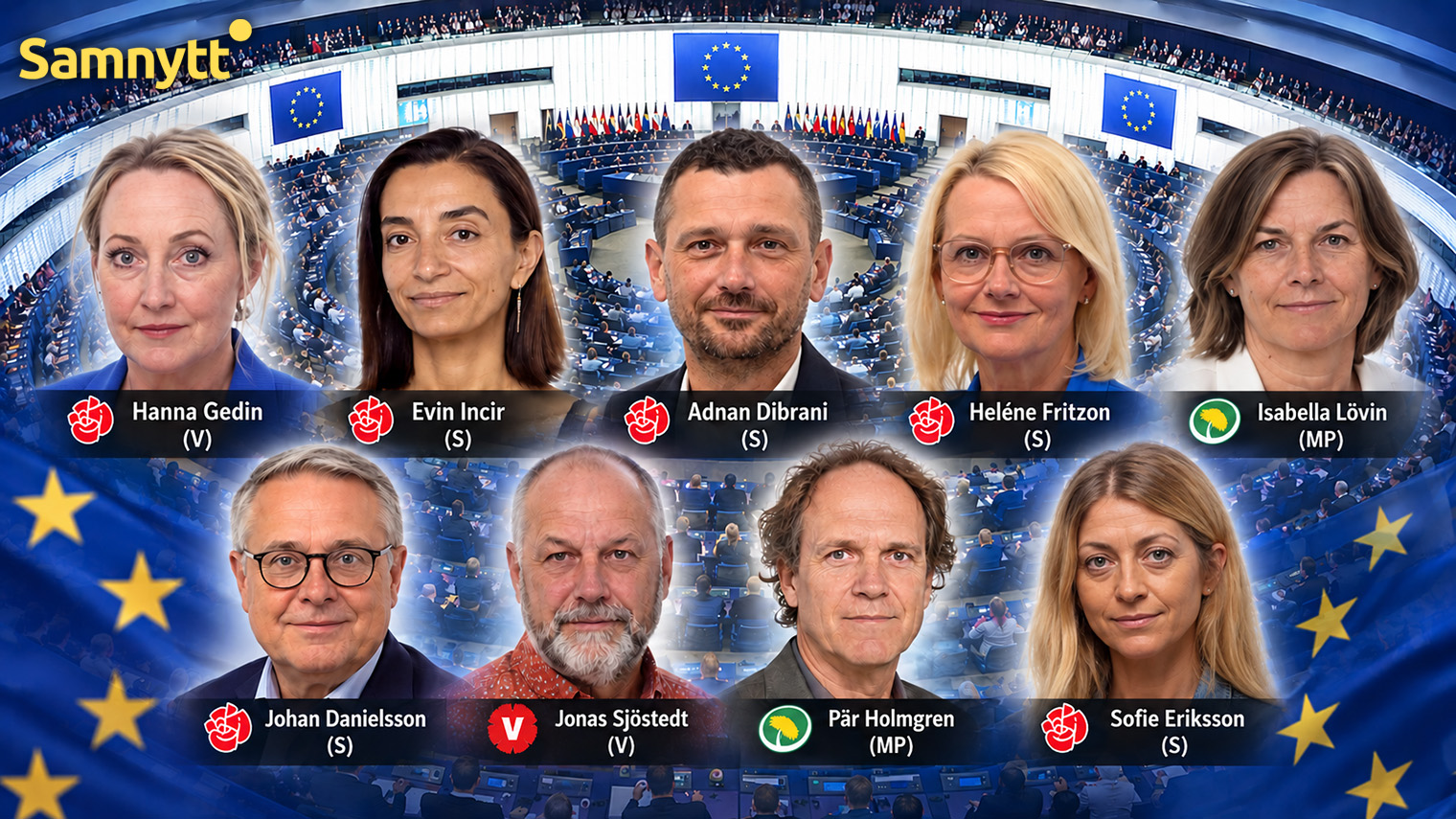
The European Parliament has adopted a resolution by a large majority, calling for strong measures against Islamist infiltration of European social institutions and the financing of organizations linked to the Muslim Brotherhood. All Swedish MEPs from the Social Democrats and the Left Party voted against, as did two out of three from the Green Party. The Center Party voted in favor—something that has led to jabs on social media toward C for the party’s planned government partners in Sweden.
It was on Thursday that the European Parliament voted to pass the resolution on the need for a common European strategy against Islamist infiltration and the influence of the Muslim Brotherhood. The proposal, propelled by the conservative and Christian-democratic group EPP, was backed by 381 members. 167 voted against, and 15 abstained.
The resolution was mainly driven by EPP and groups to its right, but also received support from many members of the liberal group Renew Europe. Opposition came primarily from social democrats, the Greens, and the Left.
The resolution is not binding legislation but a political statement in which the European Parliament urges EU institutions and member states to act to counter Islamist infiltration in Europe.
To Stop Islamist Infiltration
A central part of the resolution addresses what in English is termed “Islamist entryism,” meaning a strategy where a political or ideological movement seeks influence by establishing itself within and acting from inside other organizations and institutions, rather than through open confrontation.
The resolution refers to Islamist organizations and networks suspected of seeking influence over democratic institutions and civil society. This may involve political organizations, associations, and other social institutions.
The European Parliament condemns what it describes as a strategy of Islamist infiltration aimed at weakening democratic institutions within member states of the union.
The resolution specifically points to networks with links to the Muslim Brotherhood, the international Islamist movement founded in Egypt in 1928, which over the years has developed branches and affiliated organizations in many countries, including Sweden.
Parliament wants member states to develop a common European strategy to identify and counter the influence of such networks.
A particular concern is the use of double messaging, where Islamist actors are suspected of presenting a democratic and rights-focused message outwardly, while other political or religious aims are communicated internally.
At the same time, the resolution emphasizes the importance of supporting—where such exist—Muslim intellectuals, activists, and representatives who defend democracy and freedom of conscience.
Wants to Cut Off EU Funding
Another central issue is the use of European taxpayers’ money. The EPP group demands stricter oversight of which organizations receive financial support from the EU and how the money is used. The aim is to prevent European subsidies from going to organizations with ties to Islamist networks or that carry out activities contrary to democratic rights and freedoms.
French MEP Céline Imart, who has led the EPP group’s work on the issue, believes it is possible to distinguish between Islam as a religion and Islamism as a political ideology.
– We must ensure that Europe does not finance Islamists. Islam as a religion and political Islam as an ideology must not be conflated. We have to protect both democracy and freedom of religion, she says.
READ ALSO: Ukraine Requests Tens of Billions More – Causes Irritation in the EU
Imart also wants the EU Council of Ministers, where legal conditions allow, to add individuals and organizations with links to the Muslim Brotherhood to the terror list.
– European money must not finance groups that threaten our rights and freedoms, she emphasizes.
EPP spokesperson for budget oversight, Czech MEP Tomáš Zdechovský, also calls for complete transparency in how EU grants are allocated.
According to him, it must be possible to determine who the ultimate recipients of funds are, how much they receive, and through which support programs the payments are made. According to Zdechovský, the EU Commission and member states must check recipients even before grants are awarded and be able to halt funding when regulations are not followed.
All S and V, as well as Two Out of Three Green MEPs, Voted Against
The roll-call voting record shows that all five Swedish Social Democrats voted no to the resolution: Heléne Fritzon, Evin Incir, Johan Danielsson, Adnan Dibrani, and Sofie Eriksson. The Left Party’s two MEPs, Jonas Sjöstedt and Hanna Gedin, also voted no. The Green Party’s delegation was not united. Pär Holmgren and Isabella Lövin voted against the resolution, while Alice Bah Kuhnke voted in favor.
On the center-right and among the Sweden Democrats, support for the resolution was unanimous. All four Moderate Party members—Tomas Tobé, Jörgen Warborn, Arba Kokalari, and Jessica Polfjärd—voted yes, as did the Christian Democrats’ Alice Teodorescu Måwe, the Liberals’ Karin Karlsbro, and the Sweden Democrats’ Charlie Weimers, Beatrice Timgren, and Dick Erixon. The Center Party’s Abir Al-Sahlani also supported the resolution, while her party colleague Emma Wiesner did not participate in the vote.
Tobé Jabs C About Government Cooperation
The vote has also become directly linked to the ongoing Swedish government formation. Moderate MEP Tomas Tobé, whose EPP group helped drive the resolution, highlighted the red-green parties’ opposition after the vote and at the same time issued a message to the Center Party.
Idag tog @Europarl_EN, på M och vår partigrupps initiativ, ställning mot extremism och islamistiska infiltrering av våra samhällsinstitutioner.
Kanske kan S, V och MP:s nej-röster ge C en tankeställare om sina tilltänkta regeringspartners beskaffenhet? https://t.co/zHc5IgWUVA
— Tomas Tobé (@tomastobe) October 8, 2026
“Today, the European Parliament, at the initiative of M and our party group, took a stand against extremism and Islamist infiltration of our social institutions,” he wrote on X.
He continued:
“Perhaps the no-votes from S, V, and MP will give C pause for thought about the nature of their intended government partners?”
C on a Collision Course with Would-Be Government Partners
Tobé’s comments come in the midst of the complicated Swedish government formation following the general election. The Center Party, which has historically belonged to the center-right, is trying together with the Social Democrats, the Green Party, and the Left Party to find a way forward to a new government. The four parties combined hold a slim majority in parliament, but significant political differences have made negotiations difficult.
Specifically on the issue of the resolution against Islamist infiltration, C MEP Abir Al-Sahlani ended up on the opposite side of all Swedish Social Democrats and Left Party members, as well as two out of three Greens. It is this dividing line that Tobé now highlights to put pressure on the Center Party and question the party’s choice of cooperation partners in Sweden.
A Clear Left–Right Divide
Even at the European level, the roll-call vote shows a clear political divide, though with some individual exceptions.
Many members of the Social Democratic group S&D, the Green group Greens/EFA, and the Left group The Left voted against. EPP members and members from groups further to the right largely voted in favor, while many liberals in Renew Europe also supported the resolution.
There were, however, deviations within the groups. Swedish Green Alice Bah Kuhnke is an example of a Green member who voted for. There were also dissenting votes within the EPP.
READ ALSO: Sweden Delayed EU Approval of Tesla’s Self-Driving
The resolution does not mean that the Muslim Brotherhood is automatically designated as a terrorist organization within the EU, or that any grants are immediately revoked.
However, the decision means the European Parliament has formally backed demands for a joint European strategy against Islamist influence networks, stricter oversight of EU funding, and the possibility to list individuals and organizations with links to the Muslim Brotherhood as terrorists where legal criteria are fulfilled.
With 381 votes in favor to 167 against, the resolution garnered a clear majority in parliament.