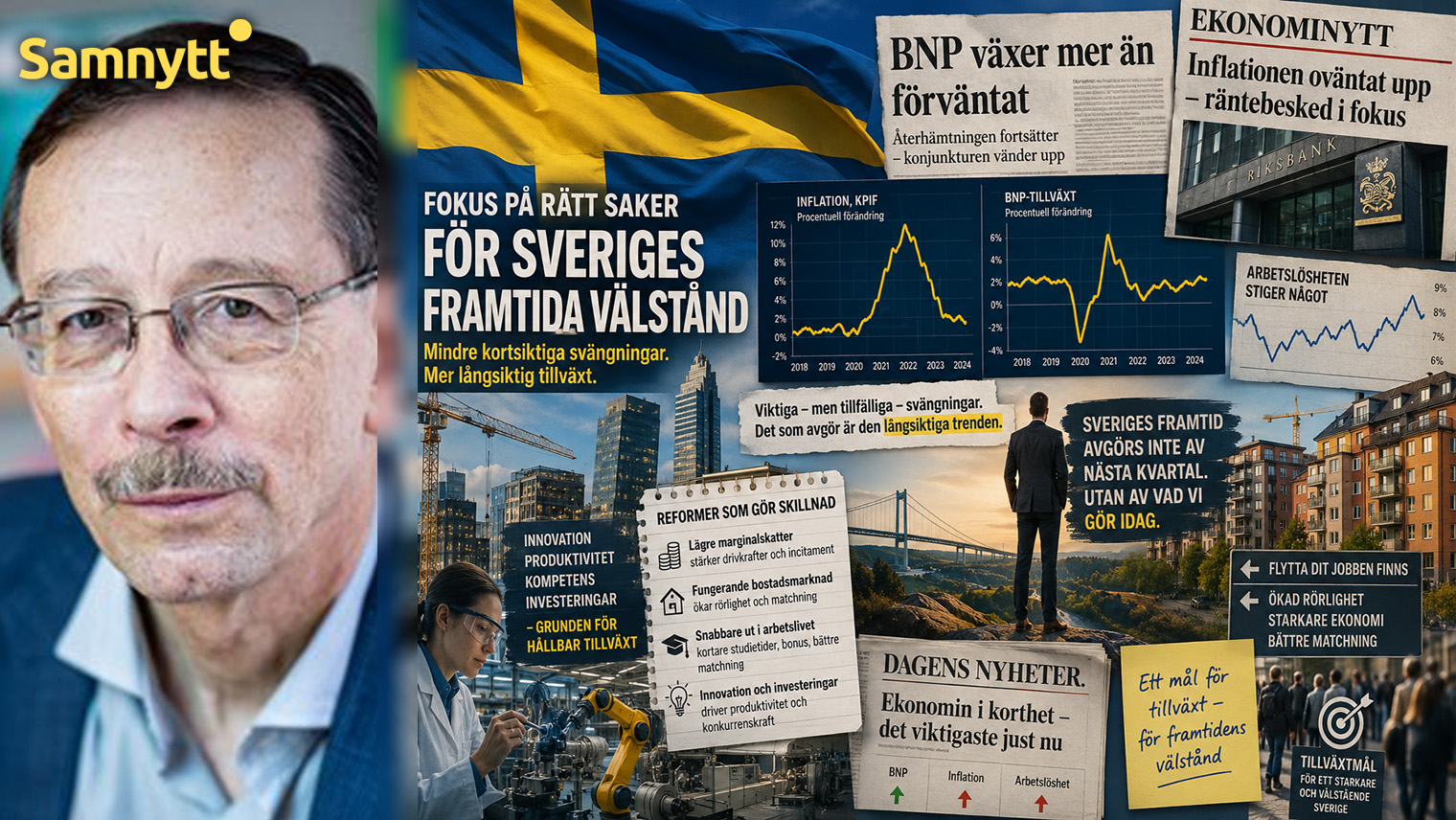
Short-term economic news dominates the debate—while reforms for long-term growth end up overshadowed. That’s the view of economist Lars Calmfors, who calls for a clearer focus on productivity, education, innovation, and how the labor market functions.
Sweden puts too much emphasis on temporary fluctuations in the economy and too little energy into the reforms that determine the country’s future prosperity. So argues economist and professor emeritus Lars Calmfors, who, in an interview with the magazine Näringslivet, believes both politics and public debate have become stuck in a short-term perspective.
Instead of discussing the economy’s long-term growth potential, the debate often centers on temporary changes in inflation, unemployment, and GDP figures from a single quarter or year. According to Calmfors, this risks diverting attention from the issues that are crucial for Sweden’s standard of living in the long run.
“Why don’t we have a target for growth—when that is actually more important than almost anything else?” he says.
Long-term growth is overshadowed
Calmfors points out that short-term economic cycles often receive disproportionately large attention, even though, according to him, they have limited impact on long-term prosperity. What matters instead is so-called potential growth—the economy’s underlying ability to expand over time.
This includes productivity, investment, education levels, innovation, and how efficiently the labor market operates. Workforce mobility and people’s willingness to pursue education and take greater responsibility also play a major role.
READ ALSO: Green Party: Stopped Growth and Higher Gas Prices to Save the Climate
Calmfors argues that both the government and the opposition often use current GDP figures as arguments to describe economic policy as either successful or failed. However, the development is highly influenced by the business cycle and international factors, rather than short-term political reforms.
He points, for example, to the weak growth in recent years as largely a result of the inflation crisis and high interest rates, whereas today’s stronger figures rather reflect an economic recovery than a changed trend.
Lower marginal taxes can strengthen incentives
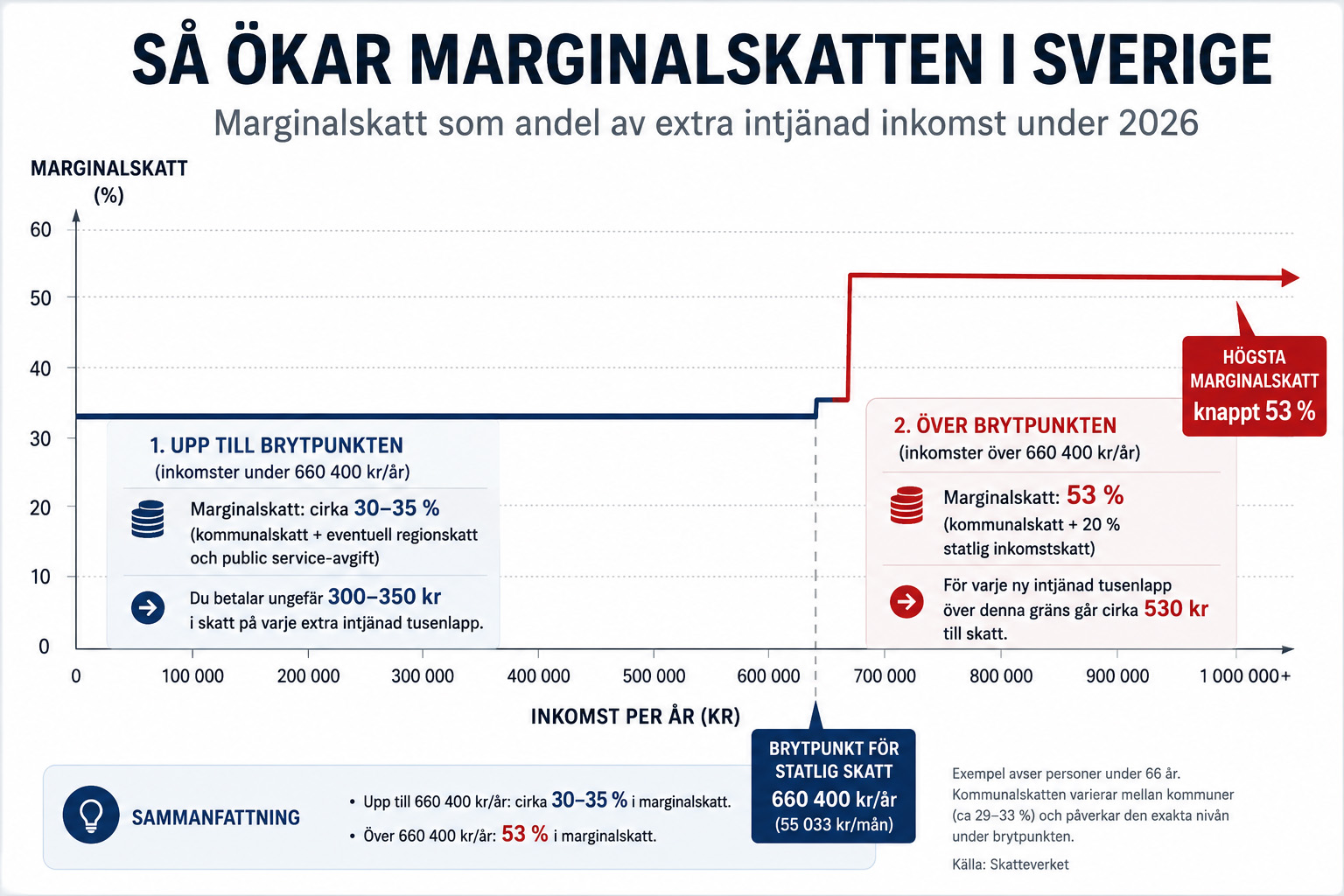
One of the most important reforms, according to Calmfors, is lowering the marginal tax on work. He refers to research showing that taxes influence much more than just the number of hours worked.
High marginal taxes can reduce people’s willingness to pursue careers, further their education, change jobs, or take on greater responsibility. In the long term, the tax system also affects norms and expectations around work and education.
Calmfors believes that many young people today enter the labor market late, and that a culture has emerged where it is not considered particularly important to start working quickly. The difference between starting work early or late is perceived as relatively small, which affects behavior even if people aren’t making precise economic calculations.
The housing market slows mobility
He also highlights the housing market as an obstacle to growth. In particular, he sees Sweden’s rent control system as a problem, since it hampers people’s ability to move where the jobs are.
According to Calmfors, a more functional rental market is needed to strengthen workforce mobility, for both those already living in Sweden and for international talent who want to work here.
READ ALSO: National IQ Level the Best Predictor for Economic Growth
At the same time, he emphasizes that changes must be carried out cautiously in order to avoid major social consequences for those already covered by today’s system.
More people need to enter work faster
Another area where Calmfors sees a need for reform is the education system and the transition to working life. He wants more people to start working earlier and for the time spent in education to be shortened.
Among his suggestions is a study grant bonus, where part of the student loan is written off for those who complete their degree faster. He also calls for better matching between education and labor market needs.
Today, many students choose academically oriented programs without a clear link to the job market, while relatively few enter technology, science, or vocational education where demand is higher.
Wants to see a Swedish growth target
To raise long-term issues higher on the political agenda, Calmfors wants to introduce an official target for Swedish growth, similar to how Sweden has targets for inflation, the budget, and the climate.
The idea is that such a goal would create ongoing pressure on politicians and authorities to implement reforms that strengthen the economy’s growth potential.
Exactly how the target should be designed, however, he is unsure. One option is a concrete target for GDP growth over time. Another is for Sweden to develop better than comparable countries.
“A great deal is determined by international technological development. Therefore, there may be arguments for a relative target—comparing with other countries rather than with a fixed number,” he says.
Criticism of economic coverage in the media
Calmfors is also critical of how economic issues are covered in the media. He believes news logic means small changes in inflation or GDP receive major attention, while slow changes in productivity and growth rarely get noticed.
According to him, this is problematic because even small differences in growth rates can have huge significance over time.
“If GDP growth next year falls by one percentage point or inflation changes, then that is news. But it is fairly unimportant compared to if we have 0.2 percentage points lower growth every year over a long period.”
At the same time, he notes that long-term development trends are harder to turn into news, since the effects often only become clear much later. According to Calmfors, this is because there’s no clear single news moment for such slow, continuous development. By the time the number is on the table, it’s too late to make news out of it.