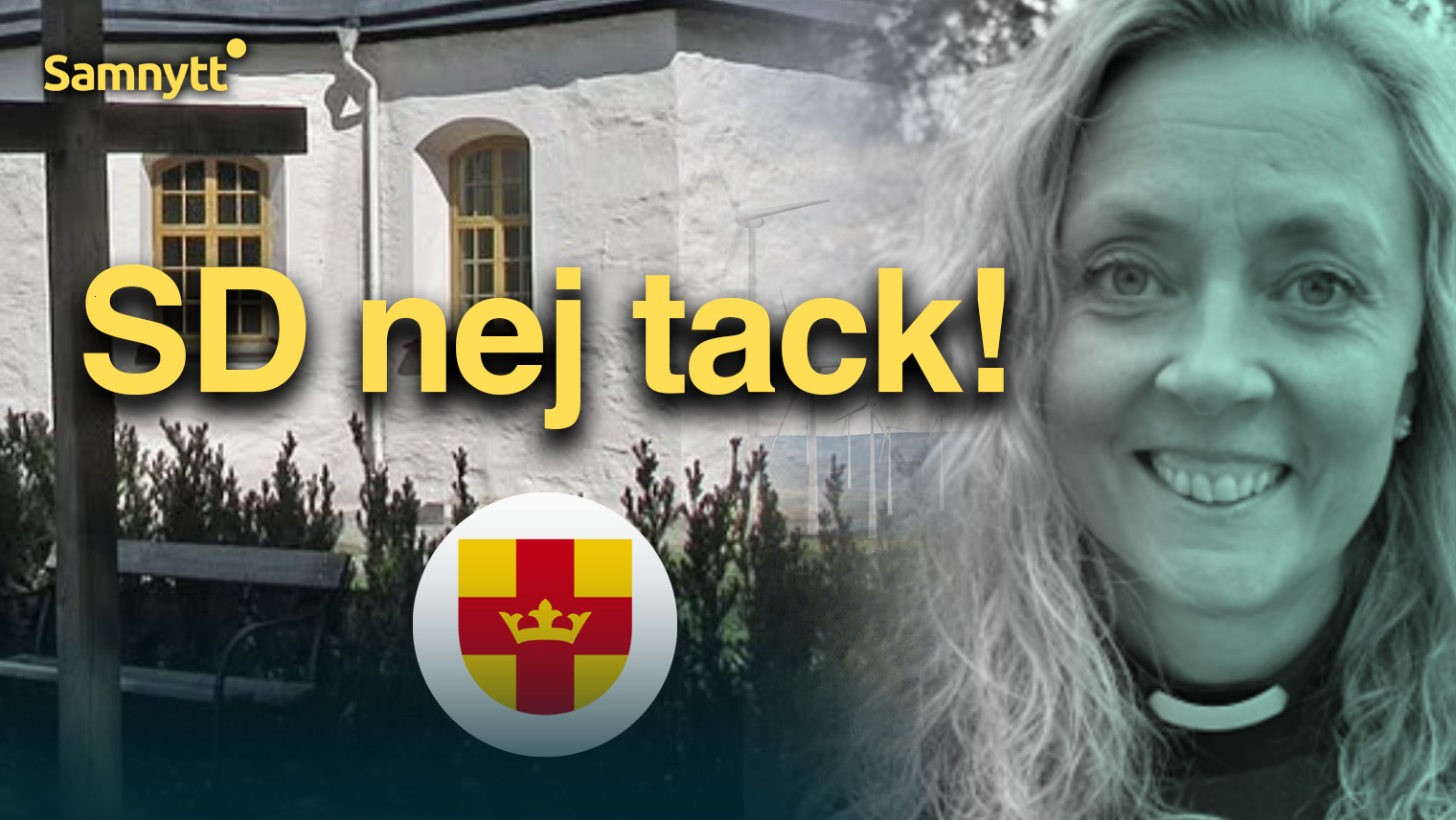
In the midst of the election year, Jenny Ludvigson, vicar of the Kafjärden parish outside Eskilstuna, has taken an open stand against the Sweden Democrats with the message “SD no thanks!”—a position also shared via the parish’s official platform. Ludvigson has previously described herself as an activist and stated that it is the church’s mission to challenge injustices in society. When Samnytt asked her where the line is between priesthood, activism, and pure party politics, Ludvigson refused to answer any questions.
The Church of Sweden distinguishes between the church’s social and political engagement and direct party politics. Within the church, there is an explicit principle debate on the idea that the church should remain free from party-political control.
Politically Unaffiliated in the Church of Sweden (POSK) writes on the Church of Sweden’s own website that the church should “stand free from party politics” and that its task is to proclaim the gospel and serve its members—“not to influence them in a specific party-political direction.”
At the same time, the Church of Sweden at the central level emphasizes that the church can and should speak out on societal issues and describes itself in that sense as political. That is why Ludvigson’s “SD no thanks!” brings another issue to the forefront—where is the line between the church’s social engagement and direct campaigning against a specific parliamentary party?
Ahead of the September election, vicar Jenny Ludvigson in Kafjärden parish openly attacks Sweden’s second-largest party.
“SD no thanks!” she writes.
This is not about Ludvigson privately sharing which party she will vote for. Her political stance has also been noted on Kafjärden parish’s official Facebook page, where she is presented in her role as vicar.
This raises a question that the Church of Sweden has so far not wanted to answer in an interview with Samnytt—how does this align with the church’s declared political neutrality?
READ ALSO: Is the Church of Sweden politicized? This is how the MPs respond
In her post, Ludvigson attacks the Sweden Democrats’ policies and directly ties her position to her Christian faith and her priestly office.
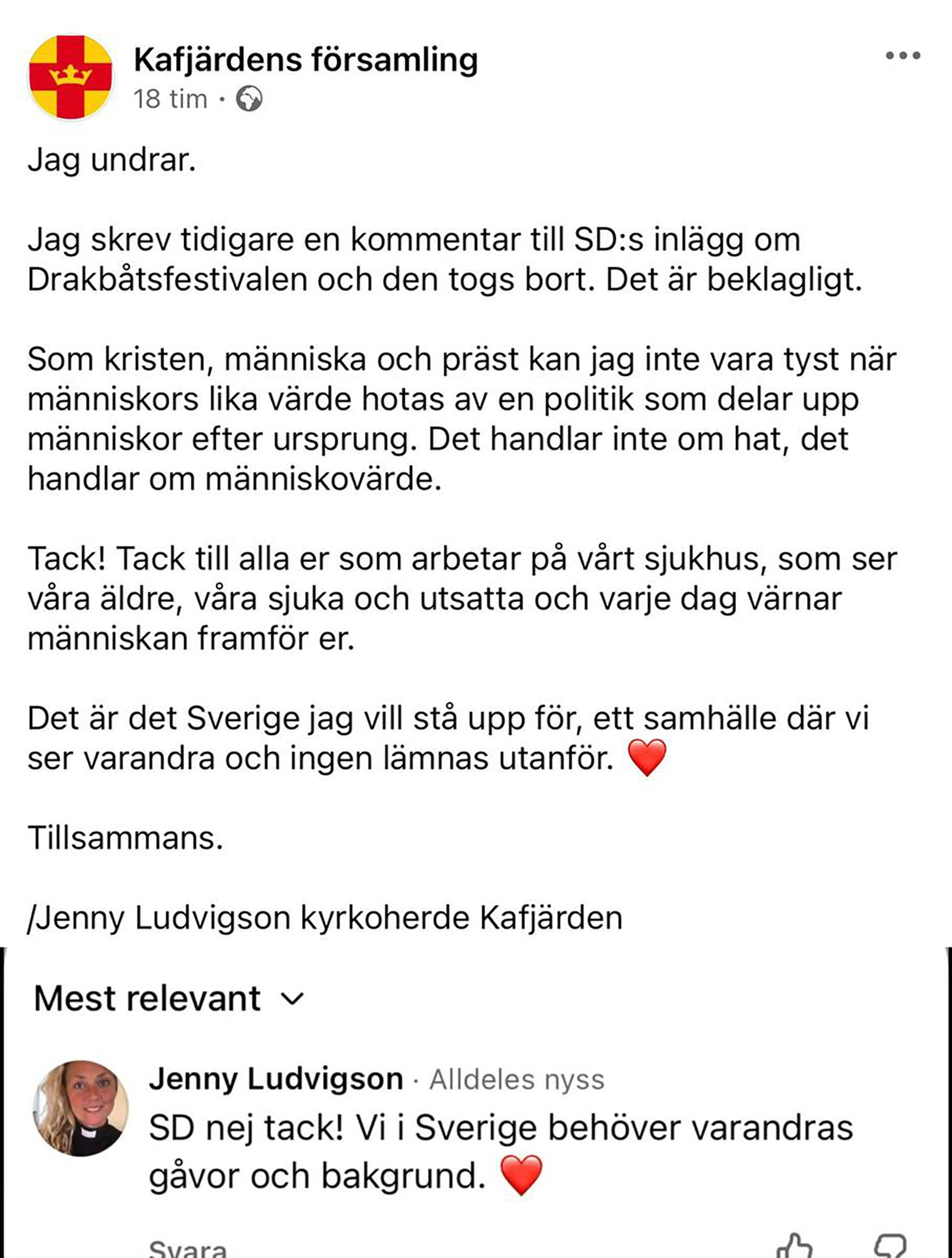
Among other things, she writes that she wants a Sweden built on “humanity, solidarity and human dignity.” She also does not settle for criticizing a specific policy proposal. It is the party as such that she says no to.
And she does this with explicit reference to her role as a priest: “As a Christian, person and priest, I cannot remain silent.”
READ ALSO: Church of Sweden between faith and politics—a growing conflict
During an ongoing election campaign, the message is difficult to distinguish from ordinary political advocacy. A named parliamentary party is explicitly singled out and rejected by a vicar during an election year.
“I will not answer any questions, not from you anyway”
Samnytt has tried to reach vicar Jenny Ludvigson for an interview. Among other things, we wanted to know how she differentiates her actions from party-political campaigning, if it is appropriate to use a parish’s official communication channels to distance oneself from a specific party, and how she thinks the church’s SD-voting members perceive the message.
We also wanted to pose a simple control question—would it be equally acceptable if another vicar during the election campaign had written “Social Democrats no thanks!” on their parish’s Facebook page?
READ ALSO: Church of Sweden’s decision: Priests must marry same-sex couples
After several attempts, we managed to reach the vicar.
You posted on the Kafjärden parish page on Facebook, “SD, no thanks!” Where do you think the line goes between being a vicar who represents the message of the Church of Sweden and expressing purely party-political messages, especially during an election year?
– I regret to say that I can’t answer any questions, that’s how it is.
It does look pretty bad if you refuse to answer any questions about this…
– No, it doesn’t. And I will not answer any questions, not from you anyway.
Why not?
– You see, I’m about to have a visitor here, so I don’t have the opportunity. Thank you.
After that, Ludvigson ends the conversation.
READ ALSO: Terror researcher warns: Church of Sweden is legitimizing Islamism
The Church of Sweden Evades the Core Question
Samnytt has therefore reached out to higher levels of the Church of Sweden organization. The Bishop of the Diocese of Strängnäs has been contacted, as have the communications officers and press service of the diocese. Samnytt has not managed to get any responsible representative to participate in an interview from these contacts either.
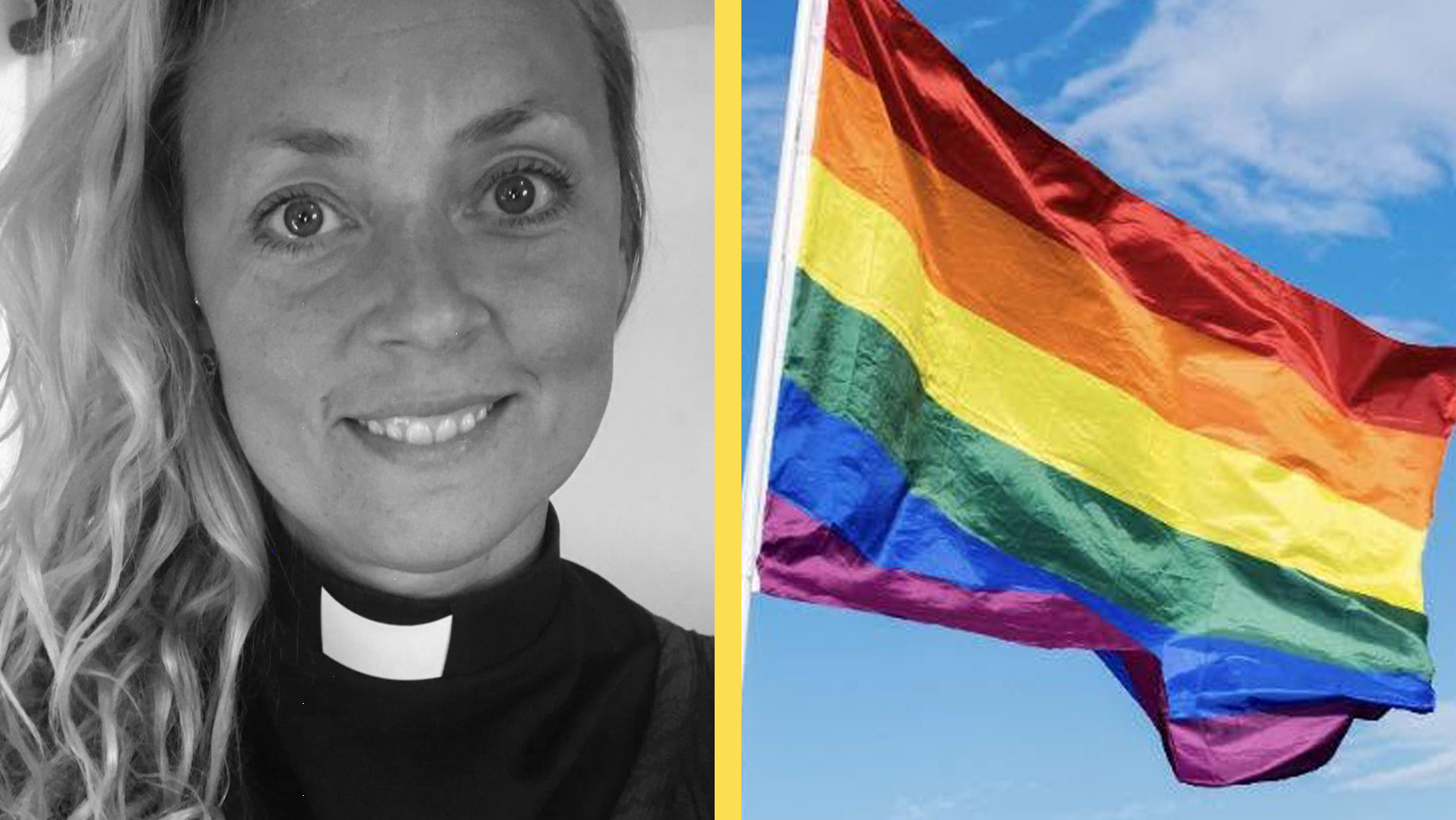
SEE ALSO: VIDEO: Church of Sweden’s trans priest preaches in Pride attire
Finally, a brief written response comes from the Church of Sweden’s press secretary, Martin Larsson:
Priests within the Church of Sweden have the same opportunity and right as all other citizens to engage politically at various levels. There is nothing in the church’s regulations that restricts such engagement. Priests have also, both historically and today, been represented across the entire political spectrum. Should anything in their stances be open to questioning in light of their ordination vows, that will be handled by the cathedral chapter of the diocese to which the priest belongs.
– Church of Sweden’s response
But that was not what Samnytt asked. That a priest, like other Swedish citizens, has the right to vote, be politically active, and express political opinions has not been questioned.
The question concerns what happens when politics enters the priesthood and the parish’s official platforms. The Church of Sweden does not answer this question.
SD Representatives Consider Reporting to the Cathedral Chapter
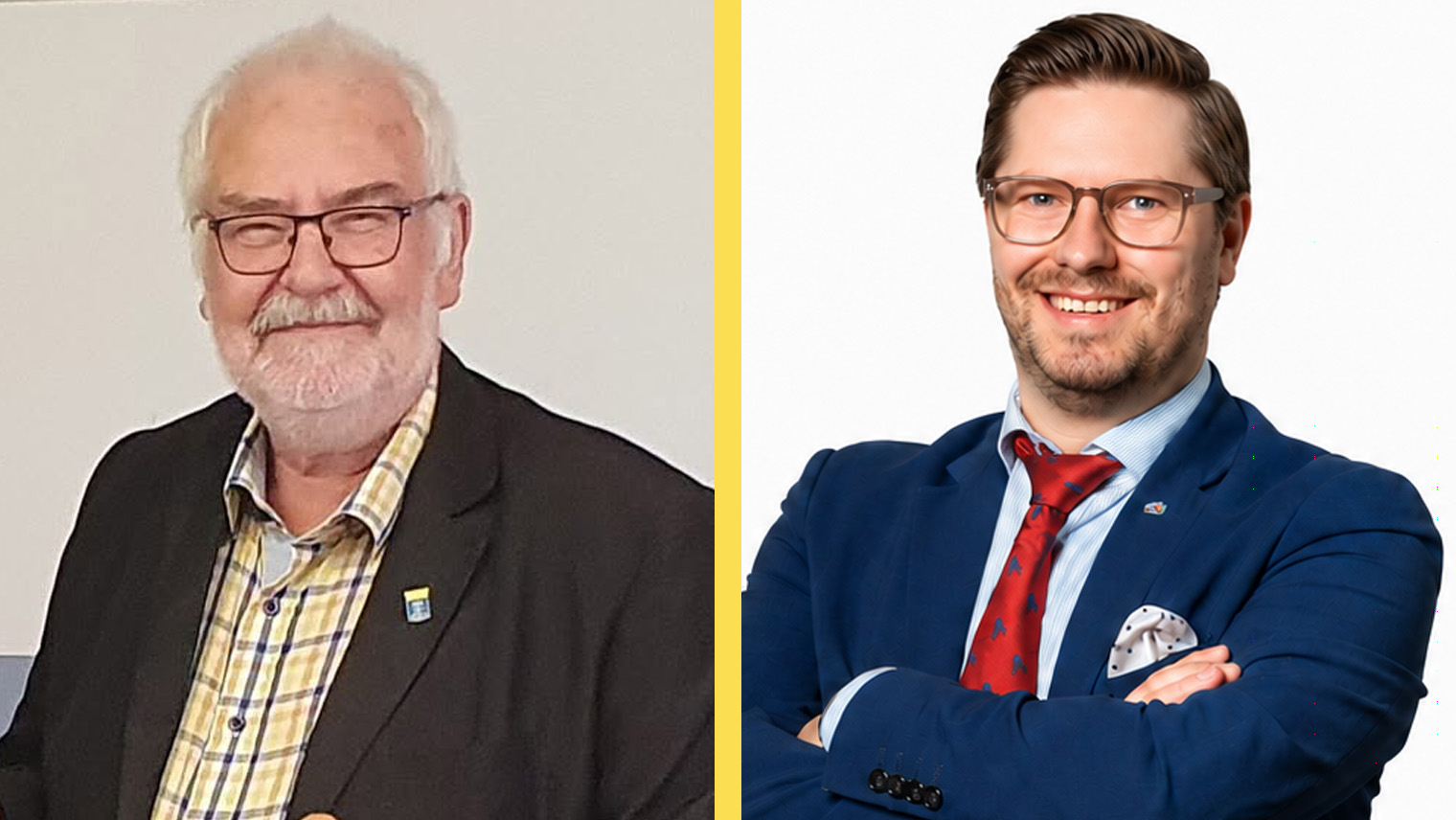
Ronnie Nilsson is chairman of the Sweden Democrats’ church association and is involved in the Church of Sweden at the national level. He also sits in the church parliament and participates in a working group on democracy issues and the future of the Church of Sweden.
When Samnytt tells Nilsson about Jenny Ludvigson’s statements, he reacts strongly. He emphasizes that he has no objection to priests having political opinions as individuals—but believes that the line is crossed when a vicar uses their public role and the parish’s platform to take a stand against a party.
– I think it is completely inappropriate to do this in a public context. What one does privately, as an individual outside their work, is up to each person, he tells Samnytt.
Nilsson argues that the conduct is particularly problematic because the Church of Sweden itself runs democratic elections in which the Sweden Democrats are represented. A vicar who openly takes a stand against one of the participating political actors, according to him, risks undermining trust in the church’s own democratic process.
– By taking that position, you have, in a way, undermined democracy, he says.
READ ALSO: Church of Sweden organizes ‘Mourning March for the Climate’
He also points out the contradiction between Ludvigson’s message and the Church of Sweden’s recurring rhetoric about openness and the equal value of all.
– Are all those who vote for SD not welcome in the Church of Sweden as members? he asks.
Nilsson also reacts to Ludvigson’s previous statements suggesting that Jesus was a “true activist.” He describes the link between Jesus and today’s party-political conflicts as peculiar and maintains that the stories of the Bible rather show a Jesus who did not differentiate between people based on group affiliation.
Nilsson takes Ludvigson’s behavior so seriously that, during the interview, he raises the question of whether the matter should be reported to the cathedral chapter for review.
“Jesus was not a party politician but the Son of God and the Savior of the World”
Samnytt also contacts Daniel Engström, who is vice chairman for the Sweden Democrats in the Church of Sweden (SD-SK) and group leader for the organization in the church parliament, the Church of Sweden’s highest decision-making body. He represents the Diocese of Lund and is thus one of SD-SK’s leading national representatives on church policy and theological matters.
The Church of Sweden says it is apolitical and above all not party-politically involved. Do you think there is a problem when a vicar in front of their congregation so clearly distances themselves from a party during an election year?
– Yes, there is. Firstly, they have not understood their own role. They have also not understood which doctrine and which church they belong to.
Engström refers to the Lutheran two kingdoms doctrine (Zweireichelehre), where the temporal and the spiritual are separated. Political domains such as migration, criminality, and schooling, according to him, are the responsibility of politicians, while the priest’s task is to preach the Christian faith and bring people closer to God.
He therefore believes that Ludvigson mixes up the roles when, as vicar, she takes a stand against SD. What a priest thinks privately is another matter, he stresses, but the office entails a special responsibility.
He also points out that the SD itself emphasizes the importance of Christianity to Sweden and describes Ludvigson’s conduct as one more example of a left-leaning tendency within the church.
Samnytt has produced several reports on the Church of Sweden and repeatedly encounters the same leftward political bias. At the same time, the church avoids questions about politicization. How big is this problem in the Church of Sweden?
– This is an enormously big problem in the Church of Sweden, and the Church itself does not understand it.
Engström argues that politicization is a much greater problem than the statements of individual priests. He connects the membership loss in the Church of Sweden to a perceived leftward shift and claims that people instead turn to Catholic and Orthodox churches, where he says they experience a greater focus on Christian doctrine than on daily political issues.
READ ALSO: Christians find a home in the Orthodox Church: “The Church of Sweden feels less Christian”
Behind this development, he sees long-standing Social Democratic influence, which, according to him, has gradually made the Church of Sweden more secular and politicized.
If a vicar had issued a message with the Church of Sweden’s logo on their parish website or on social media saying ‘Social Democrats no thanks!’—what do you think the reaction would have been?
– Now one can only speculate, but I believe there would have been enormous pressure on that representative. He continues:
– Most likely, the parish council—which is also responsible for employment—would have seen to it that this person lost his or her job. There would have been no mercy. I am very convinced of that.
Ludvigson’s Private Opinion or the Church’s Platform?
The difference is crucial. Jenny Ludvigson could have written “SD no thanks!” as a private individual on her personal platform without requiring Kafjärden parish to be associated with the message.
But when her political position is spread through the parish’s official channel, the situation changes. Then it is no longer just Jenny Ludvigson, the private individual, communicating. The sender is also a representative of the Church of Sweden.
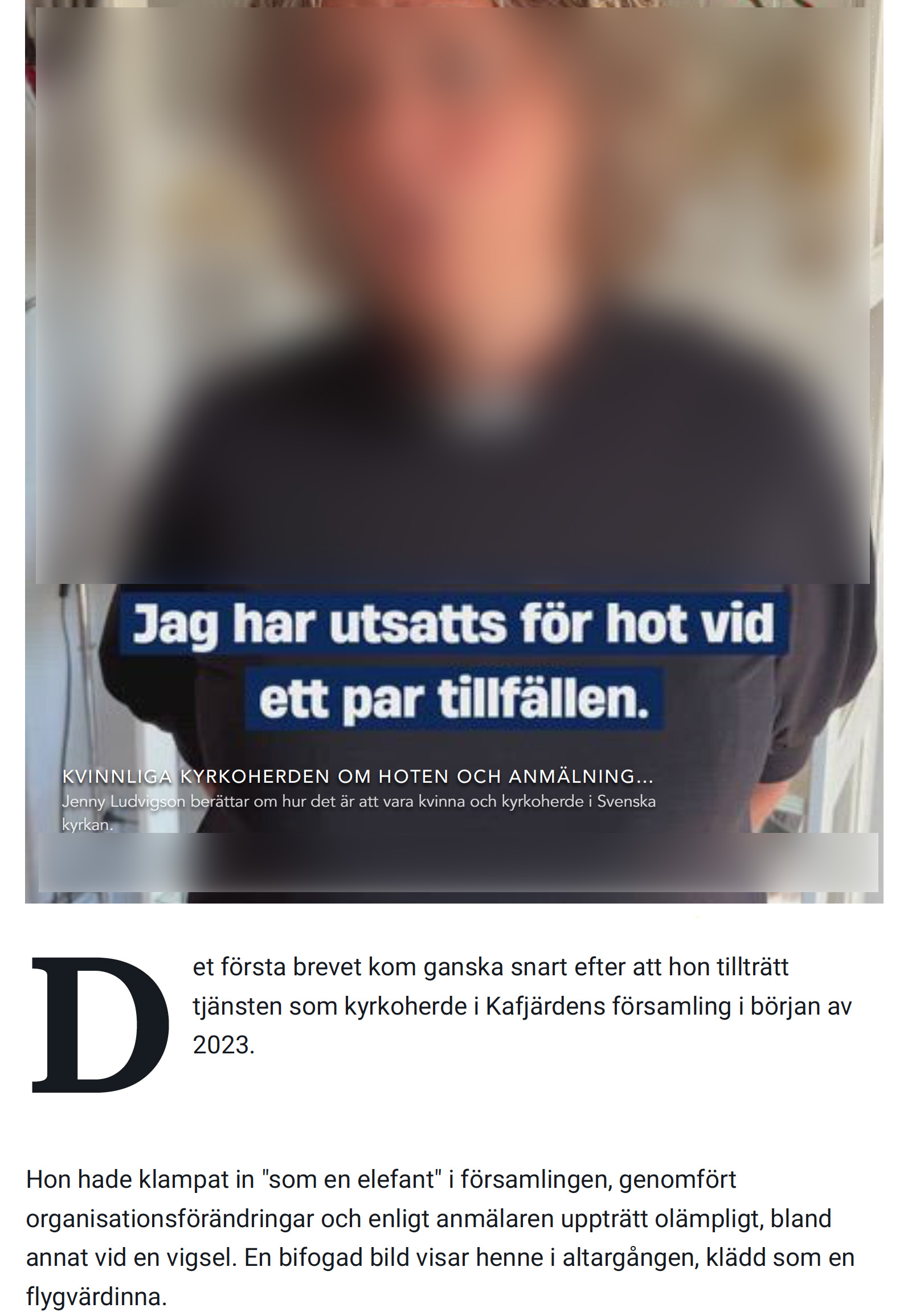
And Ludvigson herself makes no clear distinction between her political position and the priesthood. On the contrary, she explicitly cites her role as a priest when explaining why she feels compelled to speak out.
This is precisely the distinction Samnytt wanted to discuss with the Church of Sweden. The church has not agreed to give an interview.
At the same time, Ludvigson has repeatedly described herself as vulnerable—not least because she is a woman. She says she has to deliver more than her male colleagues and notes that her husband, also a vicar, has never been threatened or reported.
She herself reports threats, complaints, and sexual advances—linking her vulnerability to her gender.
“Proud Activist”
Nor is this the first time Ludvigson has been involved in debates about activism and the priesthood. She previously participated in a public protest against the planned emissions of methylene chloride by the company Senior Materials. After the demonstration, she was reported and accused, among other things, of participating in “political protest actions” and “being involved in organized activist groups.”
Ludvigson herself has no problems with the description activist. On the contrary.
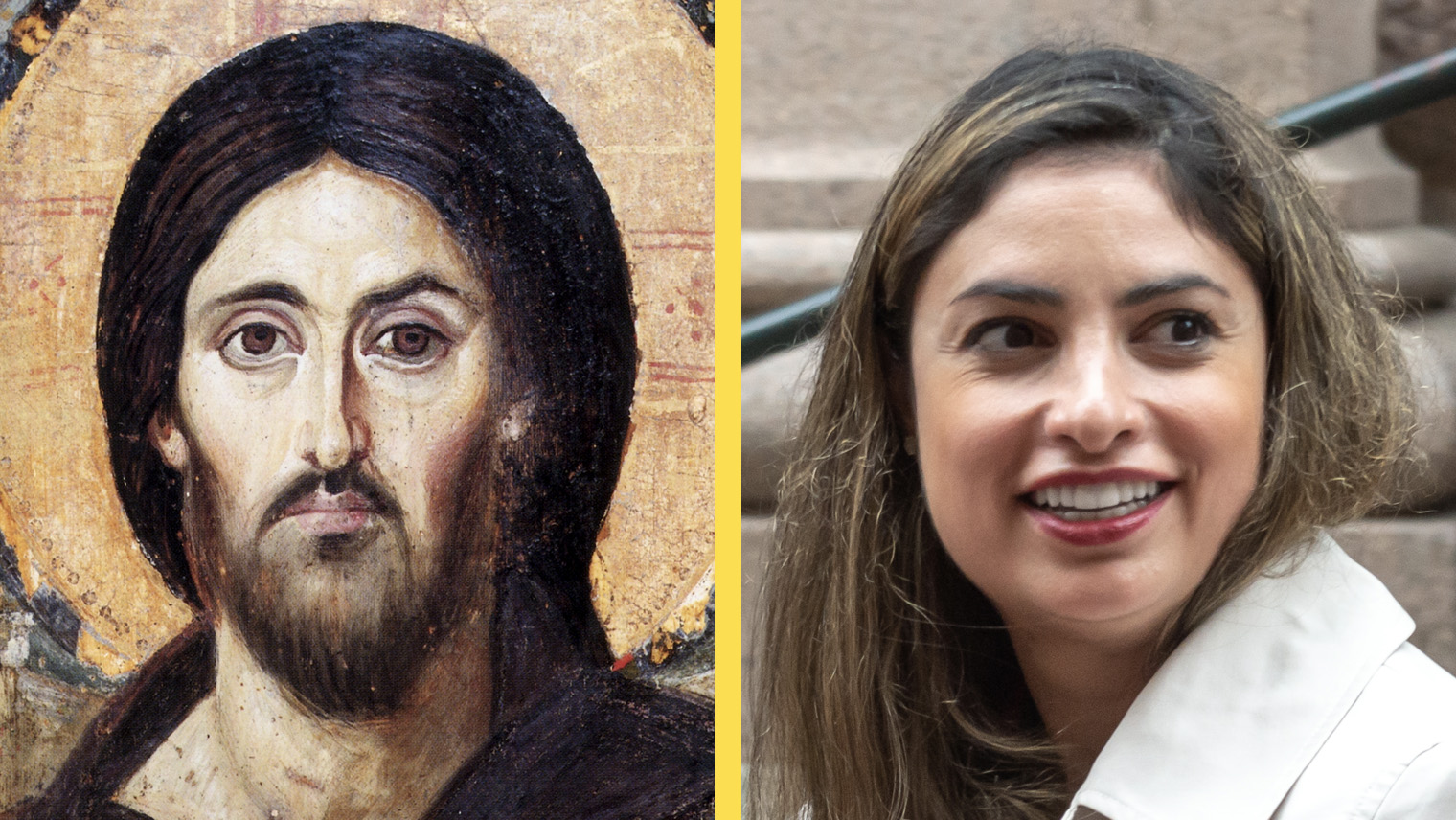
“To be called an activist, I take as a compliment. Jesus was himself a true activist,” she told Eskilstuna-Kuriren newspaper.
She continues by describing her mission as, in the footsteps of Jesus, being a “priest, shepherd, and voice for those who otherwise are not heard.”
In the same interview, she is even clearer about how she views the church’s role in the public debate: “I stand out, I am colorful and say what I believe. I fight injustice in society—that is our church’s task.”
This raises yet another question. Who decides which political beliefs constitute the “injustices” the church should take on? Ludvigson’s reference to Jesus is especially interesting since she uses it to legitimize her own activism.
A Church for All—Regardless of Political Alignment?
The Church of Sweden’s answer regarding priests’ civic rights does not address the question of how a party-political stance on a parish’s official platform affects its own members.
The Church of Sweden has members with a wide range of political beliefs. Among them are also voters who support the Sweden Democrats and who now may encounter the message “SD no thanks!” from a vicar on the parish’s own platform.
Samnytt has therefore sought to know if the Church of Sweden considers Ludvigson’s conduct to be compatible with the church’s party-political neutrality—and if their assessment would have been the same if a vicar during an election campaign, for example, had written “Social Democrats no thanks!” on the parish’s official platform.
The Bishop of the Diocese of Strängnäs was on vacation when Samnytt reached out. Neither the diocesan press service nor communicator Marlene Antonsson has had time to answer that question.
The Church of Sweden has clarified, however, that priests have the same rights as other citizens to be politically engaged. Samnytt has received no response on where the boundary lies between a priest’s private political engagement and party-political advocacy through the parish’s official channels.
So it is not Jenny Ludvigson’s right to have political opinions that is unclear. What remains unanswered is how the Church of Sweden views these opinions being expressed in her role as vicar and through the parish’s own platform.