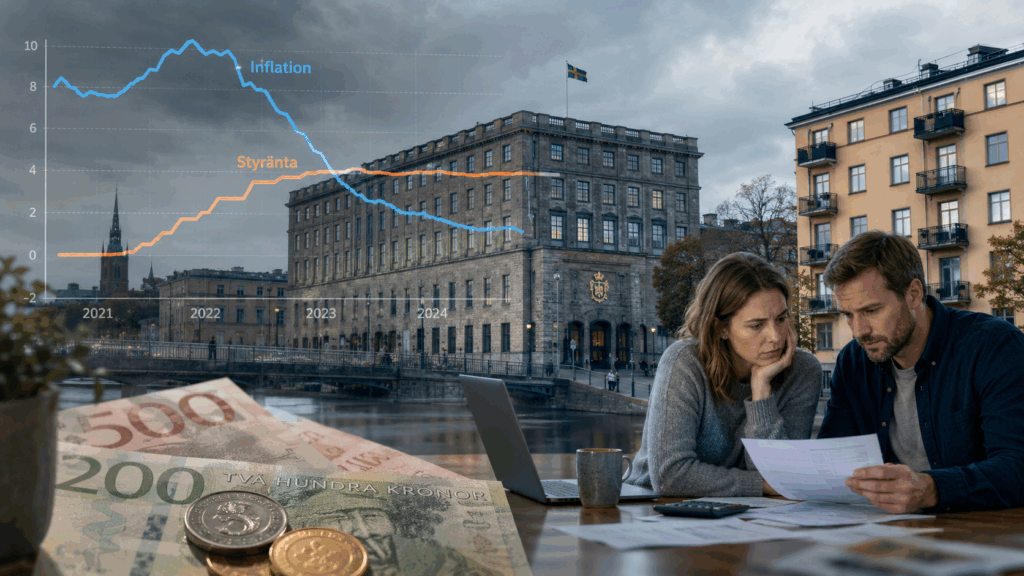
The Swedish economy is expected to continue its recovery during 2026 and 2027. At the same time, the risk of higher inflation increases, which, according to SBAB’s new forecast, means that the Riksbank is expected to raise the policy rate twice in the coming months.
The first hike is expected to come in December and the second in February. Thus, SBAB is pushing back its previous forecast for an initial rate hike from November.
An important explanation is the latest inflation outcome. Price increases in August were lower than expected, which according to SBAB suggests that the Riksbank will wait a bit longer before raising the rate.
– In light of the negative external environment, I would be extremely surprised if we don’t see a clear increase in inflation moving forward, even though it probably won’t be as bad as last time in 2022. Several central banks have already raised their policy rates, says Robert Boije, Chief Economist at SBAB, and continues:
– The Riksbank is likely to want to see that inflation is clearly above target for two consecutive months before deciding on a rate hike. Because of the unexpectedly low inflation figure in August, we have postponed the first policy rate hike from the previously assumed November to December.
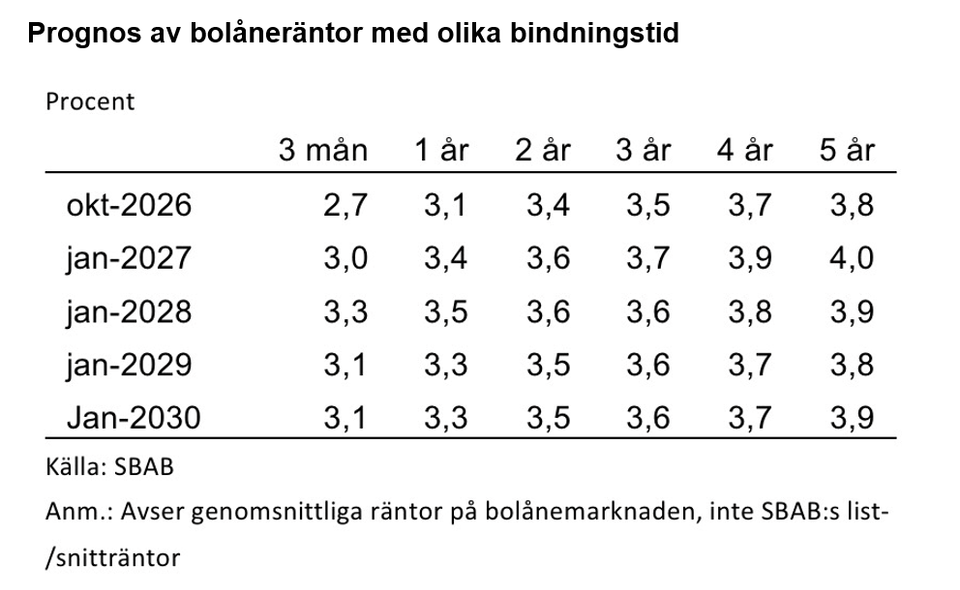
If the forecast comes true, the interest rate changes are expected to have clear consequences for mortgage borrowers. SBAB assesses that variable mortgage rates could increase by about 0.5 percentage points by the beginning of next year.
Fixed-rate mortgages are also expected to become more expensive by roughly the same amount. SBAB points out, among other things, that the rates on covered bonds have already risen quickly.
– With two policy rate hikes, variable mortgage rates are expected to rise by 0.5 percentage points by the start of next year. Longer fixed mortgage rates are expected to rise by about the same amount, and we’ve already seen rapidly rising rates on covered bonds there, says Robert Boije.
International developments meanwhile remain a major source of uncertainty. The conflict in the Middle East has affected both oil and freight prices. The Strait of Hormuz remains closed and traffic through Bab al-Mandab is limited, according to SBAB.
Higher energy prices, in turn, risk driving inflation higher. Another factor is the development of the Swedish krona. If the interest rate gap between Sweden and other countries increases, the krona could weaken, which may contribute to higher prices for imported goods.
– Increases in oil prices tend to have the biggest effect on trend inflation with quite a few months’ delay. We therefore believe that inflation will rise shortly after we’ve now had several months of elevated oil prices and with no clear solution to the Middle East conflict in sight, says Robert Boije.
Stronger GDP Growth Than Previous Forecast
At the same time, the picture of the Swedish economy is much brighter than during the last recession. SBAB expects GDP to grow by 2.5 percent this year. That is an upward revision from the previous forecast of 2.4 percent. For 2027, growth is expected to increase further, to 2.6 percent.
Above all, it is household consumption and corporate investment that are expected to drive progress. A stronger economy is also expected to lead to increased employment and lower unemployment. Bankruptcies are also expected to decrease as the economy improves.
– Previous support measures and deferred tax payments during the pandemic contributed to the number of bankruptcies being unnaturally low relative to the economic cycle for a period. When these support measures were phased out, the number of bankruptcies instead became unnaturally high, says Robert Boije.
In the housing market, SBAB expects a price increase of about 4 percent over the year. However, trends are expected to differ between different types of housing. Single-family homes are assessed to have had stronger price development than apartments.
According to SBAB, it is mainly rising household incomes that are causing housing prices to increase. At the same time, market activity has improved. Sales of single-family homes are said to be back to normal levels, while apartment sales have increased significantly. However, how the housing market develops at the end of the year is more uncertain.

– So far this year, housing prices have increased moderately and especially late autumn is usually a seasonally weak period in the housing market. How it turns out this year will depend on how much weight the economic recovery carries compared to the expected rate hike. The forecast is quite uncertain, I would say, says Robert Boije.
The improved economic situation is also expected to have some effect on housing construction. SBAB expects that about 34,000 homes will start construction in 2027.
This means an increase of just over 2,000 homes compared with this year’s level. Construction is also expected to continue to rise in subsequent years, but at a relatively slow pace.
The development is limited, among other things, by the fact that it is still expensive to build new homes. Construction costs are high in relation to the prices of existing homes, making it harder to generate demand for new builds.
At the same time, there are some signs of improvement. SBAB points out, among other things, that sales of newly built homes have developed somewhat better, especially in the Stockholm area.
– There have admittedly been a few more positive signals recently about the sale of new homes, particularly in the Stockholm area, and the economic recovery is positive for housing construction. But high construction costs relative to prices in the existing housing stock are still limiting demand for new housing, says Robert Boije.
Geopolitics Makes the Forecast Uncertain
SBAB’s assessment is thus based on a combination of economic recovery and rising inflation risks. At the same time, there are several factors that could change the outlook.
Ongoing geopolitical unrest is affecting, among other things, energy prices, trade, and transport. The Swedish political situation also contributes, according to SBAB, to the uncertainty around economic development.
– The continued turbulent geopolitical situation makes forecasts of GDP, inflation, and interest rates very uncertain. The challenging government formation process adds yet another small layer of uncertainty, says Robert Boije.