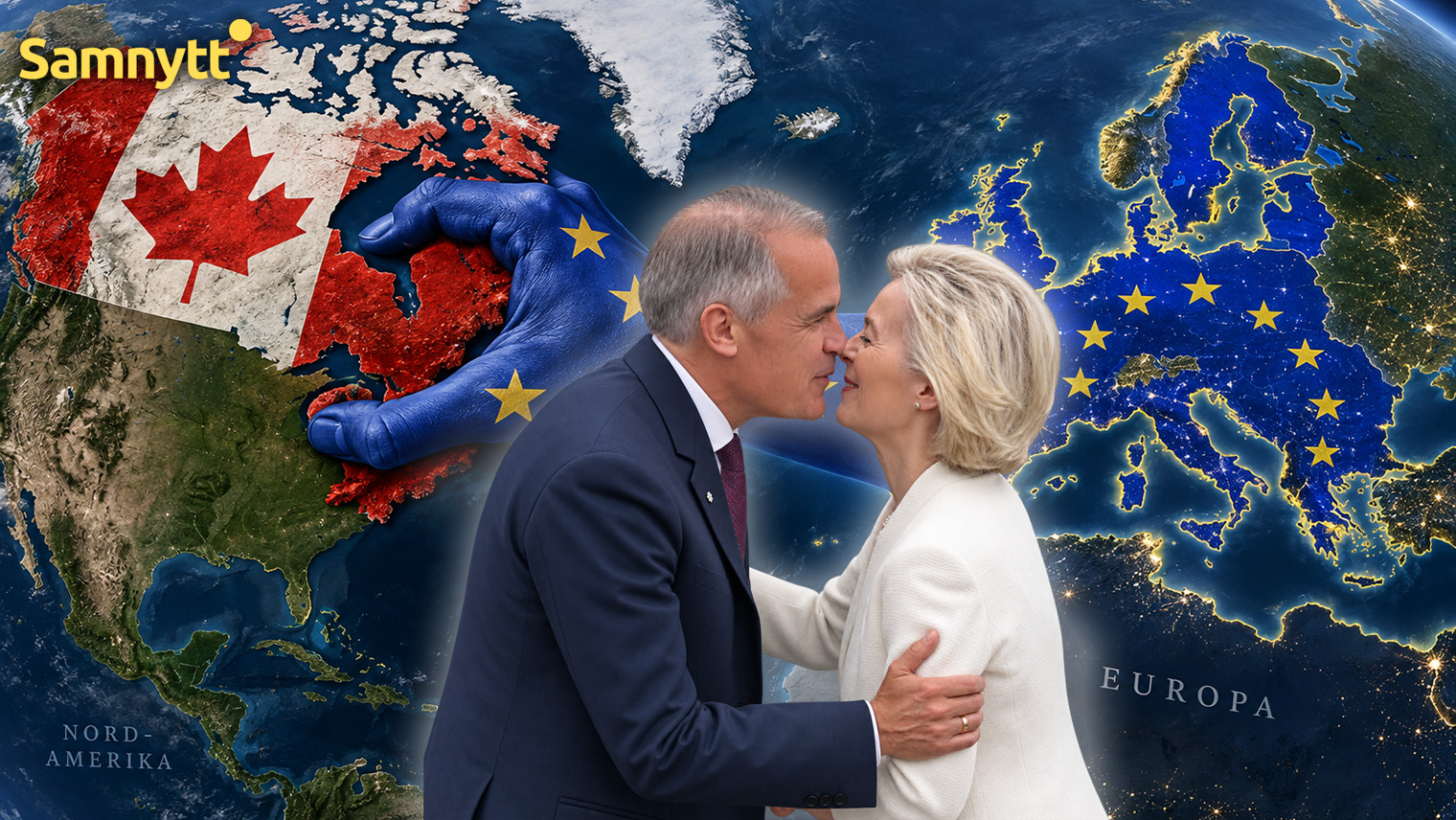
The European Commission wants to create a new form of membership and open the union’s doors to countries far beyond Europe, including Canada. President Ursula von der Leyen launched the idea in hopes that the trade conflict with the United States will drive Ottawa closer to Brussels. Alongside the ongoing expansion towards Ukraine, the Balkans, and Turkey, the picture is emerging of an EU that increasingly seeks to evolve from a European cooperation project into a geopolitical great power – now with reach across the Atlantic.
Canada could become the first country ever to gain status as an “associate member” of the EU. This was announced by European Commission President Ursula von der Leyen on Wednesday in her annual State of the Union address before the European Parliament in Strasbourg. Canadian Prime Minister Mark Carney was present at the event.
“I would like to work with you to open the door for Canada as the EU’s first associate member,” said von der Leyen.
What such membership would actually entail is still unclear. There is currently no category for “associate members” in today’s EU, and the proposal therefore means that Brussels is effectively looking to create a new form of colonial connection to the union.
Wants to ‘reconsider’ EU’s partnerships
The backdrop is a rapidly changing geopolitical landscape, especially the deteriorating relations between the USA and its traditional allies. In Brussels, there is now a desire to exploit this to expand the reach of its political influence.
Since Donald Trump returned to the White House, Washington has imposed higher tariffs on both Canada and the EU. Trump has also repeatedly referred to Canada as a possible 51st American state.
Canada, meanwhile, is seeking to reduce its heavy economic dependence on the USA. Carney last month broke off trade talks with Washington and imposed counter-tariffs on American goods.
It is this rift that Brussels now sees opportunities in. Von der Leyen explained that the EU in what she calls the new world order “must urgently reconsider our partnerships” and build global coalitions. She also highlighted the EU’s size and power, stating that Europe could take the lead in this effort.
Canada and the EU already have the CETA free trade agreement, but the Commission President wants to go much further. CETA is to evolve into a new “Alliance for the Future” with what she describes as a common area for prosperity and economic security.
The plans include advanced industry, energy, critical minerals, batteries, artificial intelligence, quantum computers, cybersecurity, and closer integration of EU and Canadian defense industries. The Arctic is also to become a joint strategic priority.
“We share an ocean, the same values, and the same worldview,” said von der Leyen.
She simultaneously emphasized that the cooperation is not aimed at any other state – a formulation that stands in contrast to the ongoing conflicts with the USA in several areas.
EU Aims for Power Status
The initiative signifies something fundamentally new. Canada is not a European country and therefore cannot simply be treated as a regular candidate country under current rules. The new term “associate member” would potentially allow Brussels to tie countries closely to the union without going through the traditional membership process.
Exactly what rights and obligations Canada would get is yet to be determined. One possibility being discussed is that the country could gradually be integrated into various EU systems and programs – such as those for defense, technology, and trade – without formally becoming a full member.
This can thus be seen as yet another step in the EU’s development from a European economic and political cooperation toward an actor with explicit global power ambitions.
From a critical standpoint, this evolution can also be described as the EU taking on increasingly geopolitical and almost imperialistic features – not in the classic sense through territorial conquests, but as Brussels seeks to expand the union’s economic, regulatory, security, and institutional influence far beyond Europe’s geographical borders.
Von der Leyen’s speech itself was also clearly marked by this broader perspective. She spoke of how Europe’s prosperity and security can no longer be built solely at home and highlighted the EU’s trade relations with over 80 countries as well as new strategic investments reaching as far as Central Asia.
Canada Already Mentioned This Summer
The idea of Canada as part of a greatly expanded European sphere does not come entirely out of the blue. As previously reported by Samnytt, Finland’s president Alexander Stubb in June launched a vision for a future EU with up to 40 member states or very closely associated countries. In addition to the UK, Norway, and Iceland, he mentioned Ukraine, Turkey – and Canada.
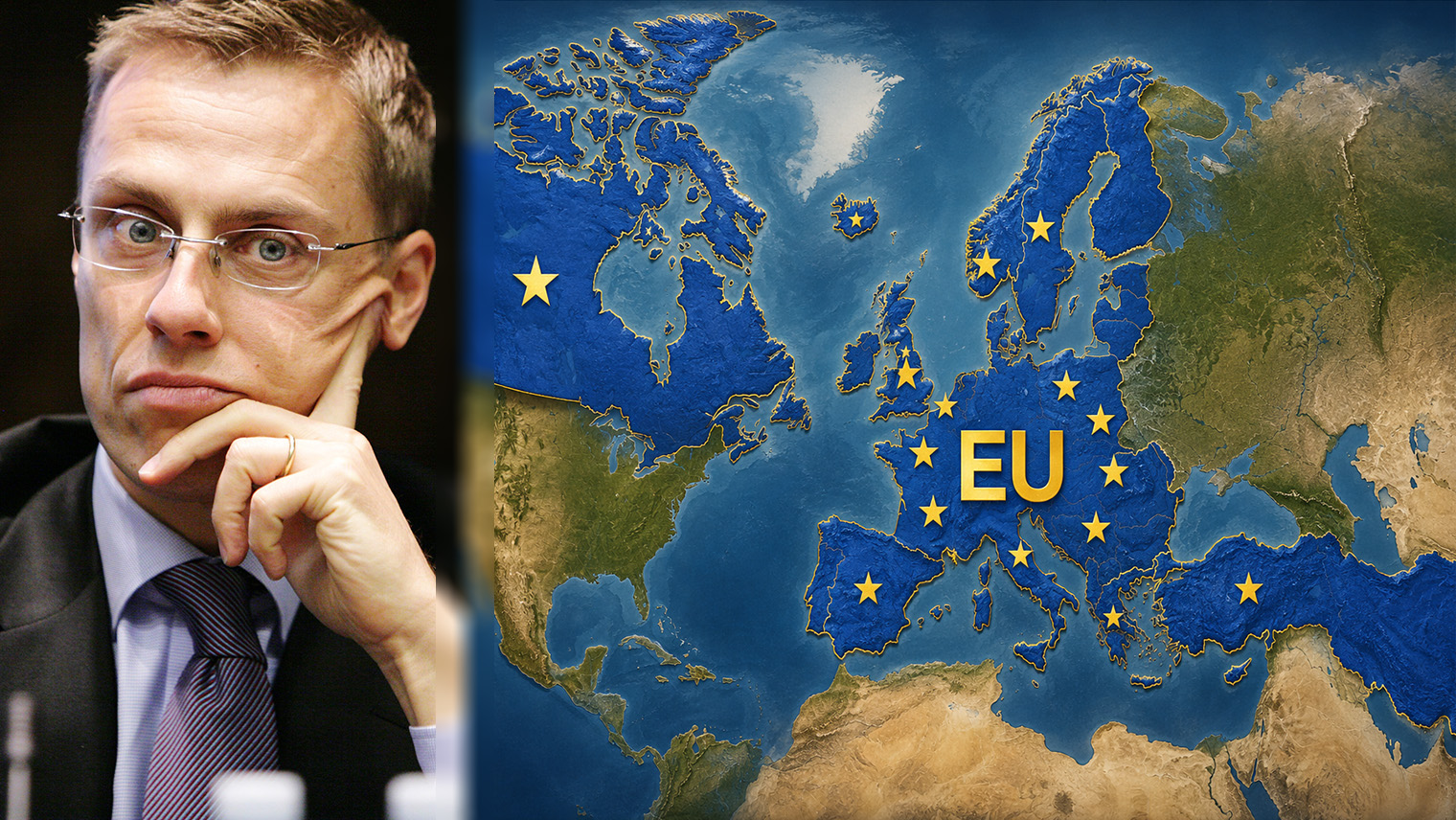
That the North American country could be included in a European project may seem contradictory from a geographical point of view. However, Stubb’s reasoning was based on geopolitics rather than geography. A larger bloc, according to him, would give Europe greater weight in the competition between the world’s major powers.
READ ALSO: Canada and Turkey European? How the President Wants to Redraw the EU Map
He also joked that it would be better if Canada became the EU’s 28th member state than the USA’s 51st. What first appeared as the far-reaching future vision of a Finnish president has now, just over three months later, made its way onto the European Commission’s agenda.
Ukraine on the Way In – Turkey Still a Candidate
At the same time, the EU’s largest expansion process in many years is ongoing. Nine countries currently have formal candidate status: Albania, Bosnia and Herzegovina, Georgia, Moldova, Montenegro, North Macedonia, Serbia, Turkey, and Ukraine. Kosovo is considered a potential candidate.
Ukraine’s membership process has accelerated since the Russian invasion. The country gained candidate status in 2022, accession negotiations opened in 2024, and as recently as July this year, the EU opened yet another chapter of negotiations, this time on foreign relations.
Turkey also remains a formal candidate country. It applied for membership as early as 1987, and negotiations began in 2005, but the process has virtually stalled since 2018 due to, among other things, EU criticism of developments regarding democracy, fundamental rights, and the independence of the judiciary.
Von der Leyen also made clear in her speech on Wednesday that enlargement will continue. She specifically highlighted Ukraine, Moldova, and the Western Balkans, stating that the Commission will soon present roadmaps for the candidate countries furthest along in the process.
From European Union to Global Sphere of Influence
The Canada proposal thus raises a broader question about what the EU is to be in the future. The union has traditionally been defined geographically and politically as a European integration project.
With a special associate membership, the geographical limitation could be relaxed and replaced by a model in which countries are tied to Brussels based on shared security and economic interests.
Von der Leyen also wants to create a new European Security Council, where even non-EU countries such as Canada, the UK, and Norway could participate alongside Ukraine. The result could be a much larger political and security sphere with the EU at its center.
How far these great power plans will ultimately go remains to be seen. There is not yet a finished model for Canadian associate membership, and the now nearly ten-year-old CETA agreement has still not been ratified by all EU member states.
Canada and the EU are set to hold a summit in Montreal at the end of October. Then it is expected to become clearer what von der Leyen’s historic offer actually means – and how far beyond Europe’s borders Brussels is prepared to stretch the union.