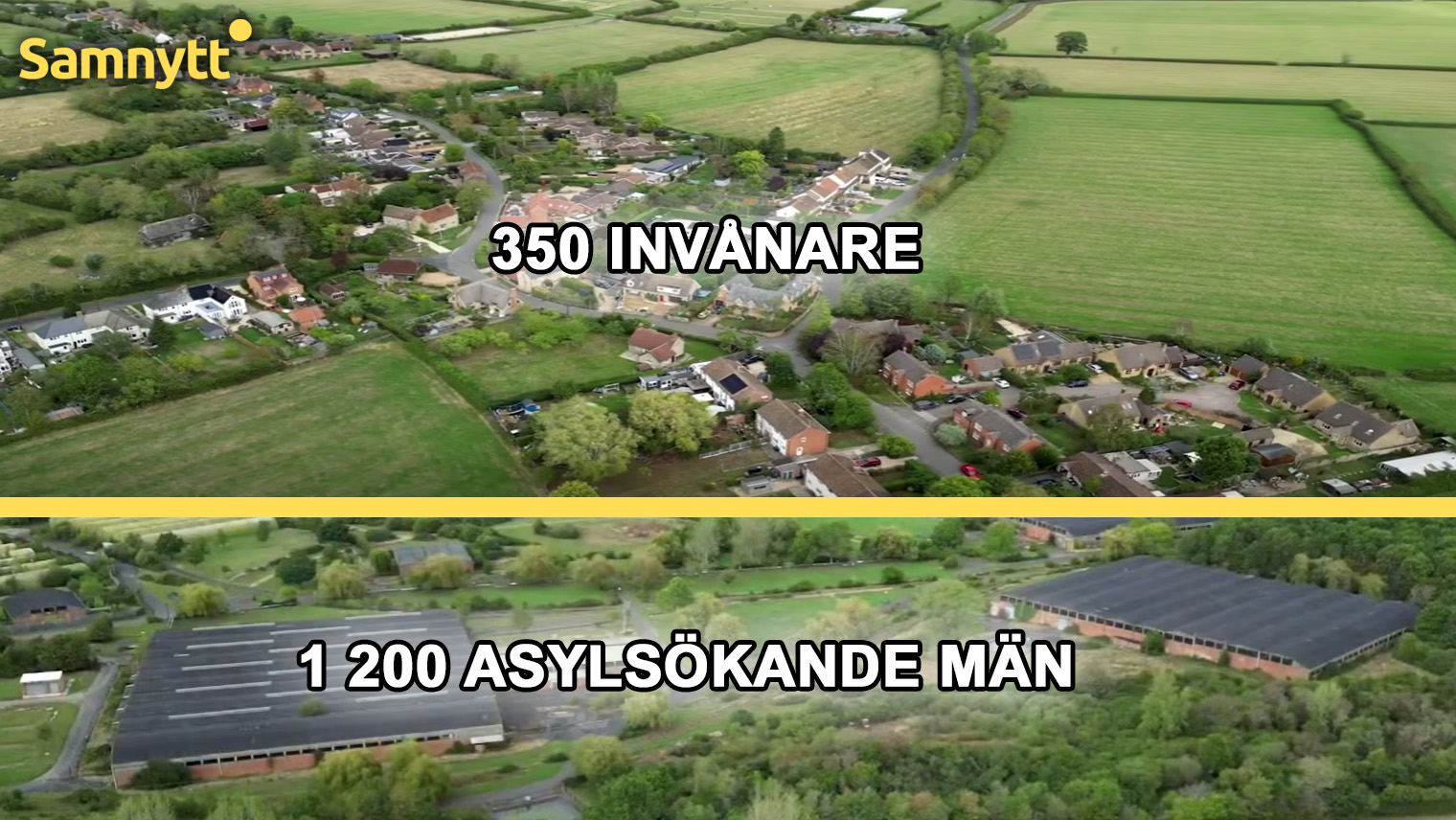
The residents of the small English village of Piddington have in a symbolic referendum voted to leave the United Kingdom. The background is the government’s plans to accommodate up to 1,256 male asylum seekers at a former military base nearby – in an area where the village itself has only about 350 inhabitants.
The vote has no legal significance, but the result was nevertheless clear. Of 312 votes cast, 285 voted for Piddington to leave the United Kingdom. Only 26 wanted to remain, and one vote was invalid.
The referendum was arranged by the village council after the British government announced that the former military facility MoD Bicester in Oxfordshire could be repurposed as accommodation for up to 1,256 male asylum seekers.
“We are Piddington, the village that roars,” said Susannah Parden, vice chair of the village council, in a comment to BBC, when the result was announced.
The village council’s chair, Tim McNally, described the vote as an example of democracy in practice.
“We entered this village hall as underdogs—we had a bold idea. We have sent a message to the world,” he said.
Women warn of insecurity
Opposition to the asylum center has been extensive in Piddington. Particularly noteworthy has been a letter signed by more than 130 women in the village, which was sent to all female members of the British Parliament.
The women write that they fear for their safety and freedom of movement if over a thousand male asylum seekers are placed near the small village.
“As women, you will understand the serious risks this exposes us to. Our safety, our security, and our freedom will be threatened. We will not feel safe walking our streets,” they write.
Some of the women have expressed concerns that “life as we know it will be destroyed” if the government’s plans are implemented.
Local politicians and organizations working with asylum seekers have also questioned the location. Hari Reed from the Oxfordshire organization Asylum Welcome points out that the asylum seekers would be far from the help and services they need, while the burden on the already limited local public services risks increasing.
The government will not back down
However, the British government shows no signs of abandoning its plans. Culture Minister Lisa Nandy told the BBC that the government understands the concerns such changes can cause in a local community, but that the alternative would be that other areas that have already received many asylum seekers would have to bear an even greater burden.
“The alternative would be to ask communities that have already seen their local population quadruple to take on an even greater share of the burden—and I think that would be deeply unfair,” she said.
Nandy also referred to the large backlog of asylum cases that the Labour government says it has inherited. According to her, applications are now being processed faster, while those without the right to remain are being deported.
The government’s position is that the UK must continue to fulfill its obligations and provide accommodation for people seeking protection while the asylum system is being handled.
“Our voice can be heard”
For Piddington’s residents, the much-publicized referendum has above all become a way to try to force the government to listen. Christina Gower, 26, said she was disappointed that villagers had to resort to something so “drastic and desperate” to get the Prime Minister’s attention.
“You see this kind of thing on TV, in front of 10 Downing Street, not in little brave Piddington in the middle of Oxfordshire,” she said.
Ian Darby, 63, described himself as very emotional when the result was announced. The extensive media coverage, he said, had made residents realize that even a very small village can make its voice heard.
Council member Joe Marshall joked after the vote that the newly formed “principality” could appoint its own leaders and issue its own identity cards. As an example, he mentioned Sealand, the former military platform off the English coast that in 1967 declared itself an independent state.
Behind the humor, however, there is a clear political purpose. Marshall hopes the protest will inspire other local communities that feel overruled by central authorities to make similar statements.
Over a thousand men in villages with just a few hundred inhabitants
The former military facility, called “Site A”, is located between Piddington and the villages of Upper and Lower Arncott. The Home Office presented the plans in June as part of its work to move asylum seekers from hotels to other types of accommodation. Similar plans existed as far back as 2005 but were abandoned by the then Labour government.
Tim Bearder, the leader of Oxfordshire County Council, has also criticized both the choice of location and how the government has handled the issue. He argues that the authorities have not sufficiently anchored the project with the local population or investigated whether the site is suitable at all.
“It is the wrong place for the local communities, for the asylum seekers themselves, and for the taxpayers,” he said.
The region’s Liberal Democrat MP Calum Miller has previously accused the government of shrouding the process in secrecy and of not guaranteeing the public any real influence.
The government has since opened up for a public consultation on the plans. For the residents of Piddington, however, this was not enough. With a vote of 285 to 26, the village instead chose to—at least symbolically—say farewell to the United Kingdom.