The Örebro Party has skyrocketed in local politics and is aiming to enter parliament through the so-called 12 percent rule. But a new survey from Infostat shows that the uphill climb is significantly steeper than the party’s strong local poll numbers previously suggested. Support in the parliamentary election is estimated at just under 6 percent in Örebro County—less than half of what is required.
Markus Allard and his Örebro Party have, in the final stages of the election campaign, received considerable attention for their attempt to enter parliament without passing the national four percent threshold. The plan instead relies on a lesser-known regulation in the electoral system. A party that receives at least 12 percent of the votes in a single constituency may participate in the allocation of the fixed parliamentary seats there, even if support nationwide falls below four percent.
For the Örebro Party, it’s the Örebro County constituency that matters. The party itself has estimated that around 24,000 votes are needed to reach the goal. A new independent survey by Infostat, however, suggests the party still has a long way to go.
Just under 6 percent in the parliamentary election
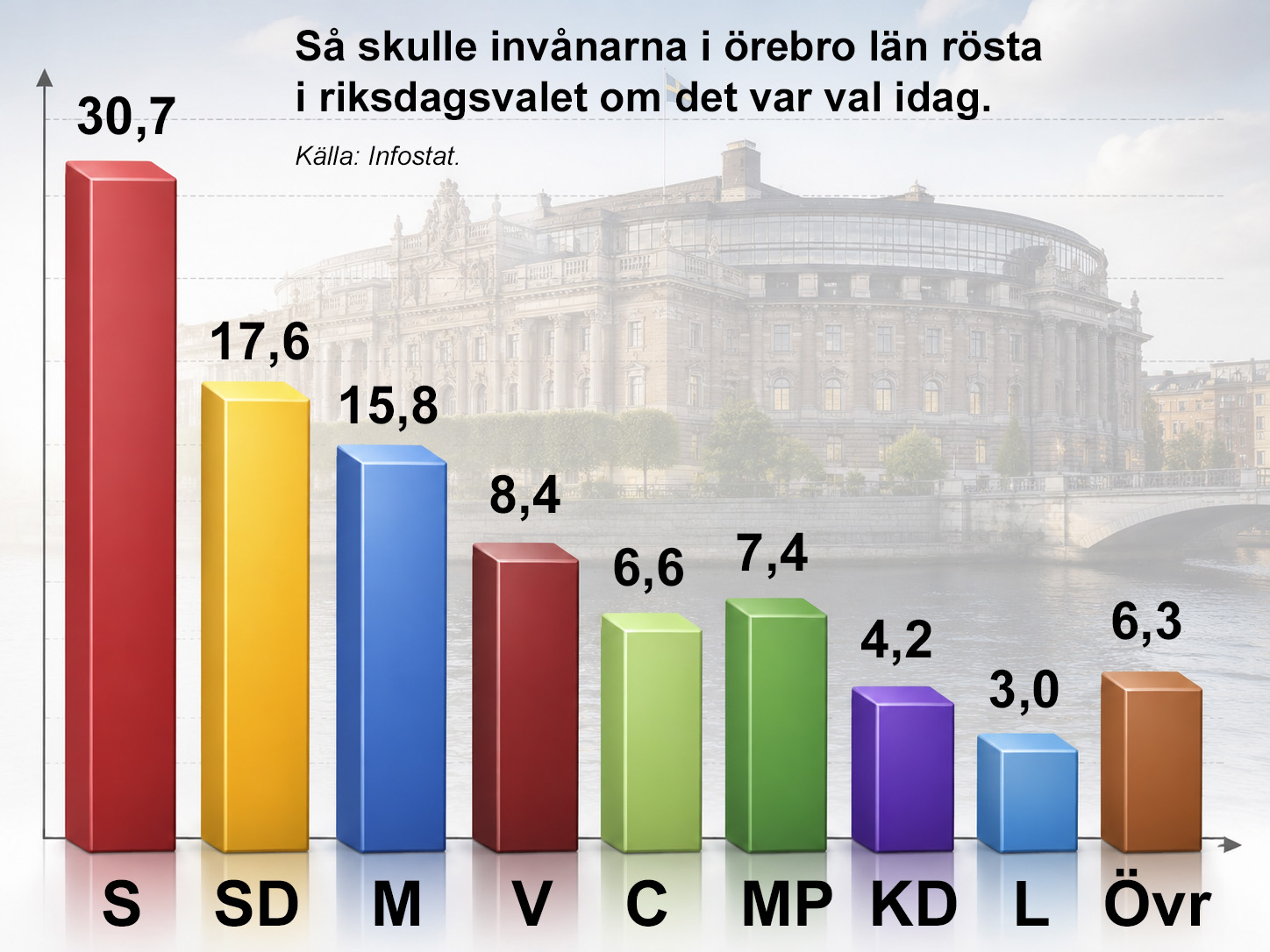
In Infostat’s survey, the response option “other party” receives 6.3 percent when voters in Örebro County are asked who they would vote for if the parliamentary election were held today.
The Örebro Party is not listed separately. However, Infostat estimates that if support for other small parties in the category does not differ significantly from the rest of the country, the Örebro Party’s support can be estimated at just under 6 percent. This would mean the party needs to roughly double its current support during the last two weeks of the campaign to reach the 12 percent threshold.
There is as yet no clear sign of such a final surge in the data. Three quarters of the interviews were conducted after August 24. Between the earlier and later parts of the measurement period, the “other party” category rose from 5.5 to 6.6 percent, but the change falls entirely within the survey’s margin of error.

Infostat’s opinion analyst Peter Santesson points out an important difference between local and parliamentary elections. Voters are more inclined to try smaller parties at the local level, whereas the question of government and the risk that the vote will not lead to a parliamentary mandate become more significant when parliament is elected.
– The stakes are higher since government power is in play, and there is an overriding risk that a vote for a party outside of parliament will be wasted.
According to Santesson, the Örebro Party therefore appears to have “significantly more difficulty” attracting voters in the parliamentary election than in the regional election, which covers the same municipalities as the constituency.
Has skyrocketed locally
The numbers stand in stark contrast to the Örebro Party’s development in local politics. The party received 7.9 percent in the municipal election in Örebro in 2022 and has since grown rapidly. In a Novus poll commissioned by Nerikes Allehanda in May of this year, the Örebro Party received a full 18.4 percent in Örebro municipality.
This made the party the second largest in the municipality, only surpassed by the Social Democrats. With such an election result, the Örebro Party would go from its current five seats to twelve in the municipal council.
READ ALSO: Is a vote for Allard wasted? Yes—and no
These successes have fueled speculation that Allard could also make the jump into parliament. On paper, the calculation did not look unreasonable. Örebro municipality accounts for about half of the votes in the Örebro County constituency. If the Örebro Party were to receive about 18.4 percent of the parliamentary votes in the municipality, support of about 5.5–6 percent in the remaining eleven municipalities could be enough to surpass 12 percent in the constituency overall.
The problem is that this calculation relies on enough voters who want the Örebro Party in the municipal council also being willing to cast their parliamentary vote for the party. Infostat’s survey suggests this is far from the case.
Municipal success cannot be translated to parliament
This means that the threshold is substantially higher than just the Örebro Party achieving 12 percent among voters in Örebro municipality. Even if the party were to double its current support in the parliamentary poll among Örebro residents during the final stretch and surpass 12 percent in the municipality, it would not necessarily be enough. The twelve percent rule applies to the entire Örebro County constituency, not just Örebro municipality.
Since the party has its political base and by far its strongest visibility in Örebro, it is unlikely to expect equally strong support in, for example, Lindesberg, Hallsberg, Kumla, Karlskoga and the constituency’s other municipalities. To compensate for a lower result there, the Örebro Party would therefore need to achieve well above 12 percent in the parliamentary election in Örebro municipality itself—closer to the poll figure for the municipal election.
This is precisely why this spring’s figure of 18.4 percent drew attention. Such strong support in the county’s most populous municipality would give the party a significant surplus to bring with them when the votes from the entire constituency are added together—provided Örebro residents are prepared to vote for Allard for parliament as well.
The new survey, however, indicates that many voters differentiate between the three ballots. Strong support for Allard and the Örebro Party in municipal or regional politics does not necessarily mean those same voters are prepared to abandon their usual parliamentary party.
Regional poll provided a completely different picture
The difference is particularly evident in light of another recent Novus poll. There, the Örebro Party received just over 15 percent when the question concerned the regional election in Örebro County, i.e., the same catchment area of voters as the constituency. If those same voters had chosen the Örebro Party ballot in the parliamentary election as well, the level would have been sufficient to surpass the 12 percent threshold.
READ ALSO: Survey: Markus Allard on his way into parliament
But it is precisely this voter transfer between elections that Infostat’s survey now questions. For the Örebro Party, the last two weeks of the election campaign are therefore not just about mobilizing its local supporters. The party also has to convince a large group of voters who are open to Allard in the municipal council or regional politics to also cast their ballot for the Örebro Party in the parliamentary election.
With Infostat’s estimate of just under 6 percent, there is still a long way to go to the necessary 12 percent. At the same time, the final push of the election campaign remains, and the Örebro Party has in recent weeks received significant national attention. Whether this can be converted into parliamentary votes remains an open question.
– The election result will show whether the Örebro Party’s recent national attention has given it a boost in the final stretch, Infostat states.
S is largest in the county
In Infostat’s survey, the Social Democrats are clearly the largest party in Örebro County with 30.7 percent. The Sweden Democrats get 17.6, and the Moderates 15.8 percent.
Next come the Left Party at 8.4, the Green Party at 7.4, and the Centre Party at 6.6 percent. The Christian Democrats receive 4.2 percent while the Liberals fall below the parliamentary threshold at 3.0 percent. The “other party” category, which includes the Örebro Party, receives 6.3 percent.
The survey includes 1,136 people over 18 years old, residing in Örebro County, and the interviews were conducted between June 18 and September 3. Results have been weighted by gender, age, and party choice in the last parliamentary election. The margin of error for the “other party” category is given as plus/minus 1.53 percentage points.