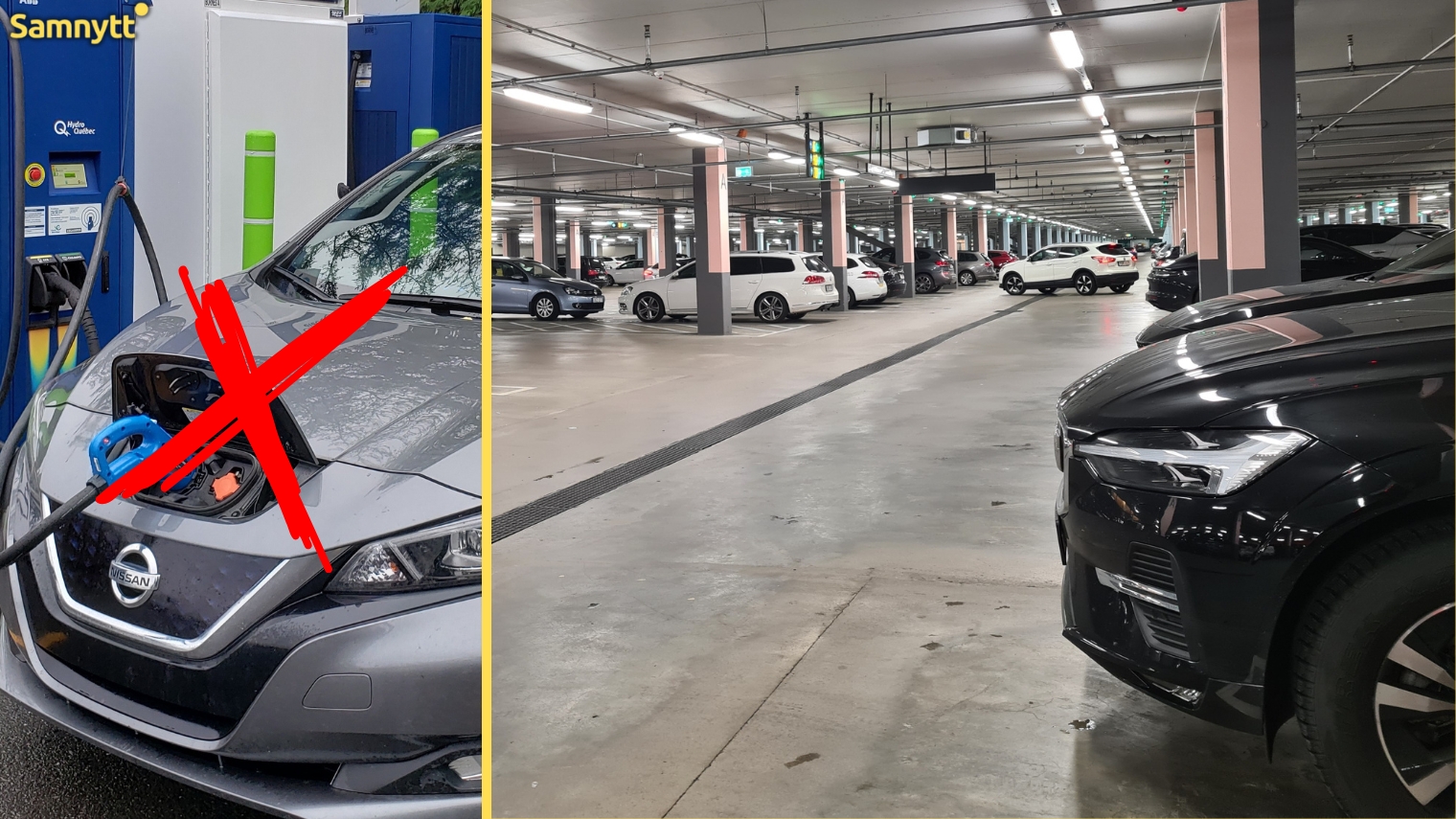
Electric cars are banned from certain rooftop parking lots at Carrefour supermarkets in Belgium. The company cites both building safety and fire risks as reasons. The decision has also raised questions since the ban applies to all electric cars, regardless of their actual weight.
A total of 18 Carrefour stores are affected, mainly in densely populated areas of Brussels. Those who want to make a green choice and arrive at the store in an electric car will have to settle for parking at ground level. This is reported by BFMTV.
Carrefour points out that several of the parking structures were built decades ago, when cars generally weighed less than today’s models. The large batteries in many electric cars can make vehicles significantly heavier, which the company says could be problematic for older concrete constructions.
“The structures of the buildings are not always adapted for the extra load that these new vehicles entail,” says Carrefour Belgium’s spokesperson Damien Bytebier to RTL Info.
Even Very Light Electric Cars Are Stopped
The main criticism is that Carrefour does not seem to distinguish between different car models. A small and light electric car can be stopped, while a much heavier petrol or diesel car is still allowed on the rooftop.
Electric cars are often heavier than equivalent petrol cars because the battery can weigh several hundred kilos. However, the differences between various models are significant.
A Dacia Spring weighs about 970 kilograms, while a Renault Twingo E-Tech weighs around 1,168 kilos and a Fiat 500e about 1,250 kilos. Meanwhile, large petrol and diesel cars can weigh well over two tons. A BMW X5, for example, can weigh about 2,430 kilos.
READ ALSO: Electric car caught fire without warning – burned up in parking lot
This means a small electric car can be banned from rooftop parking while a much heavier fossil-fueled vehicle is granted access. Philippe Vangeel from the industry association EV Belgium therefore questions whether electric cars are really the problem.
“Is the problem really that electric cars are too heavy? Or is it rather that some parking garages were simply built for a fleet of cars that just doesn’t look the same anymore,” he says.
Fire Risk Is Another Reason
There is yet another reason. Carrefour also refers to fire safety. If an electric car catches fire in a rooftop parking garage, it may be harder for emergency services to reach it than if the fire occurs at ground level.
READ ALSO: Researchers: No demonstrable emission reductions with electric cars
Battery fires can also be difficult to extinguish and may require large amounts of water. In some cases, the battery can continue to generate heat even after the flames have been put out, making the operation more complicated.
Electric Cars Face More Restrictions
Carrefour’s decision is not the only example of electric cars facing specific regulations. In South Korea, Seoul has introduced restrictions for electric cars charged above 90 percent in certain underground parking garages. The move followed, in part, a well-publicized garage fire in Incheon.
READ ALSO: Ship fire believed to have started in electric car
On ferries and other vessels, the issue of electric cars has also been increasingly debated. In Greece, authorities have imposed requirements for lower battery charges in electric cars transported by ferry. The Norwegian shipping company Havila Kystruten has gone further and banned electric-powered vehicles on its ships.
READ ALSO: Electric car fire forced crew to abandon ship – growing safety risk for shipping