
All eight parliamentary parties have given the green light for continued preparation of a so-called stop law against teenage deportations. But what the decision actually means is already under dispute. The Sweden Democrats’ new migration policy spokesperson Jessica Stegrud tells Samnytt that the party has not supported any stop law at all – and warns of a drastic course change.
Following Tuesday’s meeting in the parliament’s social insurance committee, the image was spread of broad political unanimity regarding the so-called teenage deportations. All parties backed the decision to begin preparation work.
The wording in the meeting documents, however, goes further than just “looking into the matter.” According to SVT, the committee decided to initiate preparatory work with the aim of being able to submit a committee initiative to quickly introduce a stop law.
The so-called stop law is intended as a temporary solution that pauses deportations of the affected group while parliament works out more permanent rules.
This mainly concerns young people who came to Sweden as children through connection to their parents but who, upon reaching adulthood, no longer meet the conditions to stay on the same grounds.
No finalized stop law exists yet, and it remains unclear exactly who would be covered and for how long the stop would apply.
READ ALSO: Jessica Stegrud on the “rot” in elderly care: Warns of clan-based rule
Stegrud: Not what we decided
But the Sweden Democrats’ Jessica Stegrud, who has recently taken over as the party’s migration policy spokesperson and is vice chair of the social insurance committee, gives a different picture of what the decision means.
According to Stegrud, SD has not agreed that a stop law should actually be introduced. The decision, according to her, allows the red-greens to proceed and prepare their proposal.
– There are simply too many question marks, she tells SVT.
Among other things, Stegrud points out that it is still unclear how the legislation will be drafted and exactly which people will be covered. She says that SD wants the preparatory process to clarify what the opposition actually intends to carry out.
The Green Party’s Annika Hirvonen sees it differently. She notes that all parties voted to start drafting a stop law and questions how a party can at the same time claim to be against it.
The Green Party also wants to go further than just stopping future deportations. Back in April, together with the Left Party, the Greens pushed the demand that young people who have already been deported and are deemed to be in danger should be brought back to Sweden.

The GP wanted the government to identify the people, conduct an evacuation operation, and allow them to apply for residence permits again – from within Sweden.
The demand has since re-emerged. In a motion from late September, the GP proposes that the Aliens Act be changed to allow already deported youths the possibility to return.
READ ALSO: GP motion: Bring home already deported and free education
The party cites, among other things, cases where people were denied new residence permits despite having been accepted for studies, as their strong ties to Sweden were deemed to contradict that the main purpose of their return truly was studies or work.
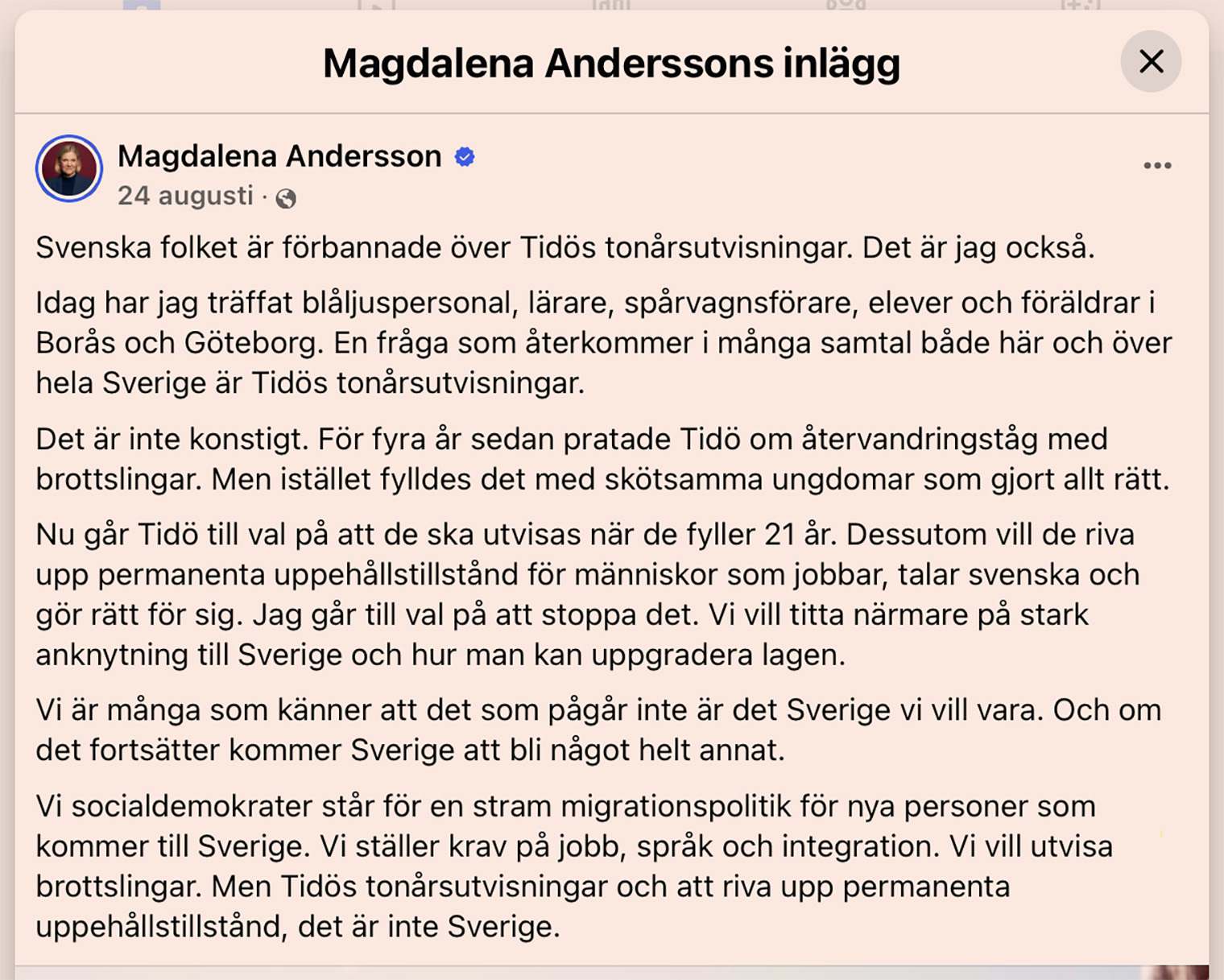
The Social Democrats have also opened up to changes in the legislation. Magdalena Andersson herself has raised the possibility of allowing strong ties to Sweden to carry more weight:
“We want to take a closer look at strong links to Sweden and how the law can be upgraded,” Andersson writes on Facebook.
Want to stop deportations
The background is thus the high-profile cases of young people who came to Sweden as minors and had residence permits due to ties to their parents, but who have risked deportation upon reaching adulthood and thus no longer qualifying on the same grounds.
S, V, GP, and C agreed earlier in October to push for a temporary stop law. The idea is that affected deportations will be halted while a permanent solution is developed.
READ ALSO: The Red-Greens won the election and act immediately: Will stop the teenage deportations
The opposition parties are, however, not completely in agreement on what such a permanent solution should look like.
V, C, and GP have, among other things, wanted to reinstate the possibility of residence permits due to “especially painful circumstances”, while the Social Democrats have previously rejected this.
The Tidö parties’ own law change took effect on October 1 and, among other things, raises the age limit for obtaining a residence permit as a child family member to one’s parents from 18 to 21 years.

Deportations continue
There will be no immediate pause for the current cases. The Swedish Migration Agency announced earlier this week that the authority will continue to apply the law as it stands today until, if at all, parliament decides otherwise.
The red-greens have a majority both in the social insurance committee and in the parliament chamber and can therefore drive the issue forward.
The GP also hopes that the unanimous committee decision will make it possible to get assistance from the Government Offices to help draft the legislation.
Stegrud: Could go much further
When Samnytt reaches Jessica Stegrud, she elaborates her criticism. She believes that the opposition’s initiative is still so vague that it’s impossible to know how many people might ultimately be covered.
Is the SD fundamentally opposed to a stop law? Or are you just saying no until you know exactly who is affected?
– It’s impossible to make a decision when you don’t even know if this is a problem or how widespread the problem even is. It’s so vague what they have come up with, so it’s unserious.
It makes no difference whether it was ten years ago, twenty years ago, two years ago. It doesn’t matter how old you are. That’s what they’re saying: “If you have ever set foot in Sweden and received a temporary residence permit, you should be allowed to stay.”
Jessica Stegrud (SD)
At the same time, Stegrud explains why SD allowed the committee initiative to proceed despite the party’s criticism. The opposition already has a majority in the social insurance committee and, according to her, SD could not have stopped the preparation by reserving themselves.
– We chose to let it go because we had a lot of critical questions they didn’t answer. So we said – you’re going to prepare it anyway. Then take this up and answer a lot of questions instead.
READ ALSO: SD women put pressure to stop “teenage deportations” – now SD leadership wants a pause
She describes the decision as a way to “call their bluff” and reveal what the opposition parties actually want to achieve with the legislation.
– What is it that you really want?

“It doesn’t matter if it was 20 years ago”
Stegrud also sees the risk that the temporary stop law becomes the beginning of a much larger policy shift. She points, among other things, to V, C, and GP wanting to reinstate the possibility of residence permits due to “especially painful circumstances”.
Either you have a policy where there is actually some sort of boundary, or you have a policy where there are none.
Jessica Stegrud (SD)
V, C, and GP now want to use the concept of “especially painful circumstances”. Are you afraid that this stop law will really be the first step toward bringing back a much more generous migration law?
– Absolutely, that’s exactly it. It’s the beginning of something, because they want a moratorium and they say in all cases and decisions, no enforcement, and so on, if one had a connection to Sweden as a child, to a parent. She continues:
– It makes no difference whether it was ten years ago, twenty years ago, two years ago. It doesn’t matter how old you are. The SD leader adds:
– That’s what they’re saying: “If you have ever set foot in Sweden and received a temporary residence permit, you should be allowed to stay.”
She also warns that a reinstatement of “especially painful circumstances” would create what she describes as a very broad loophole in migration legislation.
– That’s what they want to reintroduce. It becomes a huge loophole that is arbitrary. And with the law we have changed, there are already loopholes. I’d say they’re already generous.
– Either you have a policy where there is actually some sort of boundary, or you have a policy where there are none.
READ ALSO: The Tidö government softens migration line and pauses “teenage deportations” after criticism
New in the role
When asked if the stop law will be one of Stegrud’s first major migration policy battles since becoming SD’s migration spokesperson – and whether voters should now expect a tougher stance than her predecessor Ludvig Aspling – she replies:
– No, just as tough, I would say. Ludvig Aspling wasn’t soft.
Stegrud says she intends to stick to the course correction SD believes it has achieved during the Tidö cooperation, but emphasizes the party does not consider the work finished.
– We have managed a course correction, that we truly have, but it’s not over yet. There are more reforms to go.
Which new issues she herself will prioritize, she does not yet want to declare. She does point out, however, refugee quotas and family immigration as issues looming in the near future.
free for the rest of the year!
Right now you get Plus completely free for the rest of 2026!
DONATE VIA SWISH
123 083 33 50