The exposure to bullying, threats, and violence in Swedish schools has increased significantly over the past decade. The increase is particularly notable among students with a Swedish background, who in the latest survey also report the highest levels of victimization. At the same time, the report highlights important differences in how exposure manifests between different groups.
The government report ‘Unga tycker om andra – A Study of School Students’ Attitudes, Trust, and Victimization’ from the Forum for Living History shows that victimization among school students has increased markedly since 2013.
ALSO READ: Left-Liberal Outrage Over Highlighting Hostility Toward Swedes
The share of students reporting having been teased has risen from 33 to 51 percent, while threats have increased from 8 to 13 percent and physical violence from 11 to 16 percent. The trend is described as broad and applies to all student groups.
Swedish Background: Greatest Increase and Highest Levels
However, when the results are broken down, a clear difference emerges between groups. The greatest increase in victimization has occurred among students born in Sweden with Swedish-born parents.
In the latest survey, 53 percent in this group state they have been teased, 14 percent have been threatened, and 17 percent have been hit.
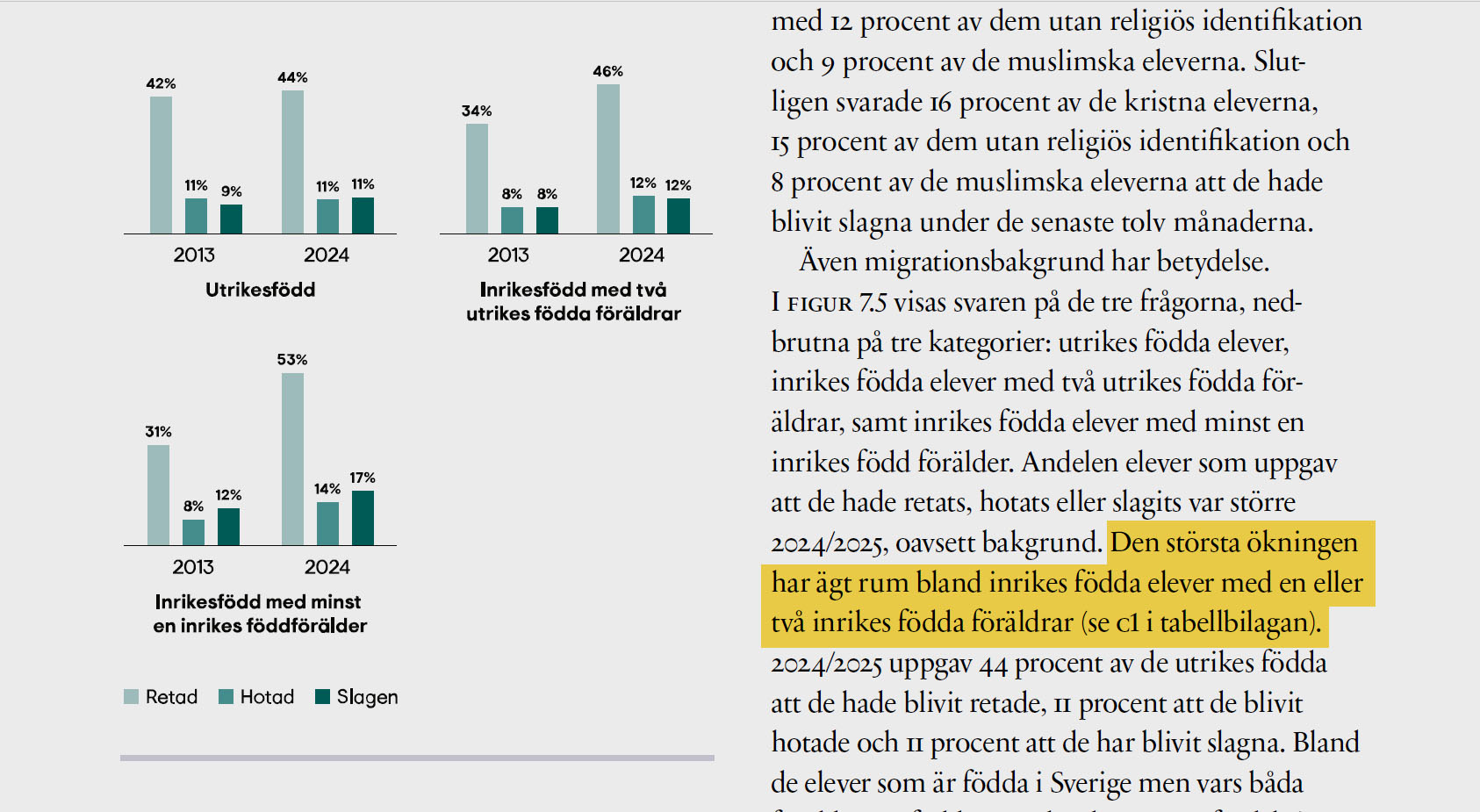
These are higher levels than for students with a foreign background, who to a lesser extent report having been subjected to these types of incidents.
Overall, this means that students with a Swedish background today not only show the greatest increase over time but also the highest levels of general victimization in school.
Differences in How Exposure Appears
At the same time, the report shows that exposure is not the same for all groups. Students with a foreign background report to a greater extent that they have been targeted specifically because of their origin. For example, 39 percent of foreign-born students say they feel teased due to their background, compared to 12 percent of students with two Swedish-born parents.
ALSO READ: SD Launches Network Against Anti-Swedish Hostility – Left Party: “Racism”
This means that while students with a Swedish background more often report general victimization, minority groups more often report exposure tied to identity.
Increased Concern and Declining Support for Immigration
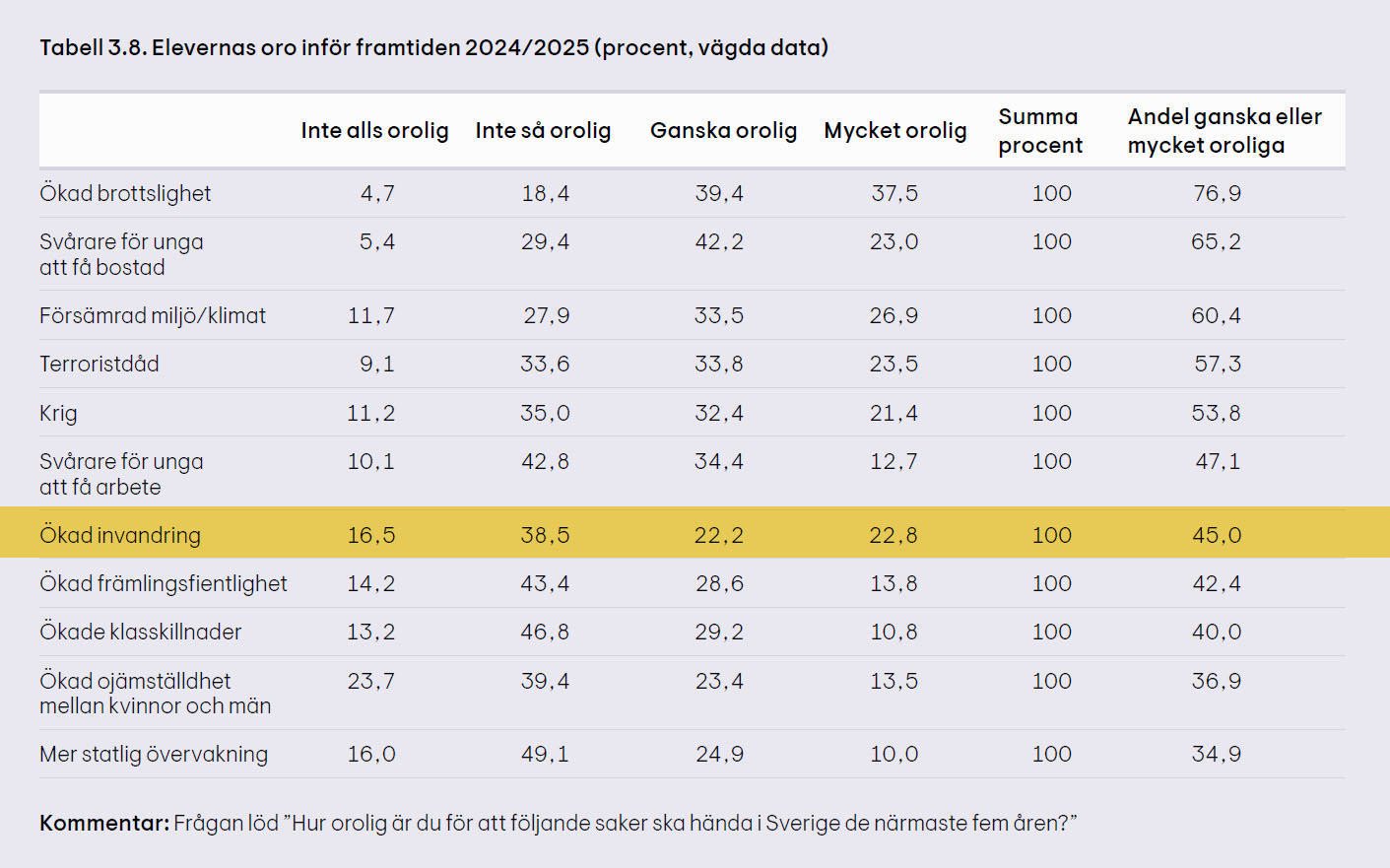
According to the report, 45 percent of school students are worried about increased immigration. This is a sharp increase compared to 2013. The percentage who are not worried is considerably lower, only 16.5 percent. The report does not specify in which groups the concern is most or least widespread.
At the same time, support for accepting asylum seekers has decreased. Here (pp. 39-42), the Forum för levande historia notes that this is not only among Swedish students, but applies to all student groups, including those born abroad. For students with a fully Swedish background, support plummeted from 55.8 to 42.5 percent between 2013 and 2024/2025.
Among foreign-born students, 56 percent were positive in 2013 compared to 53 percent in 2024/2025. The figure indicates that support for asylum reception is noticeably low even among those with an asylum-related immigrant background themselves. Among Swedish-born students with foreign-born parents, the drop is even more striking, from 60 percent positive in 2013 to only 45 percent in 2024/2025.
All figures are, according to the report, statistically significant. Forum för levande historia nonetheless concludes that the attitude towards asylum-related immigration is generally positive, though decreasing.
Misleading Picture in Media Reporting
The results of the report have largely been highlighted with a focus on attitudes toward minorities and their victimization. In descriptions of the study, it is often emphasized that it is about attitudes toward groups such as immigrants, Jews, Muslims, and LGBTQI+ people.
This is correct regarding the attitudes section of the study. But the report also contains a comprehensive mapping of students’ victimization—regardless of background—which also includes the majority group (Swedes).
ALSO READ: SD: We Will Be Proven Right About Anti-Swedish Hostility
This broader aspect is omitted in media reporting, for example by TT , which all major media outlets quote directly. In its summary section ‘About the Study’, it states:
“The study is a government commission in which the Forum för levande historia has investigated school students’ attitudes toward various minority groups in society during the academic year 2024/2025 and students’ own experiences of bullying, threats, and violence. The minority groups are immigrants, Afro-Swedes/Black people, Jews, Muslims, Roma, Sami, and homosexual, bisexual, and transgender persons.”
Increased Victimization – A Shared Development
The overall conclusion is that victimization in school has increased significantly over the last decade. That the increase is particularly noticeable among students with a Swedish background is one of the most prominent results in the material. Yet this has been omitted in general media reporting.
ALSO READ: Dagerlind: Bad Mood at Expo as Brå Investigates Anti-Swedish Hate Crimes
At the same time, the report shows that the nature of exposure varies between groups and that several student groups are affected in different ways. The Forum för levande historia emphasizes that the trend is worrying and that there is a need for continued analysis to understand the causes behind these changes.