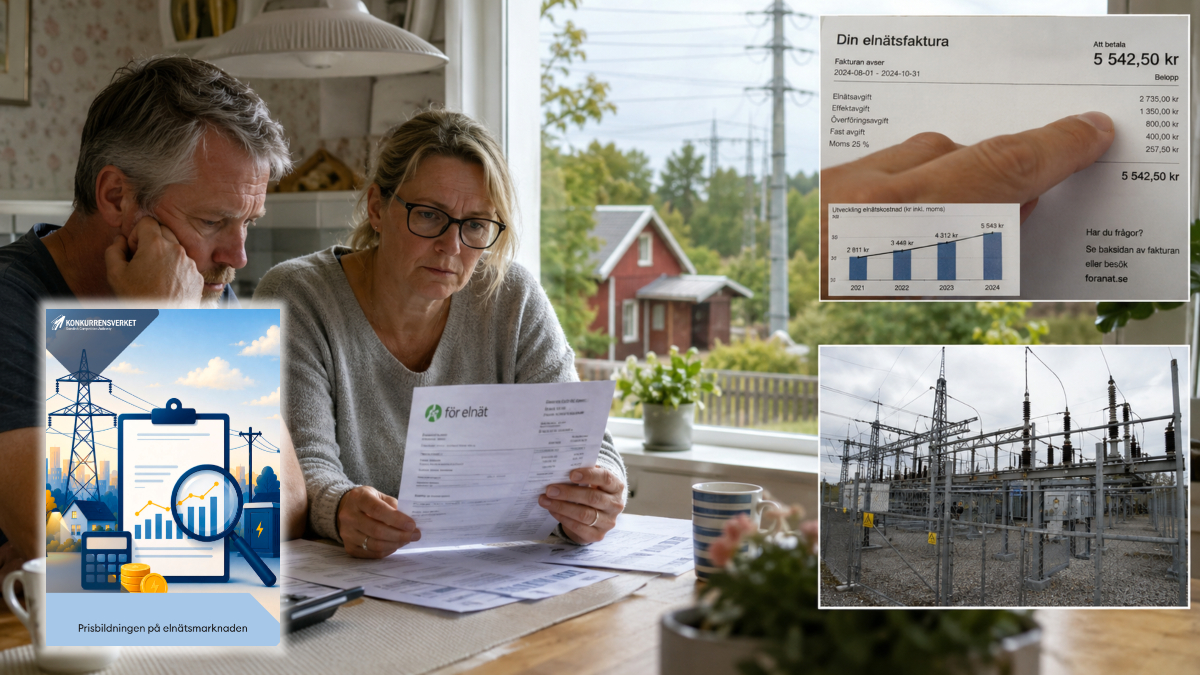
In recent years, Swedish households and businesses have been squeezed by sharply rising electricity grid fees. In a new analysis, the Competition Authority concludes that there is a risk that grid companies are charging, or may come to charge, fees that are not reasonable and are not justified by the companies’ actual costs.
The background is that the electricity grid market does not function like a normal market. Electricity can be purchased from different suppliers, but the grid itself is a natural monopoly. Residents in a given area cannot opt out of their grid company but are dependent on the operator that holds the exclusive right to operate the network there. The Competition Authority therefore states that there is no real competition in the market—and that it is also very difficult for new players to establish themselves.
According to the authority, electricity grid fees have since 2012 risen significantly more than inflation. For an average single-family home, fees have risen by just under 70 percent up to 2025, while the CPI has increased by just over 30 percent during the same period. For larger properties and small industries, the increase is just under 60 percent.
At the same time, allowed revenue caps for grid companies have soared. For the period 2024–2027, the total revenue caps for local and regional grids have risen from SEK 168 billion to SEK 270 billion compared to the previous regulatory period. This corresponds to an increase of 61 percent in nominal terms.
The Model Enables Higher Fees
The core of the problem is how the grid companies’ assets are valued. Today’s model is based on what it would cost to build equivalent facilities today—the so-called replacement value—instead of what the companies actually paid for them. Since construction costs have increased sharply, older facilities can therefore be revalued at much higher figures, which in turn gives companies greater scope to charge customers higher fees.
READ ALSO: Ekeroth: The EU is sabotaging the electricity system—and Sweden lets it happen
The Competition Authority writes that this may mean that the revenue caps have increased more than the companies’ actual costs. In other words: customers may be forced to pay for costs that in practice do not correspond to the companies’ real expenses.
The Energy Markets Inspectorate, Ei, has previously noted itself that current regulation overcompensates grid companies. The agency is therefore working on a new method for the period 2028–2031. But the Competition Authority points out that this change does not affect the already decided caps for the current period. Grid companies can therefore continue charging fees within the generous current limits until 2027.
Large Group Contributions
At the same time, audits by Ei show that many grid companies have a strong financial position. During 2020–2024, around 80 grid companies made group contributions totaling around SEK 20 billion. The three major players—Ellevio, Eon, and Vattenfall—were all net providers of group contributions during the period. Eon accounted for SEK 8.9 billion, Vattenfall for SEK 4.2 billion, and Ellevio for SEK 0.2 billion.
The Competition Authority has also met with the three largest grid companies, which together account for more than 90 percent of the regional grid revenue caps and more than half of the local grid caps. According to the authority, certain profit-driven companies have stated that their pricing is mainly governed by the ceiling that the revenue cap allows.
This means in practice that companies do not necessarily set prices based on what operations actually cost but rather according to how much they are allowed to charge at maximum.
The Competition Authority is now proceeding with its review. The focus will be to investigate which prices grid companies have actually chosen to charge during the current regulatory period and how these relate to the companies’ actual costs. The agency will also monitor how companies act as 2027, the last year of the current period, approaches.
For Swedish households, the report is yet another reminder of one of the most criticized aspects of the electricity market: while customers can switch electricity suppliers, they are locked into their grid company. When fees increase, there is therefore no alternative competitor to turn to in practice.
READ ALSO: Ekeroth: “The Sweden Democrats saved the diesel price—now the electricity grid prices must be saved”