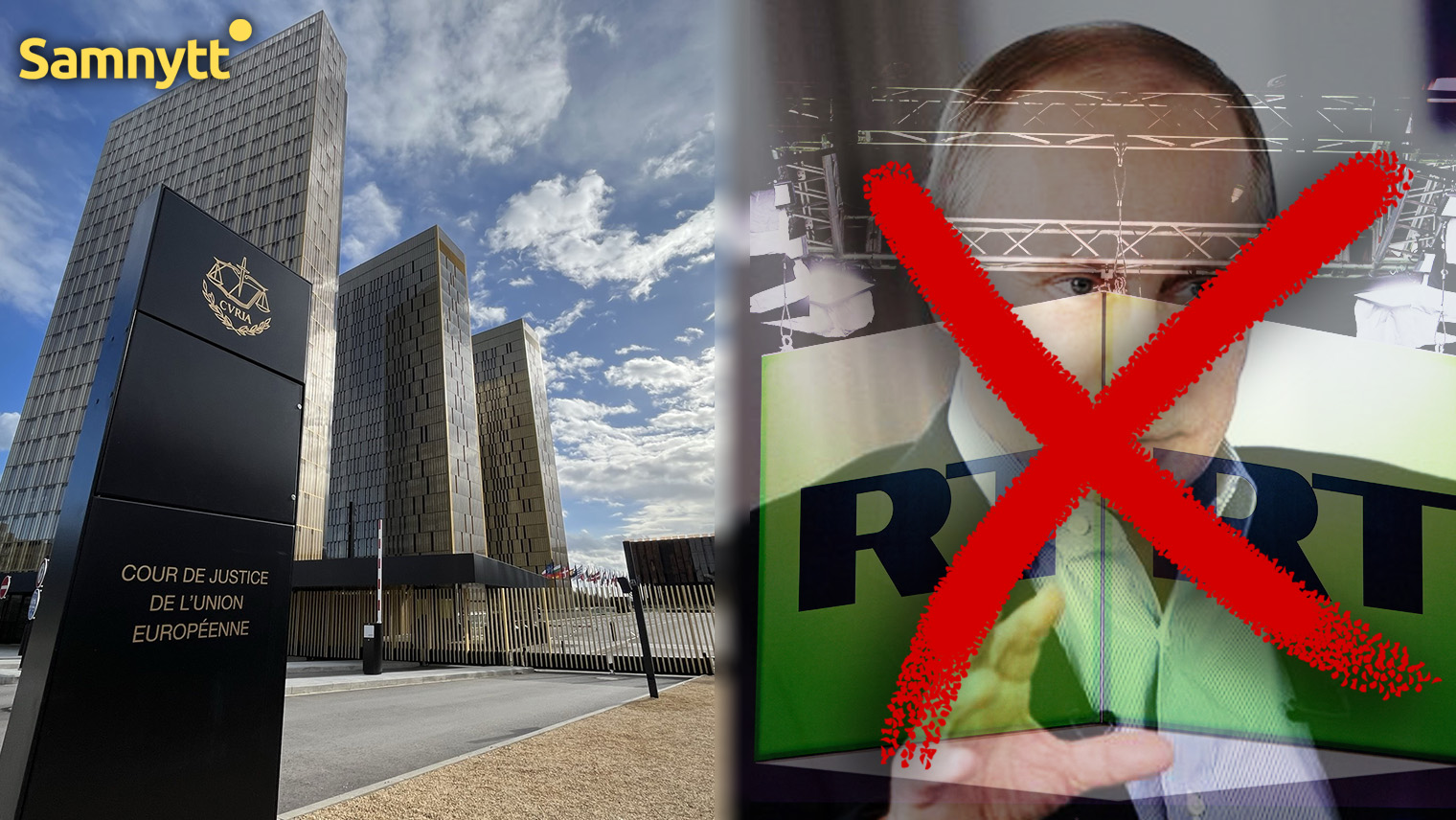
The Court of Justice of the European Union (CJEU) has ruled that the EU’s ban on distributing content from the Russian state channel Russia Today (RT) does not only apply to media companies and commercial actors. Private individuals who publish their material on publicly accessible websites can also fall under the sanctions and may face criminal consequences. The ruling raises questions about the balance between sanctions against state propaganda and the protection of freedom of expression and information.
The background is a German case, where three people in Germany are on trial after repeatedly publishing videos from RT’s German-language channel on a website that was freely accessible to the public.
The German court requested a preliminary ruling from the CJEU to clarify whether people running a donation-funded website without a profit motive can be considered “operators” under the EU’s sanctions regulations.
Profit Motive Is Irrelevant
The CJEU states that it does not matter whether the dissemination is carried out as part of a commercial activity or not. The term “operator” should, according to the court, be interpreted broadly and covers any person who directly or indirectly makes the prohibited journalistic content available to the public. This also applies to non-profit websites funded by voluntary donations.
READ ALSO: Russia Today remains censored in the EU
The court also declares that the assessment is not affected by the extent or duration of the publication. According to the judges, such a broad interpretation is necessary to achieve the purpose of the EU’s censorship sanctions against what is considered Russian state propaganda following the invasion of Ukraine.
Part of the EU’s Sanctions Package
In a supranational censorship decision already in spring 2022, the EU banned the broadcasting and distribution of RT and several other Russian state-controlled media as part of the sanctions imposed after Russia’s invasion of Ukraine.
READ ALSO: Norway does not censor Russian media channels: “Freedom of speech stands strong”
In the present ruling, the CJEU emphasizes that the censorship aims to prevent the spread of propaganda from Russian state media. Accordingly, the intent is to protect public order and security within the union.
Raises Debate on Freedom of Expression
The ruling means that the responsibility to comply with the sanctions is no longer limited to traditional media houses or platform companies. Censorship now also covers private individuals who choose to publish RT material on websites.
READ ALSO: New law: Half a million in fines for those who spread Russian media
The decision means that the EU criminalizes the dissemination of certain media content, regardless of content and context. The censorship is justified by the fact that these are sanctions targeting a state-controlled propaganda network from a country waging an aggressive war against a European neighbor.
The Ukrainian publication United24 Media has reported on the ruling, describing it as a clarification that the EU’s pan-European censorship decision banning RT content applies generally and is not affected by whether the publication is non-profit or of limited scope.
- The ban on distributing RT’s content also applies to non-profit and donation-funded websites.
- Private individuals may be subject to the rules if they make the content accessible to the public.
- Profit motive is not decisive.
- Neither the extent nor the duration of publication affects the assessment.
- The stated purpose is to stop Russian state propaganda and protect public order and security within the EU.
The information in this article is based on reporting from the Ukrainian United24 Media as well as the CJEU’s press release on case C-67/25.