A professor resigns from the Ethics Council of the Migration Agency and describes the Tidö parties’ more consistent migration policy as “inhuman.” At the same time, a backlash is growing against how the debate is conducted, with voices warning that anecdotal, emotional stories—especially in the media—mislead voters.
Ludvig Beckman, Professor of Political Science at Stockholm University, is prematurely leaving his role on the Migration Agency’s Ethics Council. He has served there since 2019, but announced this week that he no longer wants to continue.
– I cannot legitimize the deportation of 18-year-olds who have grown up here and whose parents live here, he told DN.
READ ALSO: C-top politician’s outcry for immigrants facing deportation: “Who is Swedish?”
Beckman argues that the tightened rules now being applied mark a direction which he believes no longer fits what he regards as acceptable in a rule-of-law state. He refers, among other things, to phrasing in the Swedish constitution regarding respect for individual dignity.
The resignation comes at a time when cases involving young adults—who were previously covered by their parents’ permits but have now turned 18—have received significant attention. The Tidö parties have wanted to clean up the patchwork of exceptions so residence permit rules are applied more consistently.
At the same time, the Tidö government has faced criticism after statistics showed that, contrary to announcements, deportations during the current term have actually decreased rather than increased.
A council with a clear profile
The Ethics Council consists of six members with backgrounds in academia, the church, and civil society. Several come from environments that have long argued for more generous rules, such as the Swedish Red Cross, the Church of Sweden, and the Department of Political Science at the University of Gothenburg.
READ ALSO: Inside the Migration Agency: Clans, Swedes in minority, and a culture of silence
Fredrik Beckman has previously positioned himself as radical-left in migration issues, among other things. In an interview with the far-left magazine ETC , he has said that when what he calls “far-right” politicians speak about democracy, they are “kidnapping” the concept.
S-profile: Media dumbs down
On social media, the resignation has drawn rebuttal. Social Democrat profile Widar Andersson refers to a piece by former SR employee Jörgen Huitfeldt, now at Kvartal, and calls media coverage “dumbing down.”
“The governments do not want to deport ‘teenagers’ but people without residence permits. In the same way, you don’t want to imprison ‘children’ but murderers. But the media is stuck in a dumbed-down mode,” he writes.
Huitfeldt says it as it is now as before. The governments don’t want to deport ‘teenagers’ but people without residence permits. In the same way, you don’t want to imprison ‘children’ but murderers. But the media is stuck in dumbing-down methods. https://t.co/Gn6BLNh9KR
— widar andersson (@widarandersson) February 12, 2026
This formulation sums up the criticism that has been growing regarding how part of the reporting, through word choice, diverts attention from the core legal question—whether a person has the right to reside in the country or not.
In the much-noted column, Huitfeldt argues that the Swedish migration debate risks sliding back to a position where individual, touching cases are constantly put against a legal framework that must be general to be predictable.
The point is not that these cases lack human gravity, but that politics—if it is to be legally certain—cannot change from one day to the next depending on which sob story is getting the most attention at the moment. A government that has promised stricter rules, according to that reasoning, must also accept that the application will sometimes feel harsh, Huitfeldt argues.
Differing opinions on the “safety valve”
At the same time, both opposition parties and voices within the government coalition are pushing for some sort of transitional rules and continued exceptions—often referred to as a “safety valve”—to mitigate and delay the enforcement of rules when youths turn 18 and become adults.
The Swedish Migration Agency from the inside
Don’t miss Samnytt’s article series on the Migration Agency:
-
▶ Part 1 – Inside the Migration Agency: Clans, Swedes in minority, and a culture of silence
-
▶ Part 2 – Testimonies from inside the Migration Agency: “The Tidö government is the enemy”
-
▶ Part 3 – Voices from the Migration Agency: “It’s not just corruption—it’s serious crime”
-
▶ Part 4 – Migration Agency refuses to answer Samnytt—dismisses staff testimonies and denies interview
The Social Democrats have now performed a U-turn, demanding an interim halt to deportations while awaiting new decisions, in contrast to the party’s previous support for reforms that abolished exceptions for so-called exceptionally distressing cases. Even local Christian Democrat representatives have voiced concern, citing “Christian values.”
The government continues to stress that the regulations must be both restrictive and reasonable, but that existing law must be carried out until new decisions are made. Introducing a “safety valve” is not on the agenda.
Support from activists
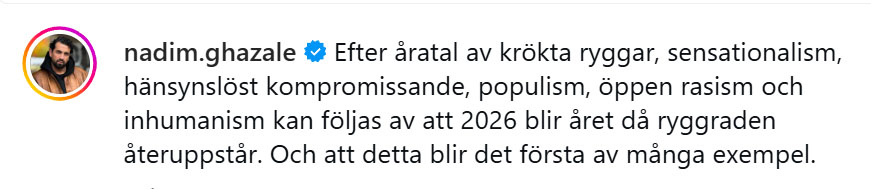
At the same time, Beckman is receiving support from, among others, the outspoken SD-critic and former police officer Nadim Ghazale, who on Instagram describes the situation as a “possible awakening” after years of what he calls “compromises and inhumanity.”
READ ALSO: Municipality arranged lectures with SD-critic Nadim Ghazale—costing nearly 90,000 kronor