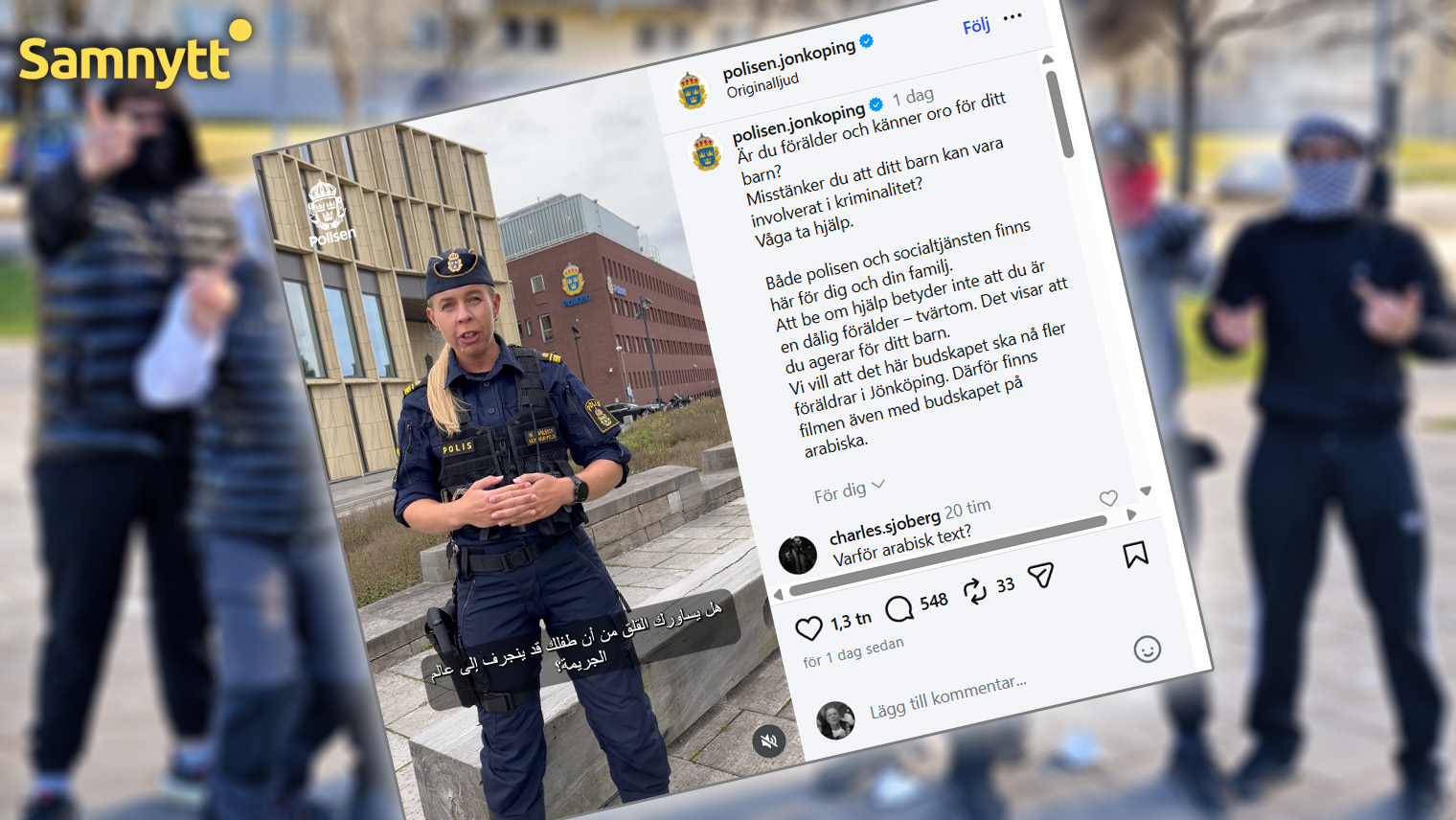
The police in Jönköping want to encourage more parents to seek help if they suspect their children are being drawn into criminality. However, when the authorities published an informational video with Arabic subtitles, the reactions were many—and far from all were positive. In the comments section, both the language choice and what it says about integration in Sweden are questioned.
The recruitment of children and young people into serious crime is a growing societal problem. In recent years, the police have therefore intensified efforts to reach out to parents and other adults who can spot warning signs before it’s too late.
In Jönköping, the police have now published a film on social media where parents are urged to take action if they suspect their child has come into contact with criminal circles. The message is that parents should not hesitate to contact the police or social services for support.
“Asking for help does not mean you are a bad parent—on the contrary. It shows that you are acting in your child’s best interest,” the police write in connection with the film.
READ ALSO: Police’s new Arabic campaign: ‘Do not sell or lend out your Swedish passport’
But it is above all another part of the post that has attracted attention.
“We want this message to reach more parents in Jönköping. That’s why the film also has the message in Arabic,” the police explain.
Arabic Raises Questions
The choice of language has sparked extensive debate in the comments sections. Many react to the fact that the police feel the need to communicate with parents in a Swedish city in Arabic.
“Why Arabic text?” wonders one commenter.
“Why Arabic specifically?” asks another.
Others settle for shorter and more mocking comments, while several connect the initiative to Swedish migration and integration policy.
“A frightening development,” writes one person.
Another notes that the police seem to realize there is a connection between youth crime and the choice of Arabic as the information language. Others go so far as to demand repatriation.
There are also comments expressing appreciation for the police initiative, including emojis such as hearts and applause.
The reactions are not limited to Swedish users either. There are several comments in Norwegian and English, suggesting the film has spread beyond Sweden’s borders.
What Does the Language Choice Say about Integration?
Behind many of the critical comments lies a broader question about integration in Sweden. If the authorities judge that there are parents who, after a long time in the country, still cannot absorb vital information in Swedish, it raises questions about how well linguistic integration has worked.
At the same time, the choice of Arabic raises another, more sensitive question. Have the police concluded that Arabic-speaking parents are a particularly important target group when it comes to preventing children from being drawn into crime? Or is it simply about reaching more people in a language many can understand?
These are two separate issues. That a group needs targeted information efforts does not necessarily mean their children are more prone to crime than others. It could also be about language skills, lacking knowledge of Swedish authorities, or a need to build trust in the police and social services.
At the same time, it is an established fact that serious organized gang crime is predominantly immigrant-dominated. However, it is not only Arabic speakers involved—there are also many who speak Somali, Dari, Pashto, and Swahili. The current post does not provide any further explanation as to why Arabic has been chosen.
Other Police Districts Provide Information in Nine Languages
The police using other languages than Swedish in crime prevention is nothing unique in new multicultural Sweden. For example, the police in Västerbotten have produced an informational film on how children and young people are recruited into criminal networks.
There, a much broader language approach has been chosen. The film is subtitled in Swedish, English, Arabic, Farsi, Russian, Somali, Swahili, Tigrinya, and Ukrainian. The national information material Gängsnacket, aimed at parents and other adults, has also been translated into nine languages.
Want Parents to Dare to Contact Authorities
Regardless of language choice, the underlying problem is serious. Criminal networks use ever younger children to commit crimes, sometimes very serious ones. Recruitment often takes place via social media and encrypted messaging services—and often in languages other than Swedish, as the target group seldom has a Swedish background.
The police stress in their national information that parents should be alert to changes in children’s behavior. For example, new and older acquaintances, unexplained money, multiple mobile phones, or secretive communication. The authorities also stress the importance of adults acting early and not trying to handle the situation on their own.
For families whose children have already come into contact with criminal networks, the situation can also involve threats and fear. Seeking help may therefore feel like a difficult step. It is this threshold the Jönköping police say they want to lower.
But while the message of protecting children from criminality is hardly controversial, the specific choice to communicate it in Arabic has sparked a debate that goes far beyond the police’s original call.
The remaining question is whether the choice of language is based on a concrete local problem within the Arabic-speaking community, an assessment of which parents are hardest to reach, or simply a general ambition to make the information available to more people. The police have not yet explained this in the current post.
READ ALSO: Police launches campaign in Arabic