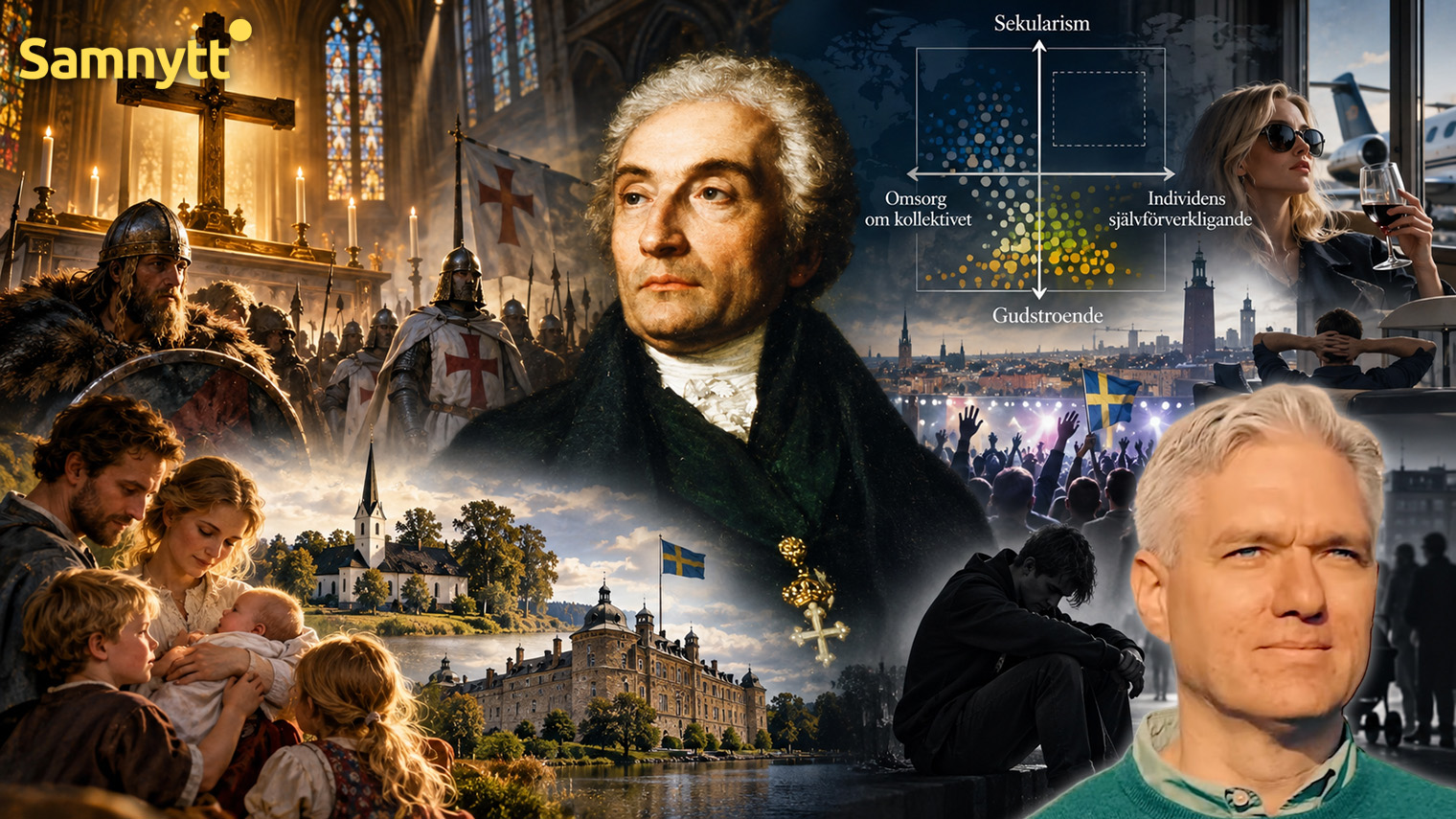
DEBATE • The title is a rewording of the French political philosopher Joseph de Maistre’s phrase Partout où vous verrez un autel, là se trouve la civilisation. In Swedish, this roughly becomes “Wherever you see an altar, there you find civilization.” For the secular Swede, of course, this is a preposterous claim. We don’t need religion, we have democracy! That is the height of civilization!
Perhaps we still have civilization, even though more and more people believe that mass democracy actually foreshadows the end of civilization. President John Adams claimed that all democracies commit suicide. If we assume that we still have civilization, we ought at least to ask ourselves for how much longer.
Let’s climb down from our high secular-democratic horses for a moment and humble ourselves a little. Is there something in de Maistre’s words? What connection did he mean existed between the altar and civilization? How, if at all, is that relevant for us today?
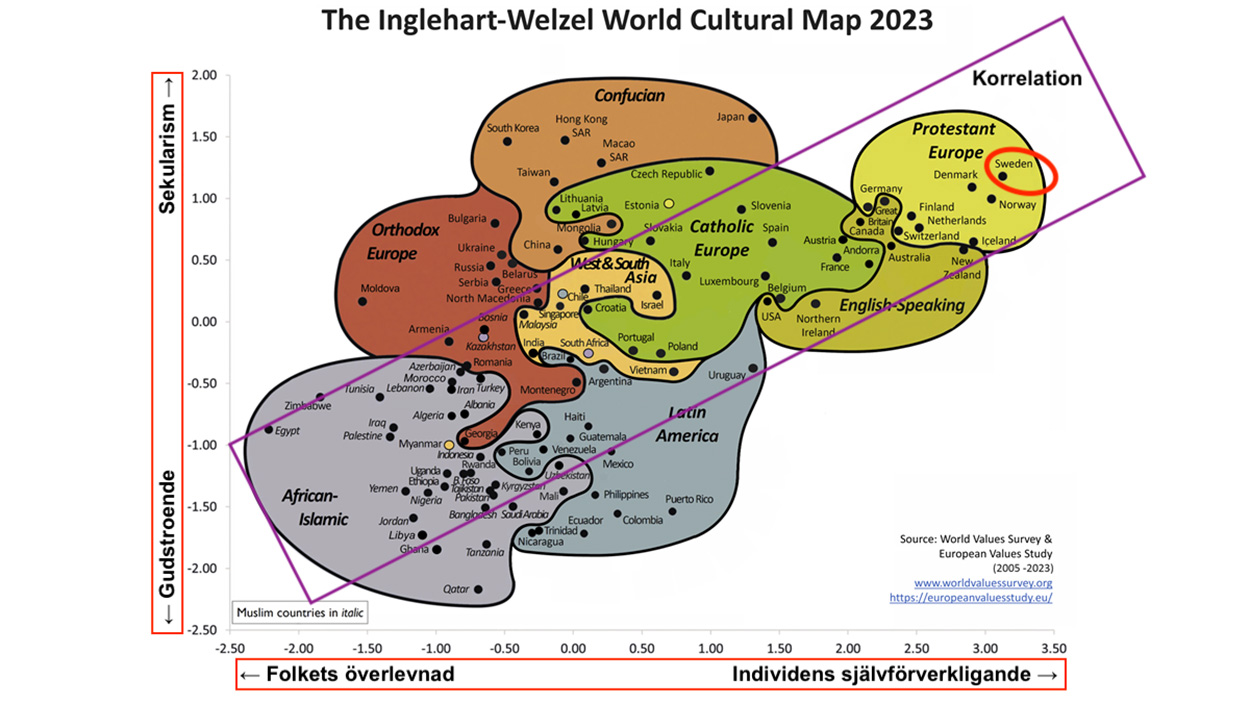
The Inglehart-Welzel Cultural Map is well known. It shows the values of the people of the world’s nations in a two-dimensional diagram. On the horizontal x-axis is collective concern versus individual self-fulfillment. On the vertical y-axis is secularism versus religiosity.
The Correlation Between Religion and National Strength
Some time ago I noticed something I hadn’t thought about before: x and y are not independent variables but are correlated! This is visible, among other things, by the empty fourth quadrant, the space down to the right. Religious nations are not particularly preoccupied with the kind of navel-gazing and self-fulfillment that occupies people’s minds in Sweden.
But even more interesting for this discussion is the similarly empty second quadrant, the area at the top left. Secular nations lack concern for their own people! They don’t care if the people go under as long as they can travel, renovate the bathroom, and sip fine wines. This is exactly what Joseph de Maistre claims. Without religion, no civilization. Firstly, civilization cannot arise without a unifying religion. And once civilization manages to arise and the religion is then abolished, it soon collapses in materialism, egoism, and falling birth rates.
Yes, yes, of course, correlation does not automatically mean causation. That is, the diagram does not prove that secularism causes a lack of interest in the survival of the people. Still, I claim that there is a strong causal connection.
Three Examples of How Secularism Weakens the Nation
The willingness to sacrifice, and even give one’s life, for higher goals is strong in a religious society. Promises of Valhalla, heaven, or 70 virgins have motivated crusaders, Vikings, and Muslims to sacrifice their own lives for their people and their beliefs. Nothing ventured, nothing gained. Without men willing to take great risks, the enemy cannot be kept at bay and no civilization can be built. In secular society, the battles are fought in Eurovision, on sports arenas, or with the keyboard. The truly tough at most risk their soul-destroying office jobs.
A common religion is a unifying force, much stronger than occasionally gathering at Sergels torg to shout for Tre Kronor’s bronze medal. A religion means shared values, a sense that we belong together, that our society is better than others, and that we must stick together to protect it from a dangerous world. Unity is strength, diversity is folly and weakness. Hostile conflict ideologies such as feminism and socialism struggle to gain interest.
Birth rates are higher in religious societies. Men love their women, women love their men, and parents love their children. In the secular society, children in daycare and school learn about all sorts of technical means to “safely” enjoy themselves without risking pregnancy or chlamydia. If “accidents” still happen, the taxpayers pay for the solution. In the religious society, young people learn that life is sacred, a large family is the start of your own dynasty, security, and power. Low birth rates mean with mathematical certainty the downfall of civilization.
This Applies to Sweden Too
Democracy in the Western world may have assumed religious forms, but as a substitute religion it is weak. It seems to divide rather than unite. Nor does it create the patriotism needed to muster the will to risk one’s life for the people and the nation. If Joseph de Maistre is right, there is only one way to return Sweden to the homogeneous, secure, and prosperous country it once was: by returning to the Christian foundation on which the country was built.
Klaus Bernpaintner
Article originally published at Folkungen.