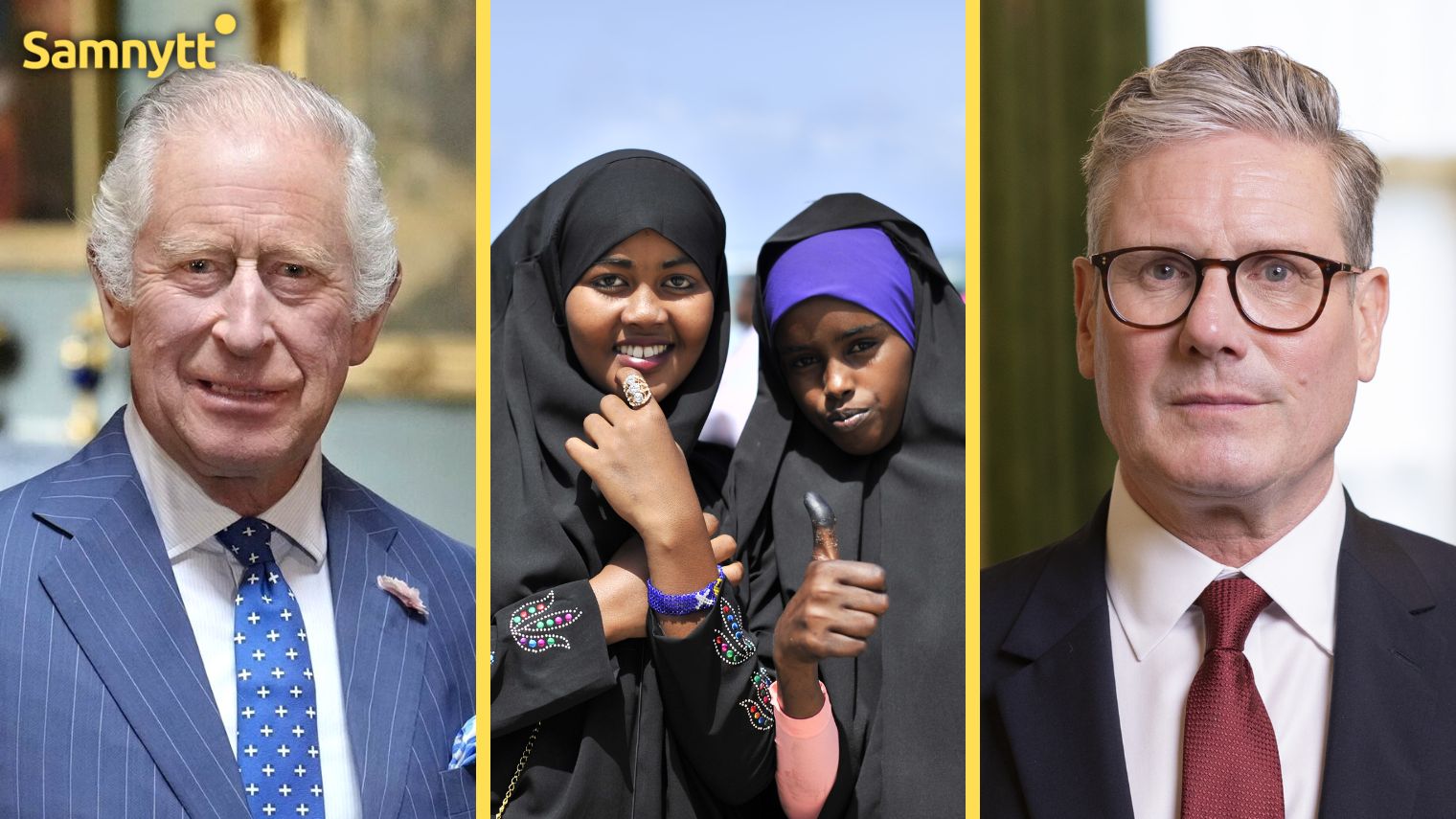
While the influx of illegal migrants continues to be permitted in the UK, and the country spirals ever deeper into ruin, the Social Democratic government has announced the opening of new legal pathways into the country for asylum seekers. At the same time, the King is given a new role focused on the country’s increasingly diluted culture.
Both announcements come at a time when immigration continues to dominate the political agenda, with issues of national identity, integration, and social cohesion among the most hotly debated in the country.
The government has announced a new program under which local organizations, universities, and employers will be able to sponsor refugees for resettlement in the UK. The model is based on a system already used in Canada and aims to create more legal pathways for people in need of protection.
At the same time, the government promises tougher actions against illegal immigration. The ability to halt deportations with reference to the European Convention will be limited, the rules for family reunification will be tightened, and the focus will be on reducing the recurring migrant crossings over the English Channel.
READ ALSO: Revealing Report on the Scandal of Rape Gangs
But while the government speaks of tougher borders, another shift is occurring at the institutional level. A new description of King Charles III’s role stipulates that the monarch should “protect the space for faith in the multi-religious nation,” a wording that more explicitly than before acknowledges the demographic developments that have shaped Britain over recent decades.
Charles has long signaled that he sees his role as broader than merely being the protector of the Church of England. The new formulation does not change the monarch’s constitutional position but signals that the royal family is adapting its message to a country where Islam, Hinduism, Sikhism, and other religions have gained significantly more presence through immigration and demographic change.
Mass Immigration
The UK has long seen significant immigration, with net migration in recent years reaching historic highs. This has made migration one of the most polarizing issues in British politics and a key driver behind both Brexit and recurring calls for stricter border controls.
The government is now attempting to reconcile two objectives that many experts see as difficult to combine: reducing uncontrolled migration while opening more legal avenues for those seeking protection.
Meanwhile, the royal family signals that the British monarchy is to represent a society whose religious composition has fundamentally changed. For supporters, this is a natural acknowledgment of today’s Britain. Critics, on the other hand, argue that the trend illustrates how some of the country’s oldest institutions are gradually adapting to the demographic changes brought about by long-term immigration.
Prison for Those Responsible
At the same time, support for Nigel Farage and his Reform UK party continues to grow. Rupert Lowe and Restore Britain are also thriving. Lowe goes even further than Farage in his assessments of what it will take to restore the country and how those who enabled these developments should be treated.
It has now reached the point where I truly believe that public officials and politicians who continue to knowingly import third world savages into our communities should be prosecuted.
It is that reckless, that irresponsible, that dangerous.
People need to go to prison.
— Rupert Lowe MP (@RupertLowe10) June 27, 2026
The inability to deal with the massive illegal immigration and its consequences is one of the reasons why Prime Minister Keir Starmer is extremely unpopular and was recently forced to resign.
Immigration to the United Kingdom
After World War II, immigration to the United Kingdom was for a long time relatively limited and came primarily from countries within the former British Empire and Commonwealth, such as India, Pakistan, and the Caribbean. From the 1990s, immigration gradually increased, and after the EU’s eastern expansion in 2004, labor migration surged from Poland, Romania, and Lithuania, among others. Since Brexit, immigration from the EU has decreased, while the number of migrants from non-European countries has risen sharply.
In recent years, the UK has seen the highest net immigration in modern times. In 2023, net immigration totaled around 906,000 people, after a record high of about 906,000 also in 2022 according to revised figures.
The majority of immigration now comes from countries such as India, Nigeria, Pakistan, China, Ukraine, and Hong Kong, with many granted work, study, or humanitarian visas. At the same time, it is estimated that about eleven million residents — roughly 16 percent of the population — were born abroad.
Meanwhile, illegal immigration is becoming an ever-larger political issue. Particularly noteworthy are the thousands of migrants who cross the English Channel every year in small boats from France.
In 2025, over 36,000 such arrivals were registered, while estimates of the total number of people residing illegally in the country range from about 700,000 to over a million. The combination of record-high legal immigration and increasing illegal migration has made migration policy one of the most hotly debated issues in British politics.
READ ALSO: Ekeroth: “The UK is a very sick country”