Every year, the Swedish Psychological Defence Agency (Myndigheten för psykologiskt försvar, MPF) measures the willingness among Sweden’s inhabitants to defend their country. Support for Sweden’s military defence is at record high levels, but the willingness to defend is declining. At the same time, it is claimed that migrants have at least as high a willingness to defend as native Swedes.
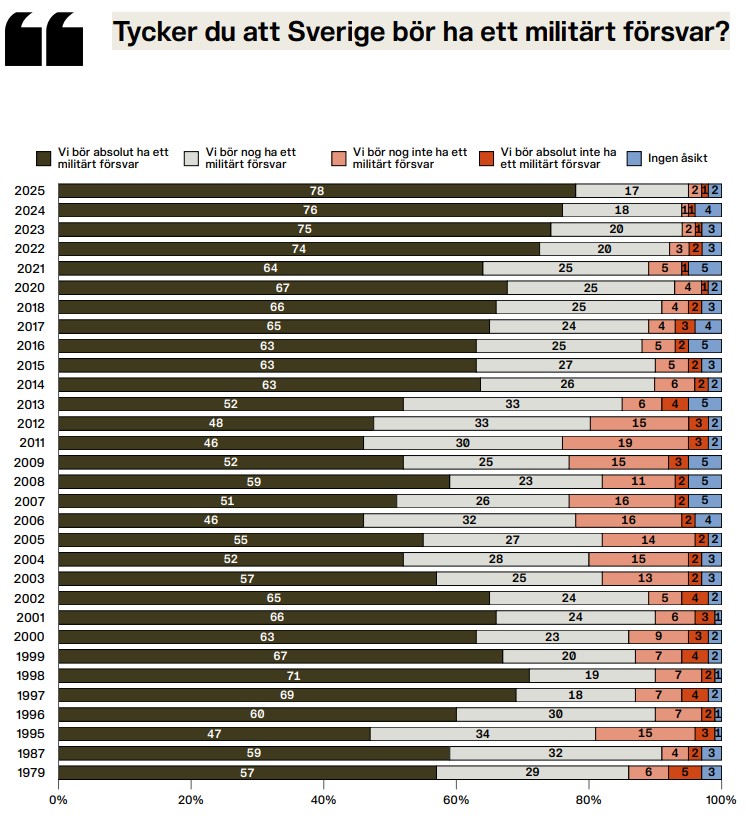
This is highlighted in the annual Opinioner survey, where MPF sheds light on the public’s views on defence, security, and influence. This year’s survey shows that support for Sweden’s military defence is the strongest since these measurements began.
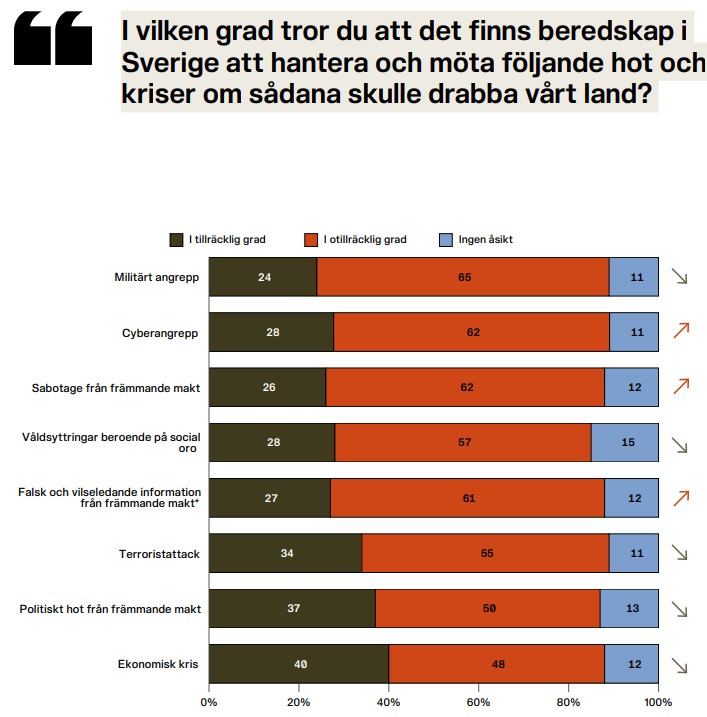
Russia is singled out as the greatest threat—84 percent of respondents believe that the country poses a threat to peace and security. The survey also shows a sharply increased concern over a military attack on Sweden. Fifteen years ago, only one percent saw this as likely; today, a fifth believe it is very or quite likely that a military attack will occur against Sweden within the next five years.
READ ALSO: MSB: The Swedish Willingness to Defend Is Too Low
“Sweden’s security environment has become significantly worse, with both Russian warfare in our region and increased geopolitical tensions :censored:6:cdd6bbaa89:ly. This is also reflected in our survey, where we see rising anxiety, but also record-high support for Sweden’s defence. It’s pleasing to see that support for Sweden’s backing of Ukraine remains strong,” says Magnus Hjort, Director General of the Psychological Defence Agency.
At the same time, there is a trend of somewhat reduced willingness to defend, as the share of respondents willing to defend Sweden at the risk of their own lives has decreased from 69 percent in 2024 to 65 percent in 2025.
Young People and Women Least Willing to Defend
It is primarily young people and women who are less willing to participate in various total defence tasks if it involves risking their own lives, while men are much more willing to defend. Meanwhile, 81 percent are positive about participating in total defence based on their abilities and skills when it does not involve risking their own lives.
According to Hjort, strengthening the willingness to defend is not only about increasing preparedness for external threats, but also about increasing knowledge and awareness, fostering participation and responsibility, and maintaining high trust in society.
“Even if we see a certain decline in willingness to defend, it still remains high. But we need to be aware that low willingness risks undermining both the practical ability to handle crises and the psychological resilience of society. If the willingness to defend is low, there is, for example, a risk that society becomes more susceptible to information influence by foreign actors aiming to create distrust, fear, or paralysis. A population that does not believe in its own ability to defend itself is simply easier to manipulate,” says Magnus Hjort.
READ ALSO: Immigrants: We Have Made Sweden Better
This year, for the first time, questions were asked about the public’s view on the extent to which various hostile actors have influenced the population through false and misleading information. Half believe that false and misleading information from Russia has affected Sweden’s population in the past year. At the same time, there is concern that artificial intelligence will continue to contribute to the spread of disinformation.
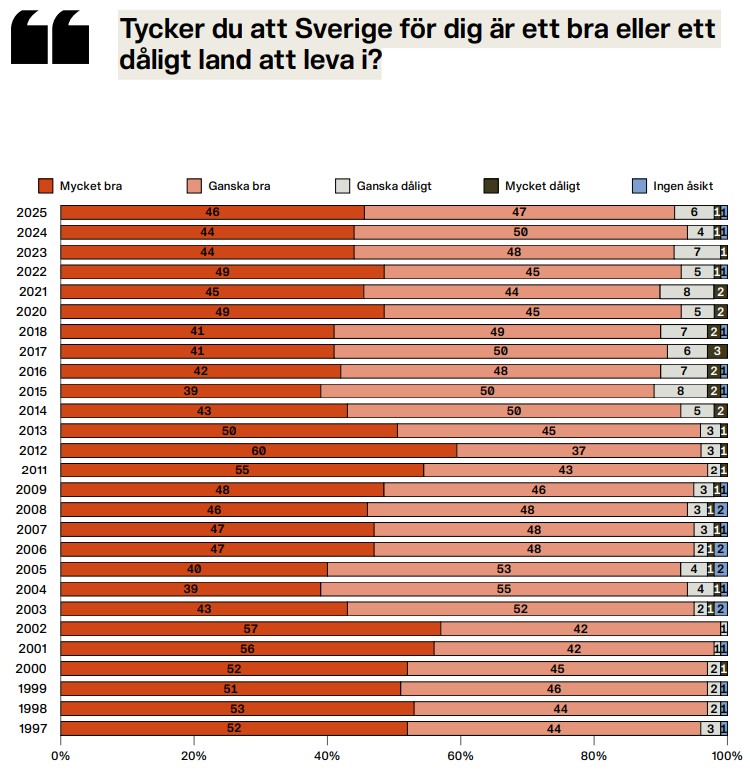
An overwhelming majority, 93 percent, believe that Sweden is a good country to live in. Meanwhile, 39 percent believe that Sweden will be a worse place to live in five years’ time. The main concerns are crime and developments in Russia.
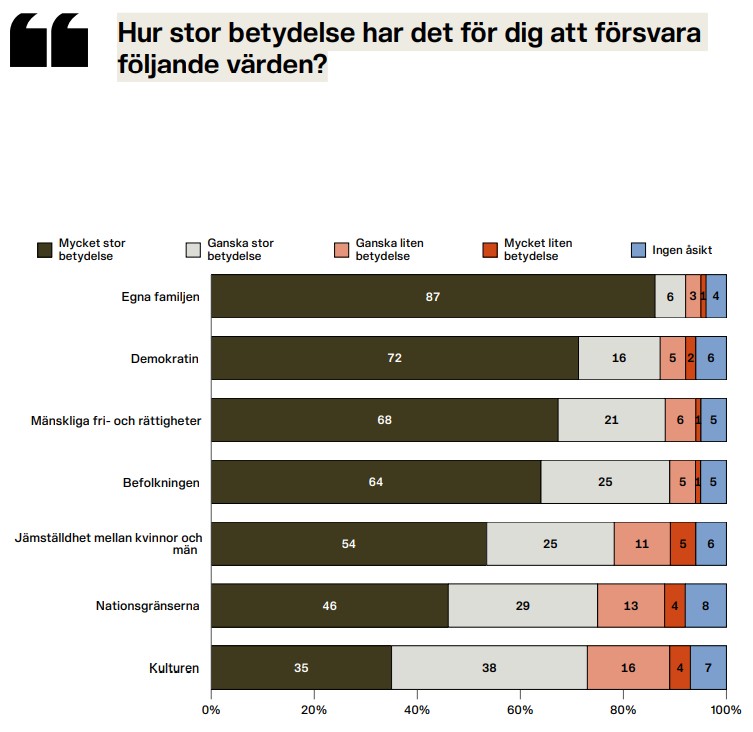
52 percent believe that an increased number of asylum seekers in Sweden has a negative impact on peace and security in Sweden. When it comes to which values are most important to defend, Swedish culture is ranked the lowest.
Meanwhile, trust in the ability to handle various types of crises is low:
Willingness to Defend Among Migrants
A new report from Järvaveckan, which works to promote diversity, is said to show that residents in Sweden’s so-called vulnerable areas have a willingness to defend equal to the rest of the population.
At the same time, the report shows that willingness to defend is highest among people born outside Europe. In this group, nearly six out of ten say they are very or fairly willing to participate in a combat role for Sweden’s defence—even at the risk of their own lives—a higher share than among Swedish-born in vulnerable areas and in the rest of Sweden (43% and 48%, respectively).
“The results challenge several persistent assumptions about willingness to defend and civic engagement in vulnerable areas and among foreign-born residents. There is strong engagement for Sweden’s defence even in groups that are often described in simplified or one-sided ways in public debate,” says Järvaveckan’s CEO Ahmed Abdirahman.
READ ALSO: Willingness to Defend Sweden Low Among Migrants
A 2024 survey found the opposite—that residents in “vulnerable areas” showed a much lower willingness to defend. Previous surveys from the Swedish Defence Recruitment Agency have also shown that the willingness to defend among those with non-Nordic backgrounds is lower.

READ ALSO: SD Men Most Likely to Defend Sweden in War