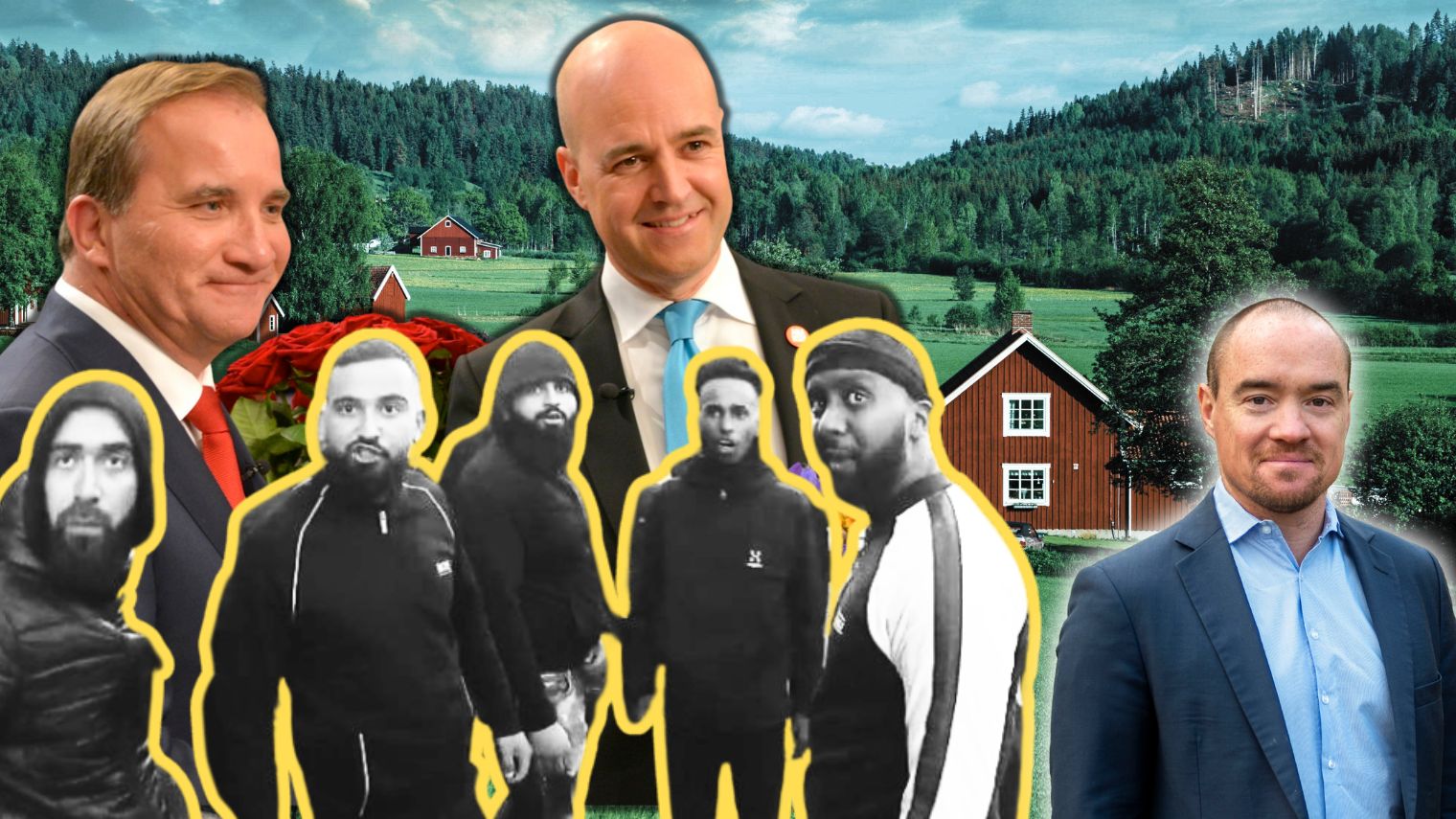
EDITORIAL • A country with thousands of years of history, with a unique culture that has given rise to a peaceful and successful people, possessing a unique language and managing a beautiful land in such a way that its nature, purity, and beauty have been preserved – should all this, and much more, be put at risk for what a handful of despicable politicians and journalists, during a very short period of the country’s history, have done?
The answer is, of course, no.
For a long time, Sweden was something unusual in the world. A country on the edge of Europe that managed to combine freedom with order, prosperity with responsibility, and individualism with community. Here, generations grew up in safety, with trust in each other and society. This trust has been described in science as unique – and fragile. Doors stood unlocked, children walked to school alone, and conflicts were resolved with words rather than violence. It wasn’t a perfect country – but it was a functioning one, built on shared norms, a common language, and a deeply rooted sense of responsibility for the whole.
Nature was not something one escaped to, but something people lived in harmony with. Forests, lakes, and mountains were managed carefully, not as political symbols but as a matter of course. Clean air, pure water, and order in public spaces were not things people needed to campaign for – they were part of the culture. Industry grew without destroying the landscape; the education system fostered knowledgeable and independent people, and welfare was built with a focus on work, duty, and long-term thinking rather than rights without obligations.
This was not a paradise in the fairytale sense, but it was a society characterized by stability, honesty, and predictability. A homogeneous people with a strong collective identity, where differences existed but were united by something greater. A country that cared for its weak without descending into total irresponsibility, that saw education as an investment and work as a virtue. And it wasn’t that long ago.
The abuse of Swedish mentality
Sweden could have been a paradise. Simply put. That is something I myself pointed out in the Swedish Parliament many years ago. But then a handful of opinion-makers took over – weak, cowardly, and intellectually lightweight politicians and journalists – and in less than three decades, they managed to destroy what had been built up over millennia. Crucial decisions were made without genuine popular support, without open consequence analysis, and without honest debate.
Surely, Swedes bear responsibility. They voted, time and again, for those who pushed this development forward. That responsibility can’t be escaped. But the political and media clique that formulated the decisions and managed the propaganda did so by systematically exploiting those very cultural traits that once made Sweden strong: trust, sense of duty, and the desire to do what’s right.
It was the fear of conflict and trust that were exploited. Naivety. Conformity. The fear of being different, of being pointed out, of being excluded. The Swede’s caution toward change – and reluctance to fight when a fight was needed – were ruthlessly abused. What were once virtues became tools for decay.
Sweden is being taken from its own people
After nearly half a century of this abusive policy against the Swedish people, we have witnessed the country being taken from its own inhabitants – bit by bit, day by day. It is taken from them already at the schoolyard, where immigrant gangs fight, threaten, and set the agenda. It is taken from them in streets and squares through violence, robbery, and rapes, but also through the occupation of the public space – when demonstrations, riots, or mass prayers make it clear who is expected to adapt to whom.
It is taken from Swedes through mass immigration that systematically erodes the resources built up for themselves. Healthcare queues grow longer, elderly care is strained, school resources are shifted to compensate for extensive deficiencies among newcomers, while illegal immigrants are offered benefits that many working Swedes themselves have to pay dearly for. Allowances, subsidies, and transfers have created a parallel welfare system – one that is practically funded by those who lose the most from this development.
READ ALSO: Ekeroth: Revoke the right to vote before it’s too late
Even the opportunity to democratically regain control has gradually been dismantled. Today, around 600,000 non-citizens are allowed to vote in municipal and regional elections. In addition, all those who have quickly been granted citizenship and thus voting rights also in the parliament – a system where clan voting and group mobilization have become a reality. The result is that political power is increasingly shaped by people without historical, cultural, or loyalty-based anchoring in the country.
The Migration Agency – an enemy of the people
Beyond the democratic mechanisms that have already been undermined, a central government agency – the Migration Agency – has been transformed into its own bastion, where loyalties and internal logic increasingly determine who is granted citizenship and thus political influence.
According to testimonies from employees at the agency, the Swedish majority within the organization has increasingly been replaced by staff with other backgrounds, many without Swedish citizenship, who in practice speak their own languages and organize themselves in internal groups and clans. Decisions concerning residence permits, work permits, and citizenship – decisions that ultimately decide who may stay in Sweden and who may vote – are made in a culture where language affiliation and group loyalty replace loyalty to legislation and legal certainty.
The Migration Agency has in reality become an enemy to its own people. This is one of many reasons why we should completely disregard citizenships handed out – and consider all those issued over the past 30 years as entirely subject to review.
READ ALSO: The inside of the Migration Agency: Clans, Swedes in the minority, and a culture of silence
Sweden has now received so many immigrants – both with and without citizenship – that the question is no longer simple: does the Swede even have the possibility to vote to save their own country?
Nothing is sacred
With all this in mind, the question must therefore be asked: why should a Swede today accept what a handful of despicable politicians did one, ten, or forty years ago? Why should today’s Swedes have to quietly bear the consequences of decisions made by Olof Palme, Ingvar Carlsson, Carl Bildt, Göran Persson, Fredrik Reinfeldt, and other leaders – decisions over which they themselves never had any real influence?
The fact is, there is no such obligation. We are not required to accept what they have done, what their policies have led to, or what Swedish authorities under their governance have caused. We can completely reject the entire development. We don’t have to accept a single consequence that we ourselves do not consider legitimate. In reality, nothing is sacred.
If Swedes had only had enough damn resolve, we could have decided to revoke, for example, a million citizenships from people we do not consider belong here. That applies whether they are naturalized – that is, granted citizenship by the state – or born in Sweden to parents who were themselves naturalized.
Objections will be immediate. That it would be unfair, legally unsafe, that it violates conventions, laws, human rights, the UN, the EU, and other international commitments. In a longer historical perspective, however, these arguments appear less decisive. Drastic measures of this kind constitute, over time, a very limited part of societal development. They would undoubtedly provoke criticism, possibly strong reactions, and could bring political or economic consequences, as well as increased tensions domestically and in relations with the outside world.
Even so, the measures can be considered defensible from an overriding societal interest. With current trends, the Sweden that was built over generations risks being lost – and replaced with the kind of insecurity and social misery that many once came here to escape.
READ ALSO: With mass immigration comes clan voting