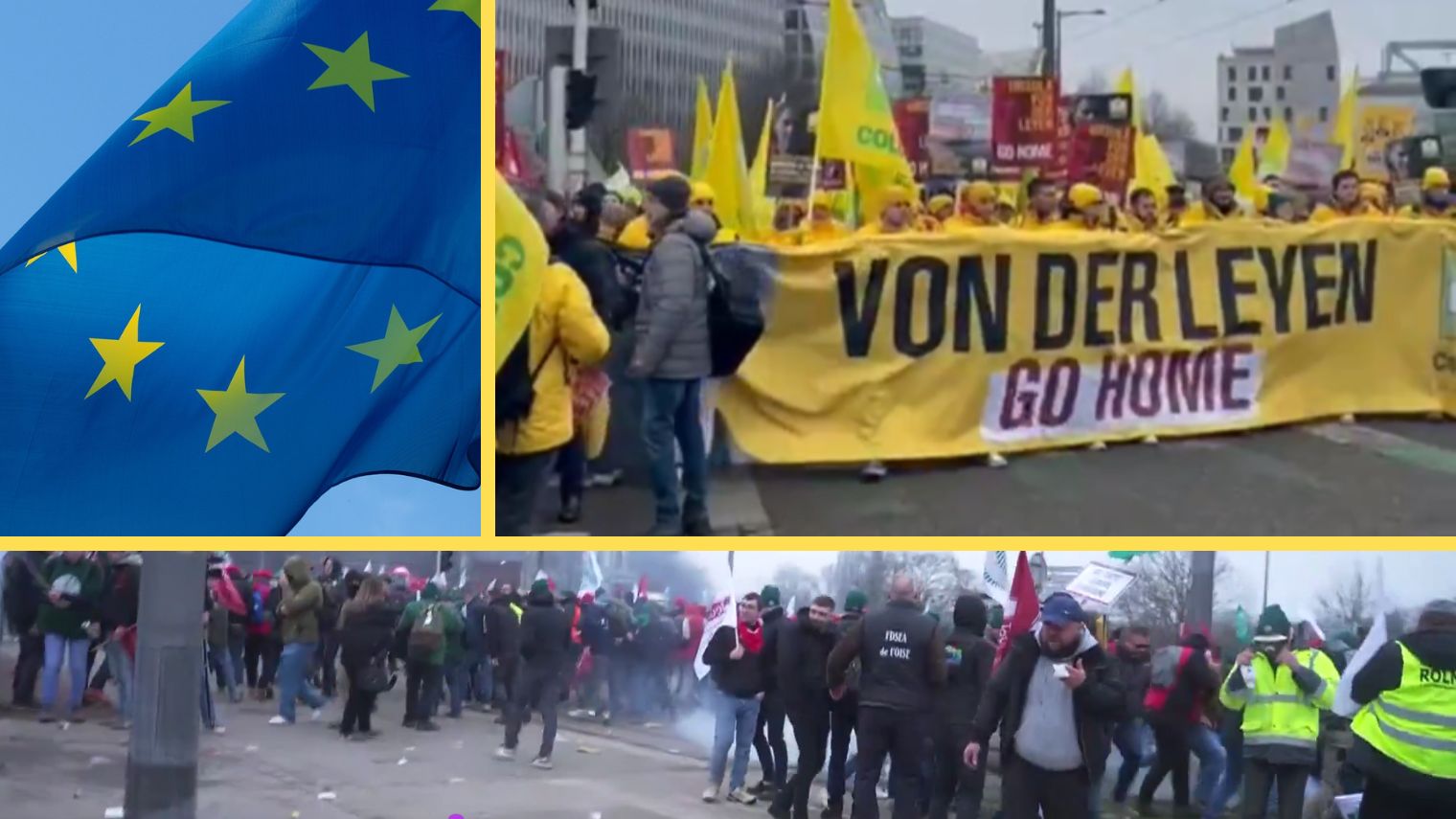
On Tuesday, thousands of farmers once again gathered with tractors outside the European Parliament in Strasbourg to protest the trade agreement signed with South America.
The agreement, which was signed earlier in January after 25 years of negotiations between the EU and its 27 member states and the Mercosur members Brazil, Argentina, Uruguay, and Paraguay, creates one of the world’s largest free trade areas with over 700 million inhabitants.
However, many farmers in Europe fear that the agreement will result in an influx of cheaper goods produced under conditions they cannot compete with—featuring lower standards and prohibited pesticides. France and Poland are leading the opposition among the member states.
READ ALSO: VIDEO: Farmer Chaos Against the EU Elite in Brussels
On Tuesday, around 5,000 farmers and supporters from several countries had gathered for new protests. Although the final approval of the treaty is still months away, on Wednesday, EU parliamentarians will vote on whether the agreement should be referred to the EU Court of Justice to determine if it is compatible with EU policy. The court’s decision could then force a change to the agreement. The farmers are supported by up to 140 parliamentarians.
“We want the members of the European Parliament to do their job, to appeal to the court so the agreement can be reviewed,” says French livestock farmer Emmanuelle Poirier to AFP.
Poirier fears mass imports of meat that do not meet France’s specifications.
JUST IN: Battles between farmers and police break out in Strasbourg.
Thousands of farmers are protesting the EU’s disastrous Mercosur free trade deal.
Police fire tear gas while EU elites wine and dine at the WEF in Davos. pic.twitter.com/JwaK0NLMGW
— Remix News & Views (@RMXnews) January 20, 2026
No Backing Down
The farmers plan to stay in Strasbourg until Wednesday and, according to Herve Lapie, secretary-general of the FNSEA union organizing the demonstration, have no intention of backing down.
After a police officer pointed a weapon at a farmer during a demonstration, several French municipalities decided to remove the EU flag in solidarity with the demonstrators.
???????? Des agriculteurs en colère brûlent un drapeau de l’Union européenne devant le Parlement lors de la manifestation contre le Mercosur à Strasbourg.
Un ❤️ si tu soutiens les agriculteurs
— – Le Direct Info ???? (@LeDirectInfo) January 20, 2026
Tariffs to Be Removed
The agreement is expected to come into effect at the end of the year and removes tariffs on more than 90 percent of bilateral trade. It is said to benefit European exports of cars, wine, and cheese, while making it easier for South American beef, poultry, sugar, rice, honey, and soybeans to enter Europe.
According to the EU’s estimates, European exports to Mercosur are expected to increase by 39 percent, while Mercosur’s exports to the EU could increase by 17 percent.
The agreement is also expected to increase the EU’s GDP by 77.6 billion euros and Mercosur’s by 9.4 billion euros by 2040.
A Win for the Farmers
On Wednesday it was announced that the EU Parliament wants the EU Court of Justice to review the legality of the agreement. This means the deal could be delayed by several months, possibly even years.
“In a time of geopolitical tensions, today’s vote is regrettable and sends entirely the wrong signals,” commented Swedish parliamentarian Jörgen Warborn (M) in a statement to TT.
Bauernproteste gegen #Mercosur heute in ???? Straßburg pic.twitter.com/w0l7kqKSoY
— Reinhild Boßdorf ✌️???????? (@ReinhildAmandi) January 20, 2026
READ ALSO: Ten Thousand Farmers Expected in Brussels – Protesting EU Agricultural Policy