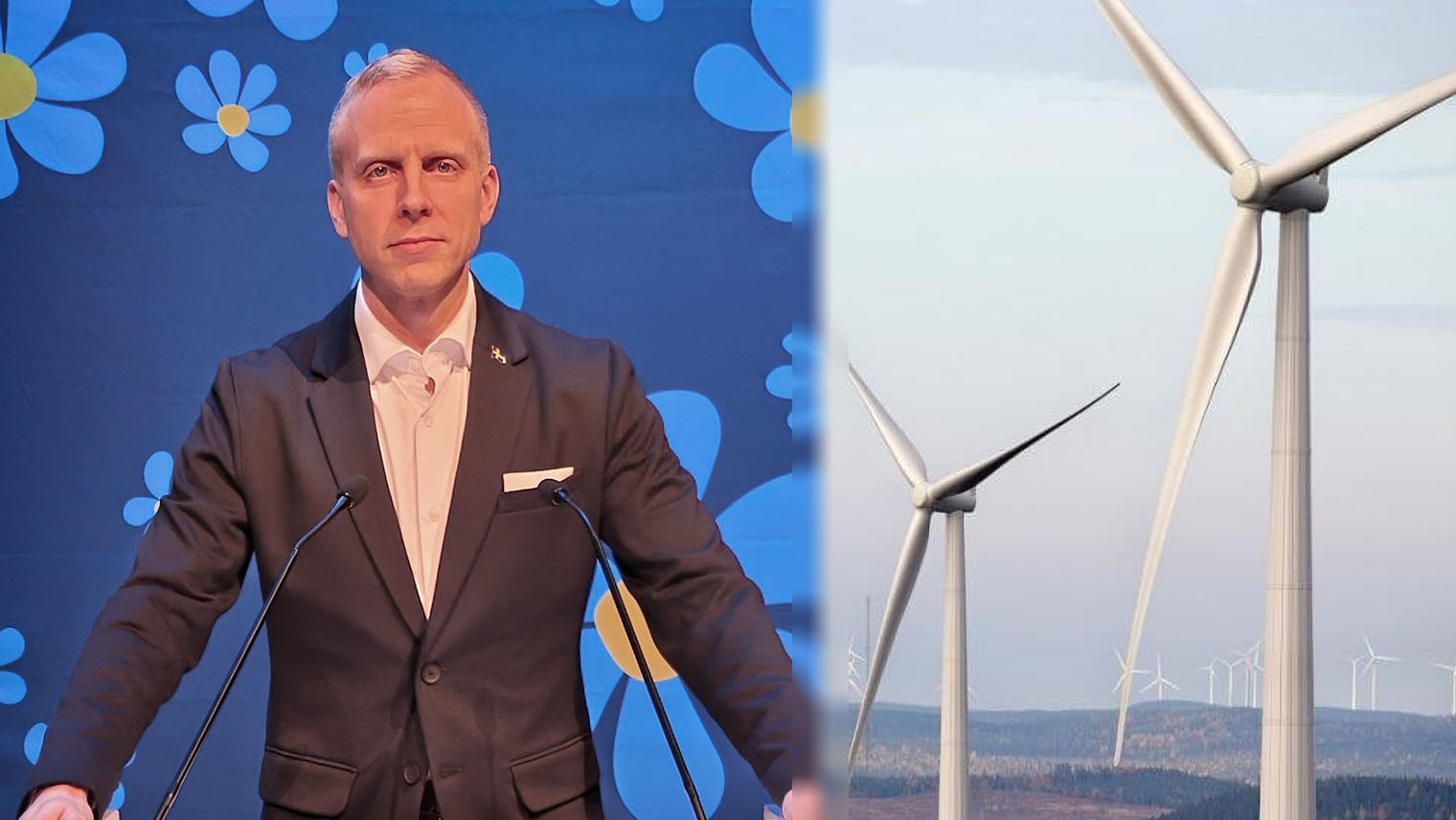
DEBATE • There is still too little talk about the wind power fiasco. Not as an idea, not as a vision, but as an actual reality. Because while wind power continues to be described as the energy solution of the future, particularly from the left, the numbers show that in practice, it has become one of energy policy’s biggest economic failures.
Nationally, the picture is now unambiguous. According to summaries based on the companies’ own annual reports, Swedish wind power suffered multi-billion losses in 2024. The analysis, including findings reported by Christian Sandström, shows sharply negative margins and that an overwhelming majority of wind turbines are owned by companies operating at a loss. This is not a temporary dip, but a structural failure where increased production coincides with falling revenues, oversupply, and more hours with extremely low or negative electricity prices.
Anyone who thinks this is a national issue without local ties only needs to look at Kalmar County. Emåbygdens Vind AB is owned by the municipalities of Mönsterås, Högsby and Hultsfred. Since its inception, the company has repeatedly failed to live up to its projections. Production has been well below forecast, the value has been written down, capital infusions have been needed multiple times, and now there is a real risk of bankruptcy. Millions in taxpayer money have already been spent, and significant guarantee commitments remain.
The Centre Party at the Center
This is not an anonymous failure. The board of Emåbygdens Vind AB has for a long time consisted of Centre Party representatives from the owning municipalities. The same party that, nationally and regionally, is wind power’s loudest defender has locally had direct responsibility for a company that has run at a loss year after year. It can no longer be blamed on the market, the weather, or bad luck. The lines of responsibility are crystal clear.
When this became obvious, the next step was a classic political maneuver: shifting the focus. Instead of talking about losses, responsibility, and risks for the municipality’s residents, the Centre Party, together with the Social Democrats, began to paint a threat of uranium mining in Kalmar County. An invented threat is being used to hide a real failure. This is not issue-based politics; it is pure scare rhetoric.
READ ALSO: The Wind Power Lobby – A Threat to Local Democracy
At the same time, the Centre Party has continued to push for new wind farm projects, most recently in Kalmar Municipality where large parks were planned despite massive local criticism and despite the well-known economic problems of wind power. The project was ultimately stopped, not by political accountability, but by the Armed Forces. Still, no self-examination has followed.
The crucial point is this: regardless of how Emåbygdens Vind AB is wound up, the municipality’s residents will pay. If the plant is sold, the loss is realized. If the company goes bankrupt, guarantee commitments risk being triggered. There is no painless way out, as the bill has already been sent to the taxpayers.
READ ALSO: The Wind Power Lobbyists’ Constant Attempts to Influence – Time to Speak Out
Why is the Centre Party so strongly positive toward wind power despite its repeated failures? There is a clear revolving door between the Centre Party and the wind power sector. Former Centre Party leader Maud Olofsson has sat on the board of the wind power company Arise. The party’s former policy chief Magnus Demervall left the party to become head of public affairs at wind power giant Ørsted.
Another clear example is Daniel Johansson, who served as state secretary for the Centre Party’s energy ministers Maud Olofsson and Anna-Karin Hatt, and who later went on to become CEO of the wind power company Arise, one of Sweden’s larger companies in the sector. Meanwhile, the lobby organization Svenska Vindenergi openly works to influence municipal politicians, even participating at the Centre Party’s municipal days, and the Centre Party itself has published material where they source “questions and answers” directly from the lobbying organization.
When you see this alongside the Centre Party boards in municipal wind power companies, it becomes reasonable to ask whether this is a matter of ignorance, prestige, or a system where the industry and politics have merged.
Conclusion
Wind power can no longer be described as a future investment. It is an ongoing economic failure, where political prestige has trumped responsibility. The question that remains is whether the Centre Party’s continued championing of wind power is due to an inability to understand the consequences, or ties that are too close to an industry living off taxpayers’ money. Either way, it shows a party that is not fit to make decisions on issues whose consequences are so great for municipalities, regions, and the voters who are forced to pay when the experiments crash.
Ted Nyberg (SD)
Parliamentary Candidate, Kalmar County