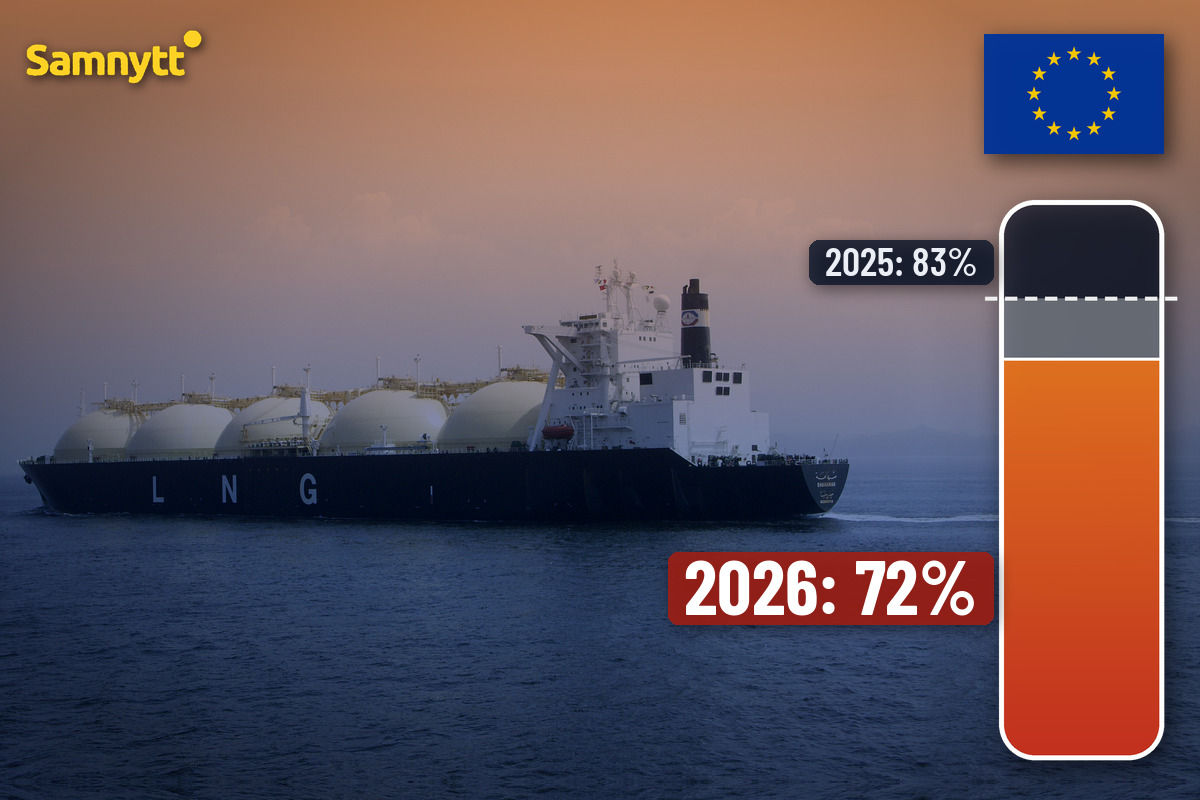
The EU is heading into winter with the lowest gas reserves for the season since records began in 2011. Storage facilities were 72 percent full on October 1, compared to 83 percent a year earlier, while attacks on shipping in the Strait of Hormuz are pushing up gas prices. If the winter is cold, the Union may be forced to reduce consumption by about 7 percent.
The storage level on October 1 is detailed in the winter analysis published last Thursday by the cooperation body of European gas transmission system operators, ENTSOG. One year earlier, storage was at 83 percent, equivalent to 943 terawatt-hours, according to the organization’s report from last autumn.
EU regulations set a storage target of 90 percent, but after gas prices soared, the European Commission urged member states to lower the goal to 80 percent to avoid panic buying. The low levels are largely driven by market price dynamics.
Storage relies on the principle that gas purchased during the summer is cheaper than gas sold in winter. This year, however, summer contracts have at times been more expensive than winter contracts, making it financially risky to fill storage facilities.
This is explained by the American analysis organization IEEFA in a report published on Friday. Gas injections from April to June were 16 percent lower than during the same period last year, and on October 3, storage was 72.4 percent full.
IEEFA estimates that storage can supply 7.3 billion cubic meters less gas between November and March than in the previous winter. At the same time, the EU’s ban on the import of Russian liquefied natural gas (LNG) will take effect in January 2027. Together, this may require gas consumption to be reduced by 7 percent, or 14 billion cubic meters, compared to last winter.
Filling the gap with extra imports, on the other hand, is estimated to cost around 3 billion euros—12 percent more than the same volume would have cost in 2025. Several countries have already begun to take measures.
The Netherlands has allocated 993 million euros in support to fill storage, Germany has tasked the state energy company SEFE to store 8 terawatt-hours by mid-December, and Spain has increased its LNG reserves by more than a quarter.
War Drives Up Prices
Meanwhile, pressure on the gas market has increased. Last week saw the highest number of ship attacks in the Persian Gulf in a single week since the war with Iran began. Traffic through the Strait of Hormuz simultaneously fell to its lowest level in over two months, reports Reuters.
Before the war, about one-fifth of the world’s oil and LNG passed through the strait. The European gas benchmark price, TTF, rose on Thursday morning by 3.2 percent to 80.59 euros per megawatt hour, according to the Wall Street Journal.
Nevertheless, gas transmission operators believe the system can withstand the winter, as the capacity to receive LNG can largely offset the lower storage levels. This assessment is shared by the European Commission, which, after a meeting with the Union’s gas coordination group last Thursday, emphasized the importance of saving enough gas for late cold snaps.
If LNG supply remains limited, however, storage could drop well below 30 percent by the end of winter, ENTSOG warns, which would make refilling for next year more difficult. The greatest vulnerability is in landlocked countries in Central and Southeastern Europe.
Risk of High Electricity Prices in Sweden
Sweden’s natural gas supply is not currently affected. However, the Swedish Energy Agency warns that rising gas prices in Europe may contribute to higher Swedish electricity prices this winter.
Weak hydrology and extended maintenance outages in nuclear power also increase the risk of price spikes. However, the agency sees no risk of electricity shortages.