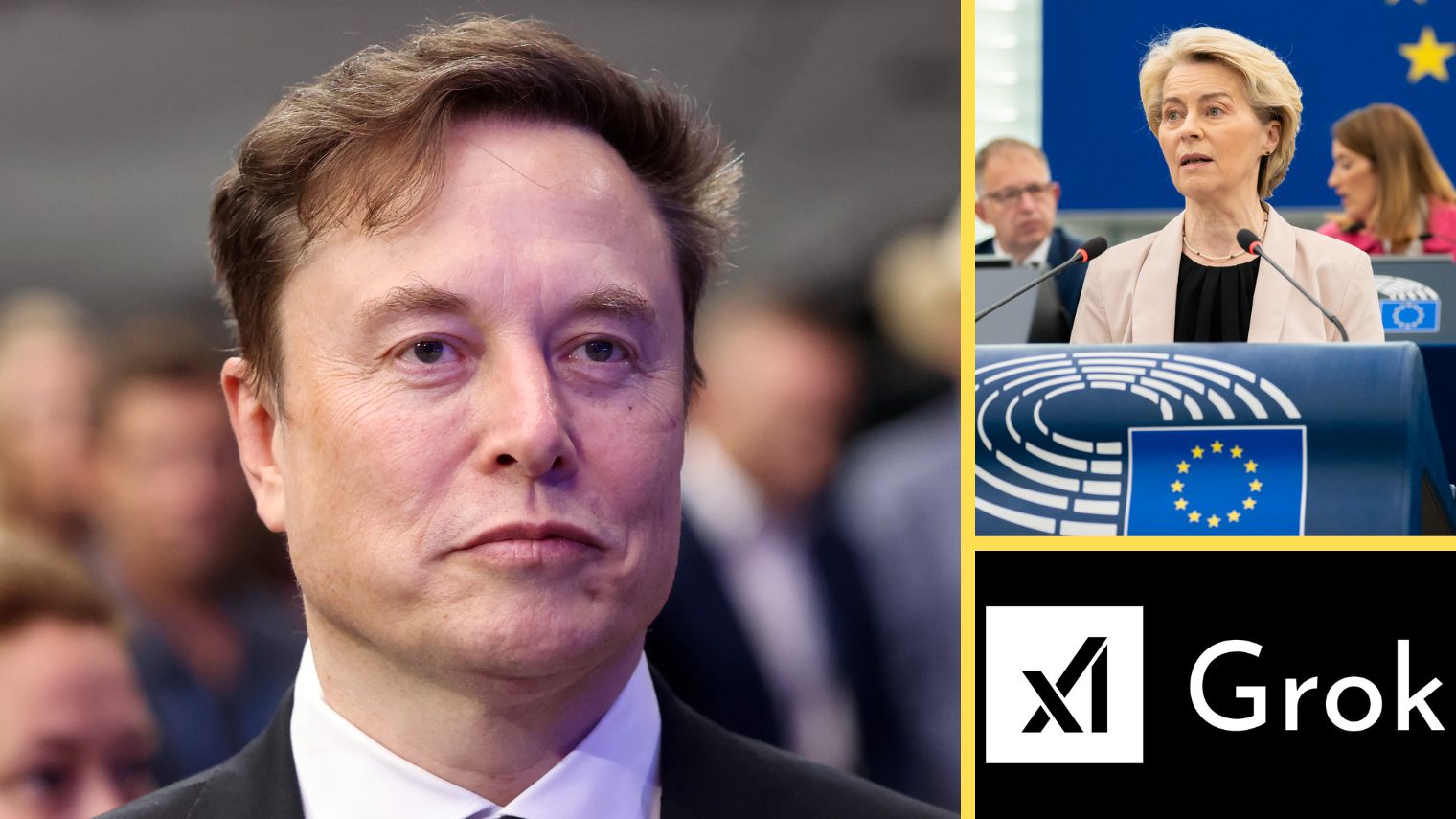
The EU does not want citizens of its member states to have access to Elon Musk’s AI tool, Grok. This is the purpose behind the investigation that begins on Monday into whether xAI, the company behind Grok, has violated the EU regulation Digital Services Act.
Officially, the reason given for the investigation is that Grok, which is available via X (formerly Twitter), can create sexualized images and videos of real people without their consent—a capability shared with other similar services.
The Commission will assess whether X met the EU’s requirements to protect users when it integrated Grok into the social media platform and its underlying algorithm.
SEE ALSO: 150 EU officials monitor when Musk interviews AfD’s party leader
“We will not leave consent and child protection up to tech companies so they can violate and profit from it. The harm caused by illegal images is very real,” wrote Commission President Ursula von der Leyen in a statement.
The EU’s investigation comes shortly after the British government, led by Prime Minister Keir Starmer, targeted the platform.
SEE ALSO: British government may block access to X
X is already under investigation on several fronts according to the EU’s digital services law and was fined 120 million euros in December for lacking transparency. The fine can reach up to six percent of X’s annual :censored:6:cdd6bbaa89: revenue.
In January, Grok’s ability to generate images was restricted, initially limiting it to paying subscribers. The Commission said at that time it was assessing whether the changes made to Grok were sufficient.
EU officials later deemed the initial changes insufficient and expressed their concerns to the platform, after which further measures were taken.

Dislikes Elon Musk
A week ago, xAI announced that it had implemented technical measures to stop the manipulation of images and videos depicting real people in sexual situations, but this is still not enough for the EU Commission.
Journalist and social commentator Henrik Alexandersson from the non-profit 5th of July Foundation notes:
There are now plenty of different AI-supported image generation services that let people do exactly what the EU criticizes Grok for—both online and as standalone programs that users can run on their own computers. But the EU Commission seems not to care about those.
It’s hard to shake the suspicion that Grok is being treated more harshly than others—not least because its owner is politically controversial in the EU. This is inconsistent with the idea of an open and free society where different ideas can meet and be challenged.
Again, one might ask whether the EU’s politicians understand what they are doing, writes Alexandersson, arguing that forcing Grok to exit the European market would be a blow to free information and knowledge gathering simply because they dislike Elon Musk.
But now the EU wants to stop one of these AI platforms. This genuinely upsets me. They want to limit the diversity of information. They want to restrict our access to facts and knowledge. They want to make it harder for us to find sources. This is pure authoritarian behavior.
In this context, it is worth noting that Grok is considered one of the few less politically correct AI tools that does not distort or manipulate information on politically sensitive topics.
SEE ALSO: Elon Musk agrees with Muslim about population replacement in Scandinavia: “His math checks out”