This week, the EU Commission confirmed that member states can use EU funds to pay for what it calls safe abortions, but it refrained from actively facilitating access throughout the union. At the same time, birth rates are already at record-low levels and immigration continues.
In response to the campaign “My voice, my choice,” the Commission’s Vice President and Commissioner for Social Rights, Roxana Minzatu, stated that countries can “voluntarily” make use of EU funds “to support access to abortion care for girls and women in vulnerable situations.”
– We want every woman to live safely and freely. This is what member states can commit to with EU support, she says.
In countries like Poland and Malta, the ability to terminate pregnancies is severely restricted. According to women’s rights activists, this means that more than 20 million women in the EU do not have access to safe abortion care.
READ ALSO: VIDEO: Centre Party Leader Outraged Over Banner: “Goddamn!”
Last year, a petition was launched urging Brussels to help women in EU countries where abortion is not easily accessible to undergo the procedure elsewhere in the union. The response was that there is no need for new legislation, but that already allocated funds can be used to facilitate travel and access to health care for women from other member states seeking abortions. Activists interpreted this as a victory and a step forward.
The petition also called on Brussels to legislate the establishment of a financial mechanism for “liberal” member states to provide abortions to women from other EU countries. Since more than one million signatures were collected, the EU Commission was required to issue a response describing the measures it intends to take.
Praise and Criticism
Katrine Thomasen from the legal advocacy organization Center for Reproductive Rights says that while the Commission’s announcement is important, additional measures are needed to realize this.
EU’s Gender Equality Commissioner Hadja Lahbib is more satisfied, describing the Commission’s action as “revolutionary.”
– It will change women’s lives. A woman who cannot afford to travel, buy a train or plane ticket, or pay for safe medical care to have a proper abortion will now be able to travel anywhere in the European Union, she says.
Record-low Birth Rates
At the same time as the EU is striving to increase the number of European abortions, record-few children are being born in many EU countries – including Sweden. During 2024, approximately 99,000 children were born in Sweden, the lowest number in two decades.
– The number of births per 1,000 women aged 15–49 dropped to 41.8, the lowest level since records began in 1973, says Mikael Ohlin, statistician at the National Board of Health and Welfare.
READ ALSO: One in Five Women Does Not Want Children – But Men Want to Become Parents
When Statistics Sweden recently presented an update on Sweden’s population, it could be noted that the population continues to grow – because of immigration. At the end of 2025, 10,605,500 people were registered as residents in Sweden.
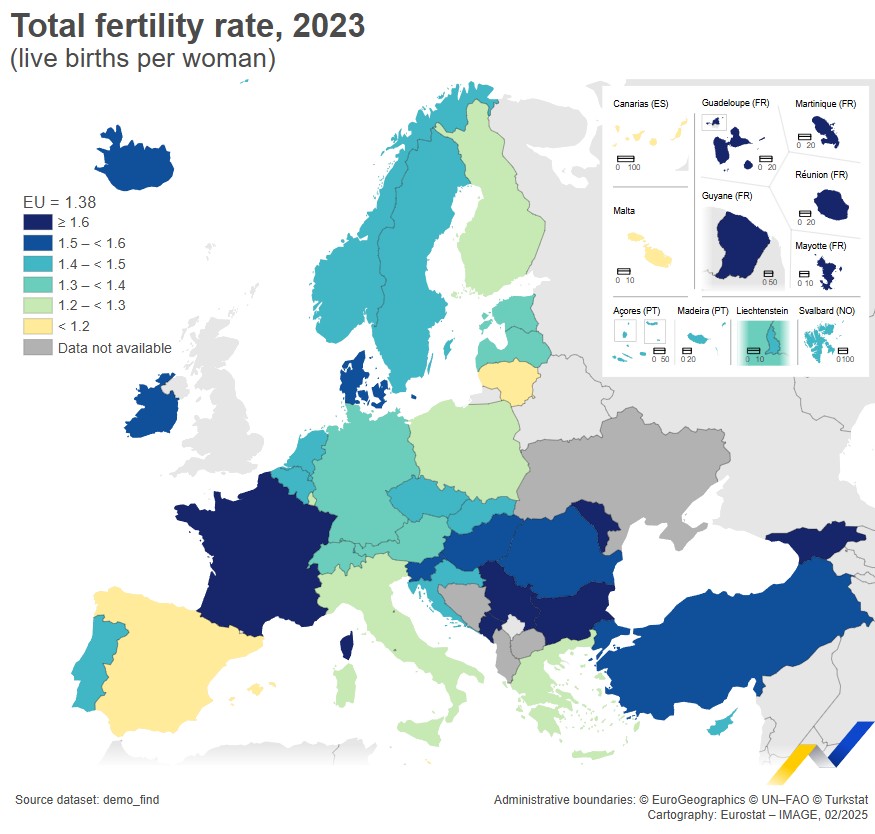
In 2023, 3.67 million children were born in the EU, a decrease of 5.4 percent compared with 2022. This is the largest annual decline recorded since 1961.
The total fertility rate in the same year was 1.38 children per woman in the EU, down from 1.46 in 2022.
In 2023, Bulgaria had the highest total fertility rate in the EU (1.81), followed by France (1.66) and Hungary (1.55). The lowest fertility rates were found in Malta (1.06), Spain (1.12), and Lithuania (1.18).
While abortions are being facilitated and birth rates are at record lows in the EU, efforts continue to increase immigration through more “legal pathways.”
READ ALSO: EU Wants More Legal Pathways into Europe for Migrants