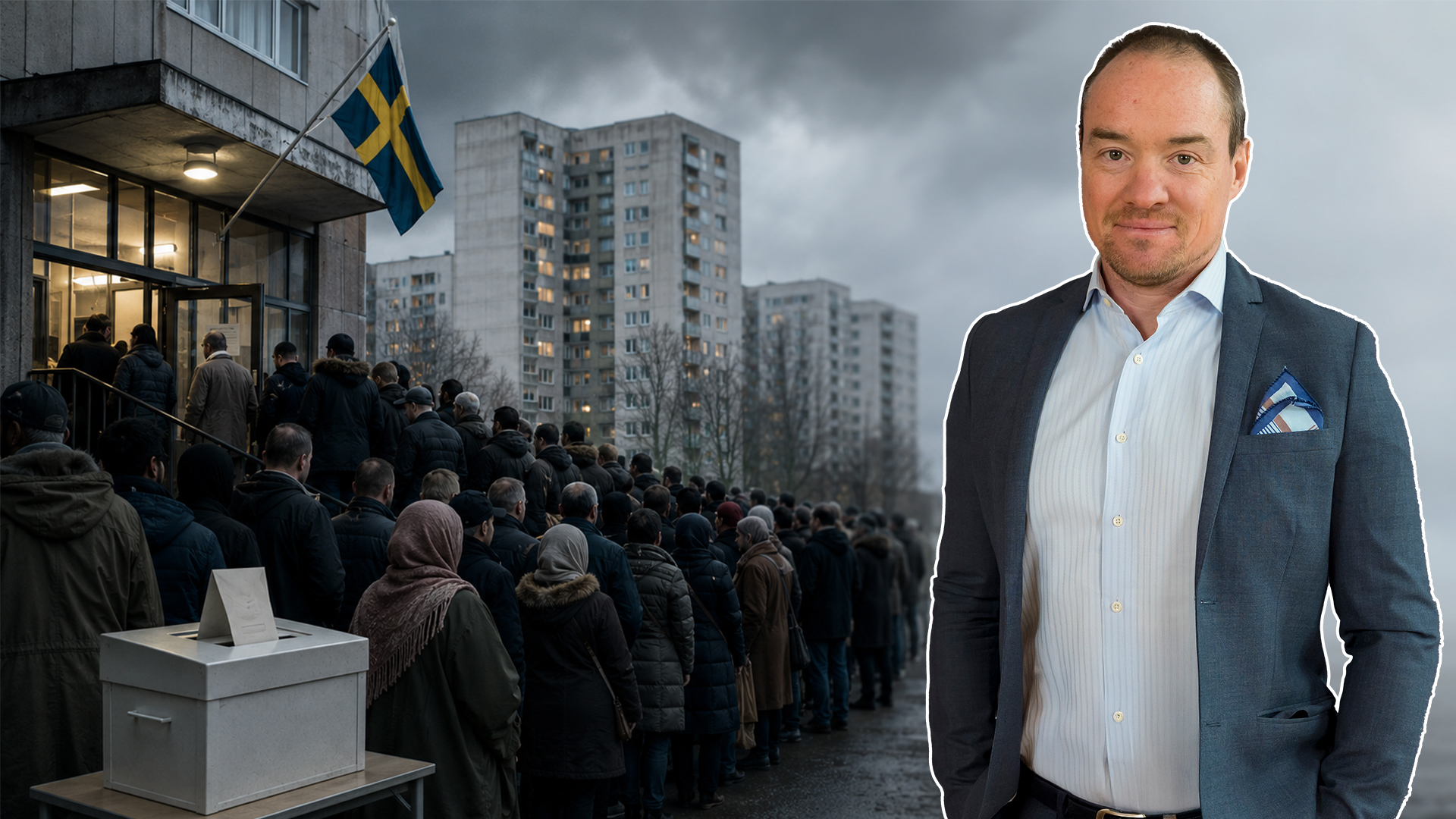
I have warned about the demographic bomb countless times. The legacy media hated me for it during my time in Parliament. Here at Samnytt, it’s probably the topic I have written the most editorials about. This is my main criticism of the Tidö era. And now, a far-left researcher seems to confirm what I have warned about: how non-Swedes in the suburbs are mobilizing. When will the threshold be crossed where Swedes can no longer decide their own future?
I wish the question was rhetorical. Demographics is power. Economic missteps can be corrected, taxes lowered, and laws rewritten. But if the population changes, so does political power—and that is much harder to undo.
That was the point I made already in 2022 when I wrote “It’s the Demographics, Dummy!“. The ethnification of politics, group mobilization, and clan voting are almost natural consequences when a previously fairly homogeneous society quickly becomes multicultural. Four years later, the question isn’t whether the electorate is being affected, but how far the process has gone.
There Is a “Rumbling” in the Suburbs
The left-wing researcher and former Afa activist Tobias Hübinette seems almost elated. He writes that there is a “rumbling” in the million-program areas and talks about a possible “historic mass mobilization” among residents with non-European backgrounds to vote out SD and Kristersson’s government.
Hübinette argues that the lower turnout among people with non-European backgrounds contributed to the victory of the Tidö parties in 2022. He writes that if only ethnic Swedes, together with voters with Nordic and European backgrounds, had been eligible to vote in this year’s election, the evidence suggests that Tidö would win again.
It is not me making this analysis. It is Tobias Hübinette. And this is precisely the mechanism I have warned about.
Raw Data Shows Record Increase
Kvartal’s Pelle Zackrisson has compared the Election Authority’s raw data from the first six days of early voting with the same period in 2022. In 19 vulnerable areas where the same polling station is used, the number of early votes increased from 6,929 to 13,860—a doubling. Nationwide, the increase was 44 percent. In Tensta and Hjällbo, the number tripled, and at Fittja’s citizen service office, it was almost four times as high as in 2022.
If you take all 65 vulnerable areas, the increase is 105 percent, albeit with greater uncertainty. At the municipal level, the same pattern is seen: the larger the proportion of residents with a foreign background, the greater the increase in early voting.
So we have a dramatically changed electorate, stronger left-wing support among foreign-born, vigorous mobilization in areas with a large non-European population, and a left-wing researcher himself describing it as mobilization to kick out Tidö.
SEE ALSO: S and V get over 80 percent among Muslim voters
How many warnings do you need?
It is also exceedingly bold. What mentality does an immigrant have who comes here and then claims the right to try to stop the Swedes from making changes? From preserving their own country?
There is no moral right for newcomers, their children, or their clans to determine the direction of Sweden. They did not build the country. They have not carried its historical burdens. They did not create the trust, rule of law, and prosperity that made Sweden attractive enough to immigrate to. Yet, they have been given the legal right. First through local voting rights for non-citizens. Then through the industrial distribution of Swedish passports.
That is an enormous audacity. Humility would be appropriate. Instead, we get an occupation mentality.
You Gave Them the Power
My anger is primarily directed at Swedish conservatives. The individual voter uses the power the system gives him. The question is why Swedish politicians gave it away so thoughtlessly—and why M, KD, and L continued after the 2022 election.
Just weeks after the Tidö victory, I wrote that new citizenships should be halted by a moratorium until new rules were in place. Later, Jimmie Åkesson said that SD had in fact demanded exactly this during the Tidö negotiations but received no support from any government party.
According to my previous review, roughly 217,000 Swedish citizenships were granted between October 2022 and the end of July 2026. There was no moratorium. The tightened rules began to apply only as of June 6 of this year.
Of these, I estimated about 162,000 were eligible to vote in this year’s election. Based on SCB’s party sympathies and the 2022 voter turnout, I illustrated how this single group could theoretically give the left a voting advantage on the same scale as Tidö’s entire victory margin in 2022.
READ MORE: Ekeroth: 217,000 New Citizens—The Right’s Historic Own-Goal?
Conservative politicians won power on the promise to break with the old migration policies. After that, they continued to grant hundreds of thousands of people the ultimate political right: the ability to help decide who should rule Sweden.
Now the same electorate can help vote them out because the government has tried to restrict the very migration policy that brought them here. Hübinette calls it a “karma and boomerang effect.” I call it total and complete insanity.
This is not an argument for staying at home. Tidö must win. But the criticism that it came too late remains.
When Does the Change Become Self-Locking?
How long can a people pursue a policy that changes the electorate before the policy becomes self-locking?
Millions of people move in. Hundreds of thousands are naturalized. Their children become voters. At the same time, election after election shows major differences in party sympathies between population groups. At what point can the original majority no longer elect a government that can undo previous decisions?
This is the question Sweden should have debated 20 years ago. Instead, anyone who brought up demographics was called a racist or conspiracy theorist. Meanwhile, the clock kept ticking.
In December, I showed that about 600,000 foreign citizens had the right to vote in local and regional elections and that the share of non-citizens was greater than the margin to the 50-percent mark for the Tidö parties in 143 municipalities. This does not mean that all vote left or decide the municipalities, but it shows the magnitude of political power that has been distributed without any requirement for Swedish citizenship.
READ MORE: Ekeroth: Withdraw the Right to Vote Before It’s Too Late
Then come the citizenships, then the second generation, and then the third. It is of little help to realize ten years later that one should have thought of this earlier.
Citizenship Is Political Power
This is why I have been almost obsessed with the citizenship issue. When the state naturalizes an adult, it gives that person a permanent share of Swedish state power: a vote, the chance to influence Parliament, to help change the constitution, and to decide what migration laws will apply in the future.
When hundreds of thousands of such decisions are made in a few years, these are not administrative trivialities but demographic and political decisions of historic proportions.
I have therefore argued that Swedish citizenship must again become a privilege, associated with long-term belonging, loyalty, and very high requirements, and that opportunities to revoke citizenship must be increased. Tidö has finally taken steps in the right direction. But demography did not wait while ministries investigated.
What is truly provocative is not that people in the suburbs vote. They use the power granted to them by politicians. The scandal is that Swedish authorities have treated political control over Sweden as an unlimited natural resource: come here, live here a few years, get a passport, and then help decide immigration policy, culture, tax money, and who will govern the country.
When someone asked what this would mean in the long run for Swedes’ self-determination, the establishment laughed. Now we see where this development could lead.
Tidö Got a Historic Opportunity
The Tidö government got a historic chance. The 2022 election provided a clear mandate for a change of direction. SD had shifted the public debate. There was an opportunity to sharply reduce immigration, immediately halt the routine naturalization, and remove the right to vote for non-citizens in local and regional elections.
Much has been done and much has improved. SD has obviously had to fight M, KD, and L for many changes. But the most important thing was missed—and you can’t get those lost years back.
In my editorial “SD – The Demographic Clock Is Ticking!” I wrote in the spring of 2023 that it was not enough to refer to processes and future investigations. Every month, the conditions for the next election were changing.
Now the next election is here. And suddenly there is a “rumbling” in the areas where the left may have its largest untapped voter reserve.
A Border That Must Never Be Crossed
There is a bigger question than whether Kristersson stays on after September 13. Democracy is based not just on votes being counted correctly but on legitimacy—on citizens actually being able to depose those in power, change political direction, and correct previous mistakes.
But what happens when politicians first carry out a historic demographic change and then say that the only legitimate way to address the matter is through elections, while at the same time, the same change gradually makes it harder and harder to win those elections?
Then you get a democratic Catch-22.
No one knows exactly where the line is. But that is precisely why every responsible politician should act long before we reach it.
For the day when a significant proportion of the Swedish people conclude that the democratic process no longer gives them any realistic chance to set the course of the country, we will have something much more serious than another term for the Social Democrats: a crisis of legitimacy for democracy itself.
And what options will be left for Swedes then?
Maybe a Last Chance?
Just today, we are reading a poll showing the Social Democrats imploding and the gap between the blocs shrinking to 2.6 percent. That poll shows the same trend as similar polls have in recent weeks: Tidö parties are catching up with the left bloc. So it’s a contest again, as I wrote recently.
Maybe this is Swedes’ last chance to determine their own future. Maybe, just this election, just this time, if Swedes—including those who for some reason hesitate with Tidö or even vote for the Social Democrats—pull themselves together and cast their vote for Tidö. Then, maybe, we can, with bated breath, save our right to decide over our own country.
Maybe.
But it requires that Swedes mobilize in the same way as the MENA immigrants in the suburbs do. Here and now. Without hesitation. All those who usually stay home, all who are uncertain, all discontented, and even all those who lean left but still have some self-preservation instinct.
Go out now and show that Swedes have fighting spirit and self-preservation. Show that we Swedes, even if some of you perhaps vote left today, still have a fundamental loyalty to our own, to the Swedish. And show that we do not allow mass immigrants from Africa and the Middle East to take over our country the “democratic way.”
For hell’s sake. Rise up and fight now.