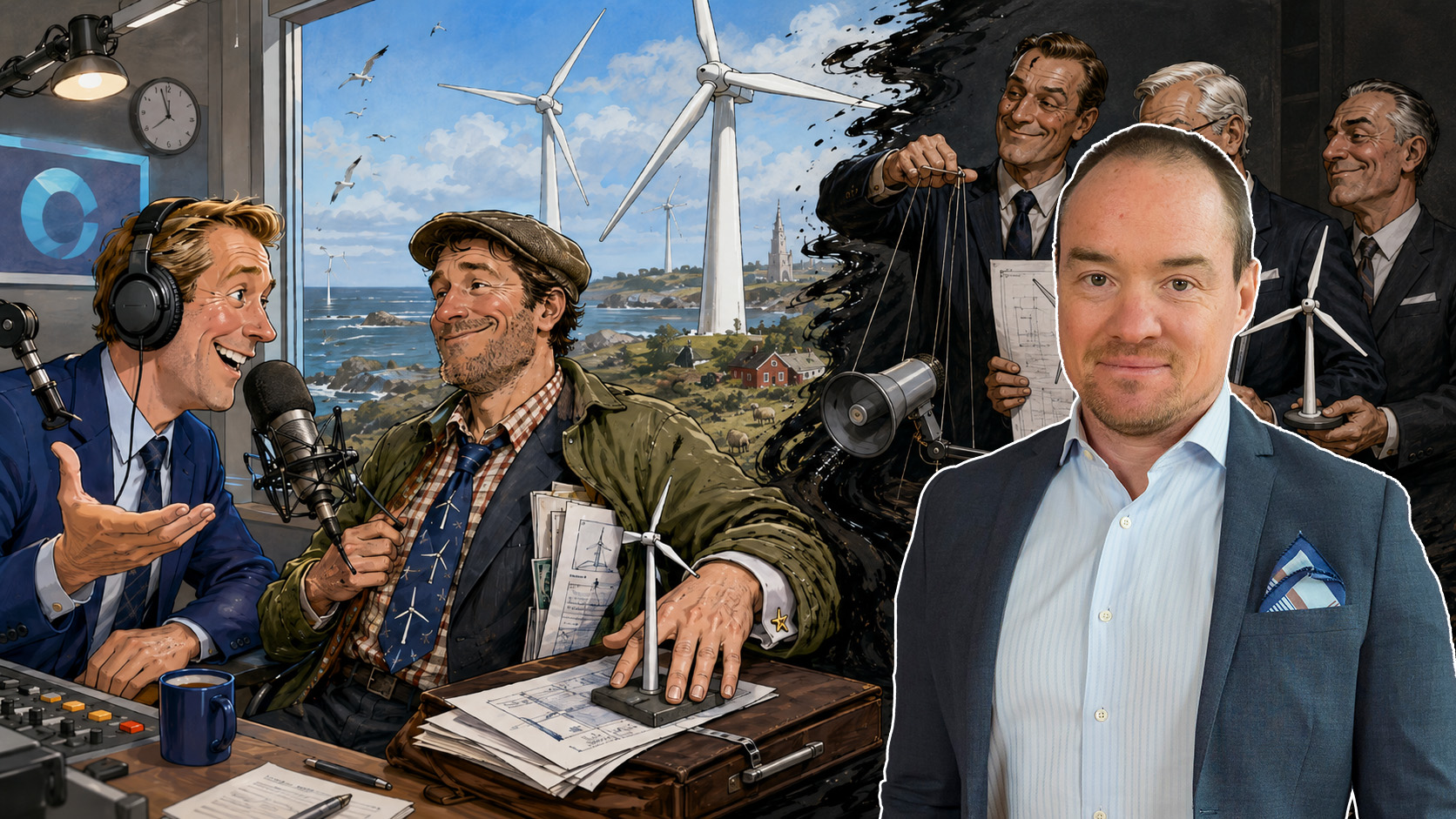
EDITORIAL • When public service pushes the wind power line so hard that industry representatives have to pretend to be ordinary citizens, the line between journalism and advocacy has been crossed.
There are mistakes. And then there are things that are almost too perfect to be called mistakes.
Sveriges Radio has now been forced to unpublish an article about a wind power-positive resident of Öland. The reason? The “ordinary” local who was interviewed to illustrate how uneventful it is to have wind power near your home turned out to serve on the board of a wind power company. To put it mildly, that is a relevant piece of information.
When someone with ties to the wind power industry is interviewed as a positive citizen’s voice in a politically charged energy issue, that’s not a minor detail in the margin, it’s the very core of the credibility issue. Either Sveriges Radio didn’t check who they were interviewing—then it’s lousy journalism. Or they knew but chose not to tell listeners, which is even worse.
And perhaps the most revealing aspect is that, unfortunately, both alternatives seem entirely possible.
Wind Power Propaganda with a Public Service Seal
This naturally does not happen in a vacuum. Just recently, Sveriges Radio warned that Sweden is especially hard-hit by false messages about wind power. According to their broadcast, critics of wind power could be linked to pro-Russian groups, fossil fuel interests, politicians, and alternative media.
It was an extremely crude narrative: anyone questioning wind power’s costs, impact on landscapes, grids, wildlife, the local environment, or municipal autonomy risks being mentally lumped together with Kremlin influence operations.
But what was the basis? A report from the wind power industry’s own trade association. Let that sink in.
Sveriges Radio, which routinely talks about “disinformation,” “impartiality,” and “independent journalism,” chose to spotlight the wind power industry’s own report as if it were a neutral, higher truth. The industry singles out its critics as disinformers, and the state media naturally provides the megaphone.
It’s like if Ekot allowed the tobacco industry to define who spreads “misleading narratives” about cigarettes, or let gambling companies warn about “disinformation” concerning gambling addiction.
The only difference is that when it comes to wind power, large parts of the media establishment seem to lose all journalistic instincts.
When Criticism Must Be Pathologized
The real purpose of this type of reporting is not to inform, but to smear opposition to a political project. Opposition to wind power is not to be addressed in substance. It must be discredited.
Do people have opinions about huge industrial zones being placed near homes, nature, and heritage sites? Then it can be described as “disinformation.” Does someone point out that wind power is weather dependent and requires balancing power, grid expansion, and often subsidized support systems? Then it can be implied they’re helping Putin. Do local residents say no to having their environment changed for generations to come? Then perhaps they’re victims of “false narratives.”
It’s a well-worn—and rather lazy—method. It avoids the tough discussion about the real costs and consequences of the energy system. It avoids talking about who profits. It avoids reporting which interests are pushing for it. It avoids respecting ordinary people’s objections.
The Industry’s Voice Becomes the People’s Voice
Against this background, the unpublished SR article becomes even more revealing. First, public service promotes the wind power industry’s portrayal of its critics: they spread false messages, are influenced by pro-Russian narratives, and hinder the green transition. Then a positive “resident of Öland” is interviewed—who turns out to be on the board of a wind power company. Do you see the pattern?
The wind power industry gets to define the problem. Its representatives provide the solution. Then Sveriges Radio packages it all as independent journalism.
It’s hard to imagine that the same generosity would be shown to other interests. If someone with connections to the oil industry were interviewed as an “ordinary driver” about lower fuel prices, every public service newsroom would immediately recognize the problem. If a nuclear lobbyist were presented as an impartial local in a story about new reactors, the issue of conflict of interest would likely be raised within five minutes.
But wind power has a special status. In the establishment media, it’s not just an energy source. It’s part of the “good” story, and within that story, it suits the left-liberal media to keep certain interests invisible.
Taxpayers Finance the Debacle
This is obviously bigger than a single unpublished article. Sveriges Radio is not supposed to be a private campaign organization. It should not be a PR agency for the wind power sector. It should not be an activist climate platform helping the “right” energy source over the hurdles of public opinion. Because it is tax-funded media.
Your tax money. Even the taxes of those critical of wind power. Even funded by those living in rural areas who are expected to accept that their environments are sacrificed for urbanites’ climate image. Even by those who see how Swedish energy policy has for years been built more on symbols than on stability, reliability, and competitiveness.
ALSO READ: EXTRA PHOTOS: How wind power companies want to transform the Swedish coast
These people have the right to demand more than moralizing angles, industry reports, and poorly disguised partial interests. They have the right to demand scrutiny. They have the right to demand that Sveriges Radio does not treat criticism of wind power as an illness to be diagnosed by the industry itself. They have the right to demand that interviewees are properly presented.
The Real Threat to Trust
Sveriges Radio likes to write about its credibility and impartiality. But trust is not built by solemn words on a homepage. When a person with industry ties is paraded as if he were a neutral citizen, trust is damaged. When a trade association is allowed to define criticism towards its own industry as disinformation, trust is damaged. When it is suggested that alternative media and politicians who question wind power serve foreign interests, while the broadcaster itself uncritically repeats the industry’s narrative, trust is damaged.
And when corrections only come after others reveal the problem, trust is damaged even more. The wind power critics are not Sveriges Radio’s major trust problem. Sveriges Radio itself is.
Every time state media acts as if its mission is to help green industry win public opinion, it confirms what many already suspect: that “independent journalism” in practice all too often means that the worldview of those in power and the establishment gets airtime while critics are discredited.
This is just a continuation of the media establishment’s obvious left-wing bias, where for decades they have brainwashed the people. Using your tax money.