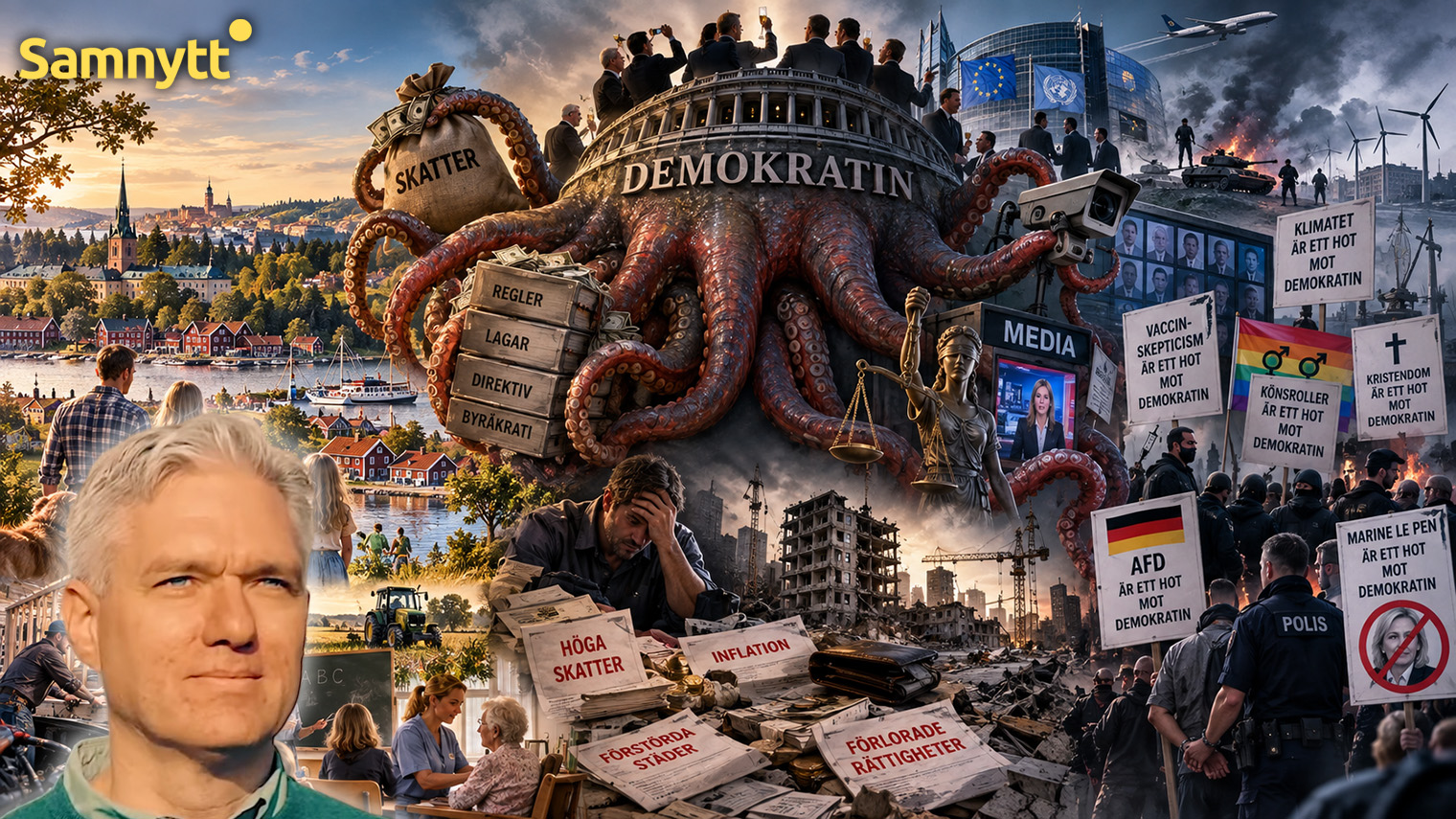
DEBATE • A popular headline template in the media is “X IS A THREAT TO DEMOCRACY,” where the variable X is replaced by something traditional, libertarian, or reasonable—things that used to be considered right-wing.
The alleged threats to democracy are becoming increasingly bizarre. For example, nowadays freedom of speech is counted as a threat to democracy. The opinions and expressions of subjects are monitored by authorities, and regime-critical statements are prosecuted as incitement against ethnic groups. The so-called climate changes are a threat to democracy. Vaccine skepticism, abortion opposition, gender roles, and Christianity as well. Democratic parties and popularly elected politicians are also a threat to democracy: In Germany, the established parties are figuring out how to ban the competitor AfD, and in France, the most popular party leader Marine le Pen is banned from participating in elections. All to protect the fragile democracy from the threatening people.
Personally, I care about democracy roughly zero. There are far better forms of government. Or, I care in the sense that I believe democracy is a threat to society. After just a generation with universal suffrage and a fully developed social security system, democracy quickly began to attack society: plundering with high taxes and inflation, tearing down beautiful cities, curtailing obvious rights, and abolishing itself. Google “threat to democracy.” The conclusion is that democracy is a threat to democracy, which is, after all, what history teaches us. America’s second president John Adams said that “There has never been a democracy that did not commit suicide.”
Society’s Parasitic Upper Layer
Let’s sort out the concepts a bit. A society is a group of people who stick together. They do this because of common origin, language, geography, religion, and similar values about property, personal freedoms, and more. Society is us. All of us who live our lives, make a living, create prosperity, raise the next generation, drive diesel cars, eat meat, fly on vacation, develop the new, improve the old, care for, nurse, teach. It’s society’s members who organize everything that’s accomplished and create all the necessary resources. Society is ancient, it has lived and developed over thousands of years. It has consistently improved our material conditions through hard work, investment, and sacrifice.
On top of society we have the state, called democracy by politicians. Economically speaking, it’s a parasite that sucks its nourishment from society and never creates a shred of prosperity but only redistributes what society creates. Nevertheless, it has granted itself the right to control its host. It is ruled by a work-shy class of “representatives” who have rarely held an honest job. In its current form, democracy is about a hundred years old. Compared to society, it’s a newcomer that’s barely dry behind the ears. Yet it considers itself to know better than thousands of years of customs and traditions. Society struggles on even though democracy throws a wrench in the works with a growing bureaucratic burden of rules, sabotages our energy supply, stifles wealth-generating businesses, bleeds us of resources and distributes them to foreigners, war profiteers, and friends in corrupt states and global organizations.
The Innocent Origins of the Parasite
Where does the parasitic layer come from? Imagine people at the dawn of time. There have always been malicious elements who disrupt peace, freedom, security, and want to take other people’s stuff. People organize with like-minded individuals to protect themselves against others. Defense is a group effort since individuals alone are weak. Coordination and organization are required. Practically, this could be managed in many ways. For example, it could be handled by ONE strong and wise leader (monarch, dictator, enlightened despot), or by a particularly competent group in society (aristocracy), by religious leaders (theocracy), or under the influence of the entire populace (mass democracy), just to name a few possibilities.
It essentially does not matter how society chooses to organize itself, as long as society’s own members are satisfied. Different arrangements have their strengths and weaknesses (think about it!). However, according to the liberal democratic world order, mass democracy is the only legitimate way. People who have not yet succeeded in reaching this blissful state must therefore be bombed until they learn.
Turning the Weapons Inward
It is human to want to live comfortably off others’ work. Therefore, rulers—no matter the form of governance—must be kept in check with the threat of severe punishment. This applies to elected representatives as well as dictators. But soon enough, they begin to set up protection mechanisms to secure their comfortable position. Popular mechanisms are, for example, buying votes with subjects’ money, four-percent electoral thresholds against political competition, curricula that impart the rulers’ worldviews to the next generation, state regime media, and opinion laws. Thus, an entire population can be made to believe it is freedom and civilization that murderers, pedophiles, migrant workers, illiterates, and people who have never held an honest job or managed a logical conclusion get to have a say over you, your freedoms, and your children’s future.
Over time, the subjects’ money runs out. The very last dregs have been scraped from the domestic electorate’s barrel, and indeed they have even imported a new and docile electorate. The political decisions become increasingly bad and short-sighted to accommodate the lowest intellect of the population. Society starts to creak at the seams, the subjects grumble. The rulers have run out of carrots and now have to resort to the stick to protect their elevated position—i.e., “democracy”—from the mob who threaten it with their unmotivated “hate.” Out of frustration and fear, the rulers turn their weapons inward—the subjects become the enemy—and simultaneously turn their interest outward to foreign policy, climate, unions, alliances, wars, where they find sympathetic like-minded people from other states.
The organization that began as a legitimate way to protect common interests has thus gone off the rails, gained a life of its own, and become an end in itself.
Society is More Important Than Democracy
The inability to distinguish between society and democracy makes it hard for people to correctly formulate problems. Those Swedes who early on opposed the population exchange did so mainly because they saw how it changed society. They quickly detected insecurity, violence, and that it simply feels uncomfortable when there are strangers around with whom we have nothing in common. They resisted because they wanted to preserve a good society. They also understood that in the long term, our self-governance and freedoms were threatened, but that consequence was far off and secondary.
For most popularly elected politicians, it is instead their own livelihood and career—i.e., “democracy”—that are most important. Society is secondary. They confuse them roughly like King Louis XIV: “Society? That is democracy.” The same confusion is also common among political commentators trained in the same way of thinking.
Here, for example, is Henrik Jönsson with How Islamism Threatens Western Democracy. And here an immigrant explains to us that Christianity threatens “our democracy” more than Islam.
It is only now, when immigration begins to threaten politicians’ positions and perks (“democracy”), that the issue starts to burn for the elected. The current and outgoing government therefore commissioned a study last summer entitled Religious Radicalization with Focus on Political Islam – Consequences for Democracy, Integration, and Exclusion. The title reveals that they are still not interested in Swedish society, only in “democracy” and that guest workers don’t feel sufficiently at home among Swedes.
Minimize Democracy’s Influence on Society
Throughout history, people have tried to protect society from “democracy” in various ways. Kings were forced to go on royal progress and swear an oath to respect the old laws and customs. The constitution is a modern way of trying to shield society from the harmful effects of democracy with phrasing like “the individual is guaranteed against the public…”. Even the Penal Code tries, under the heading of high treason, to prohibit putting Sweden under foreign rule. Unsurprisingly, democracy over time has taken the liberty to interpret and ignore the laws designed to limit it.
Tips for the Election
With every new gift, every new law, and every international union, democracy expands its power over society, families, and individuals. It does not voluntarily relinquish power to the individual. The likelihood that Sweden can be repaired democratically is vanishingly small. The work must be pursued on several fronts. General elections are only ONE such front, perhaps even the most hopeless of all. But if you participate in the election, democracy’s holy sacrament, look for representatives based on the following principles: Reduce democracy’s influence over society, much lower taxes, independent foreign policy, diplomacy instead of war-mongering, Swedish sovereignty, withdrawal from international organizations, and increased local self-governance. The selection is not large.
Klaus Bernpaintner
Article originally published on Folkungen.