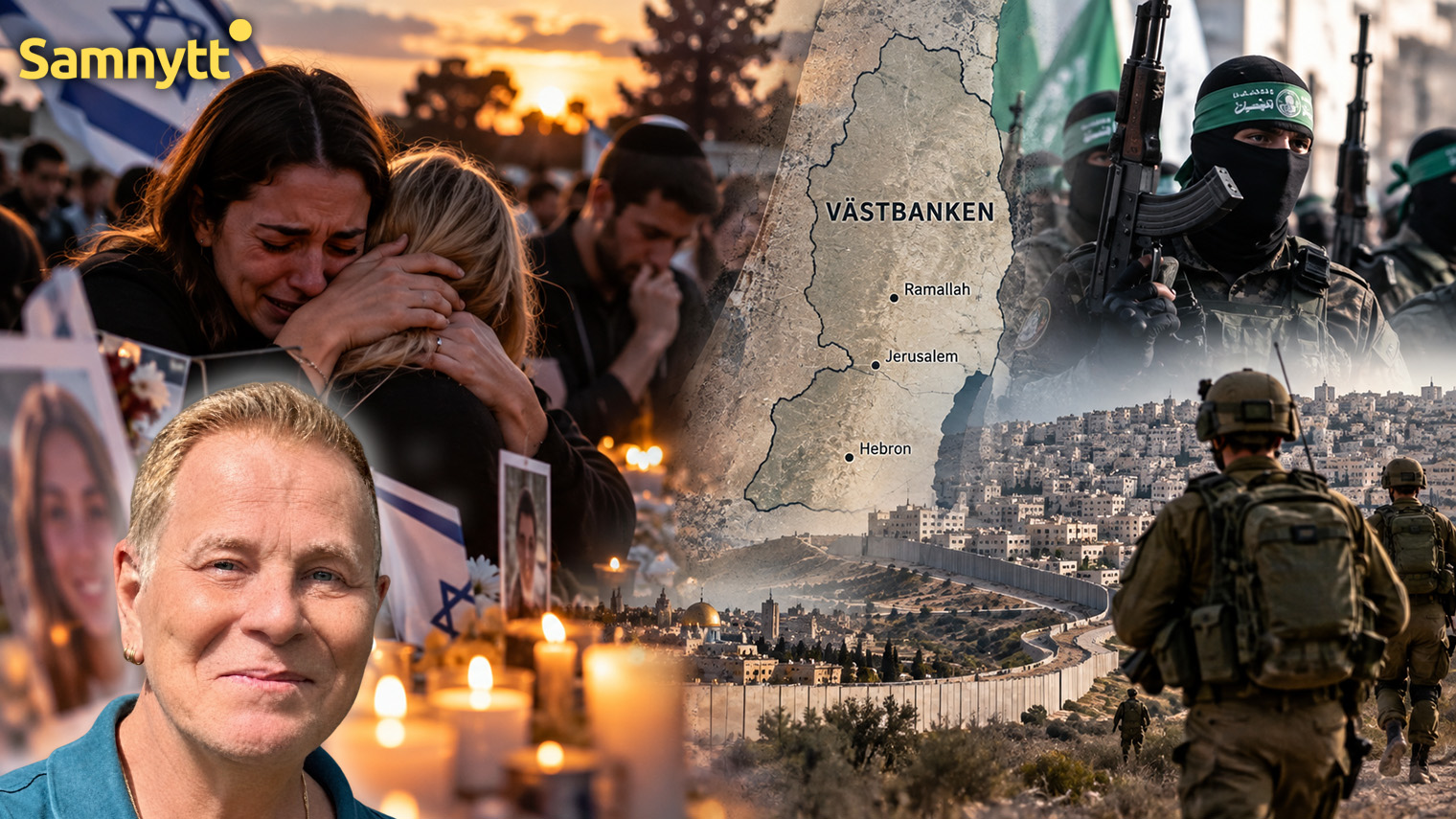
EDITORIAL • On Wednesday, three years had passed since the Hamas massacre of October 7, 2023. The attack and its aftermath should also have prompted a more reality-based discussion about one of the most prominent concepts in the Middle East conflict—the Israeli ‘occupation’ of the West Bank. The term is used by the dominant interpreters of international law. Israel disputes this description. But behind the legal dispute lies an even more difficult question: To whom would Israel hand the area over—and what happens the day after?
On Wednesday, Israel again paused to remember October 7, 2023. Around 1,200 people were killed when Hamas and other Palestinian terrorists stormed across the border from Gaza, and 251 people were taken hostage.
Three years later, all remaining hostages have returned, alive or dead, and since last October, a formal ceasefire has been in place in Gaza. But the conflict is far from resolved. Hamas has not been disarmed, violence continues, and Israel still controls large parts of the Gaza Strip.
October 7 changed much. But the attack should also have changed the discussion about what Israel is expected to do with the other Palestinian territory—the West Bank.
This is because a number of terms are still repeated as if they, in themselves, decide the whole conflict—’occupied Palestinian territory,’ ‘the 1967 borders,’ and ‘illegal settlements.’
There is strong international legal support for this terminology. But there is also an Israeli objection that is all too rarely even presented.
Occupied from whom?
This question is posed in an informational film a few years ago about the West Bank’s history and legal status.
The film’s arguments are clearly Israeli. But its fundamental question is relevant: If Israel occupied the West Bank in 1967—from which sovereign state was the area occupied? The answer is Jordan.
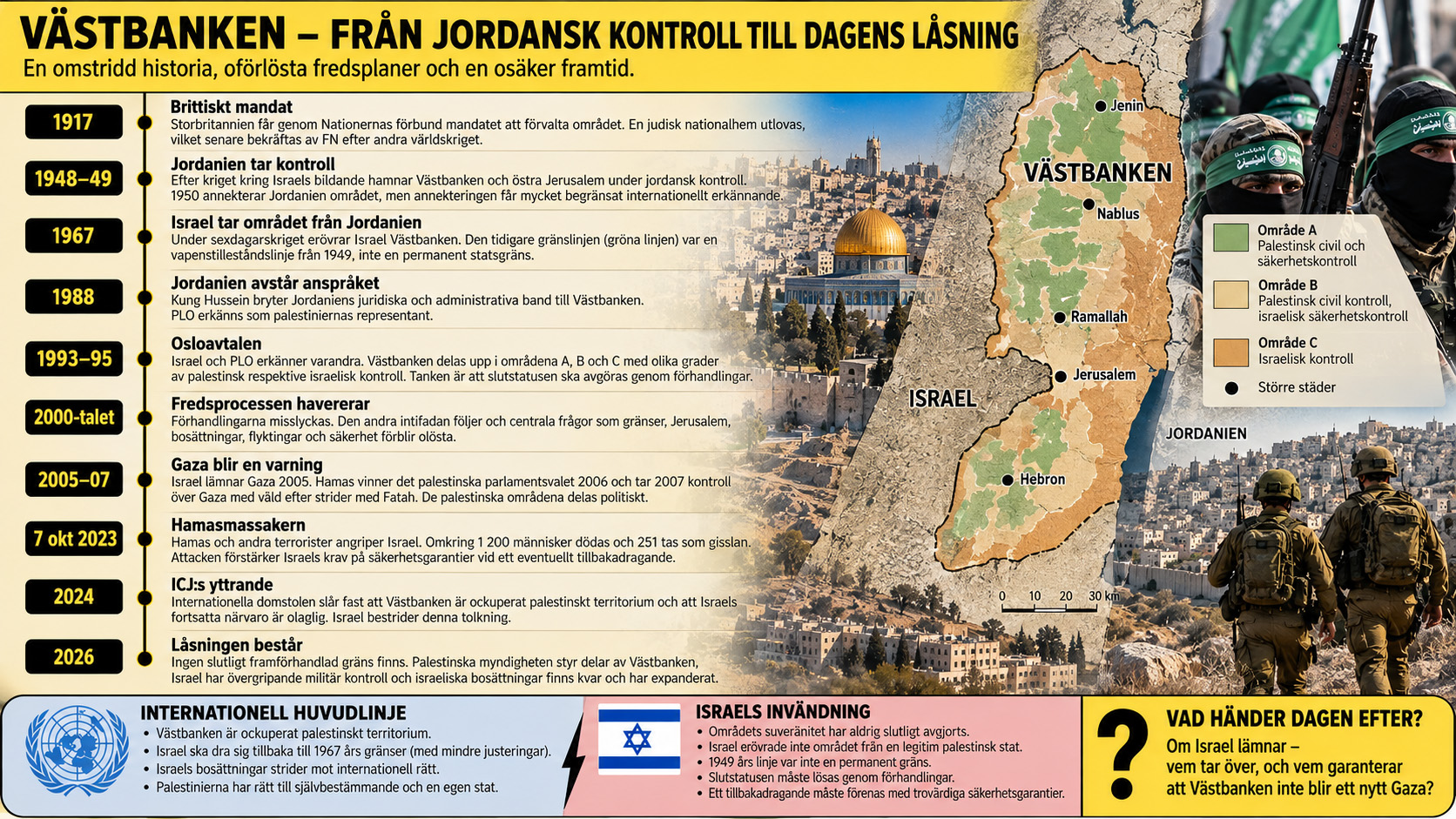
After the war of 1948–49, the West Bank came under Jordanian control. Jordan annexed the area in 1950, but this annexation won very limited international recognition. When the Six-Day War broke out in 1967, Jordan entered the war and Israel captured the West Bank.
What is often called ‘the 1967 border’ was, in fact, the 1949 armistice line, the so-called Green Line. This was expressly not established as a final international border.
UN Security Council Resolution 242 after the war demanded an Israeli withdrawal from territories occupied during the conflict, but at the same time linked this to the right of every state in the region to live within secure and recognized boundaries. No final border between Israel and a future Palestine was established.
This forms the basis of the Israeli position that the West Bank should rather be described as ‘disputed territory’ than as an area Israel occupied from a previously legitimate Palestinian sovereign state. The logic goes further to argue that, for this reason, Israeli settlements are not inherently illegal. Among others, this view refers to legal scholars Eugene Rostow, Arthur Goldberg, and Stephen Schwebel.
The argument gained an additional component in 1988. That year, Jordan’s King Hussein severed the country’s legal and administrative ties to the West Bank and gave the PLO the responsibility to represent the Palestinians’ national claims. So today, there is no Jordanian state demanding that Israel return the West Bank to Jordan.
The world says otherwise
However, it would be misleading to present the Israeli interpretation as the internationally dominant one. It is not.
The UN, EU, and a large part of the international community regard the West Bank, including East Jerusalem, as occupied Palestinian territory. The International Court of Justice (ICJ) in its advisory opinion in 2024 concluded that the area is occupied and went even further—Israel’s ongoing presence was deemed illegal and the settlements considered a violation of international law.
The Court’s reasoning is based, among other things, on the Palestinians’ right to self-determination and the principle that territory cannot be acquired by military force. This is heavy legal ammunition against Israel’s position.
But even within the ICJ, the issue was not as uncomplicated as it is often portrayed. Three judges—Peter Tomka, Ronny Abraham, and Bogdan Aurescu—objected to the conclusion that Israel’s presence as such could be declared illegal and that the country should be expected to withdraw without guarantees for its security. Their objection leads directly into the question that law cannot magically solve: What happens after the withdrawal?
Gaza provided an answer that cannot be ignored
Israel has already carried out an experiment similar to what the country is being urged to do in the West Bank. In 2005, Israel left the Gaza Strip, withdrew its soldiers, and dismantled the Israeli settlements there.
The following year, Hamas won the Palestinian parliamentary election. The conflict with Fatah then turned into open violence, and in 2007 Hamas took control of Gaza by force.
The result was not the peaceful Palestinian statehood many had hoped for. It was dictatorial Hamas rule, rocket attacks, recurring wars—and ultimately October 7, 2023.
This does not mean that the West Bank and Gaza are identical. Nor does it mean that Palestinians can be denied the right to political self-determination just because Hamas exists, though it is very much questionable whether they are ready to be entrusted with the governance of any Palestinian state today.
But it does mean that anyone demanding an Israeli withdrawal must also be able to answer what will fill the security vacuum that arises.
Who takes over the day after?
The West Bank is not far from Israel. It lies within Israel’s geographic core area. From the heights of the West Bank, the distance to Tel Aviv, Ben Gurion International Airport, and Israel’s densely populated coastal plain is in some places only a few kilometers.
So imagine that tomorrow, Israel did exactly what critics demand—withdrew the army, relinquished military control, and left the West Bank. Who can then guarantee that Hamas, Palestinian Islamic Jihad, or some future armed movement would not take over? The Palestinian Authority?
It is hard to ignore the problem. The last Palestinian parliamentary election was held 20 years ago. Hamas won. Mahmoud Abbas was elected president as early as 2005, and no new presidential election has been held since. The Palestinian political order is split between Hamas and Fatah and has long lacked a valid democratic mandate.
October 7 also showed what can happen when a terrorist organization has years to build military capability right next to Israeli communities. After this, to demand that Israelis simply trust that the same development will not be repeated in the West Bank is not a peace plan. It is naivete.
The law does not solve reality
This does not mean that everything Israel does in the West Bank is defensible. The continued expansion of settlements is particularly problematic. The more permanent Israeli civilian infrastructure is established, the harder it becomes to claim that the presence is only about a temporary security arrangement while awaiting a negotiated peace.
Therefore, criticism of settlement policy cannot simply be dismissed by referring to Israel’s historical ties to Judea and Samaria. Nor should the security argument become a blank check for permanent Israeli control over the millions of Palestinians who, since 1988, lack citizenship or political rights in the country that ultimately controls their territory.
But the same demand for realism must be made of the other side. A Palestinian state cannot be created by international organizations drawing a line on a map, calling everything on one side ‘occupied,’ and assuming that peace will ensue.
Israel must be able to leave territory without at the same time handing over the heights above the country’s population centers to the next Hamas. Palestinians must be able to achieve self-determination without Israelis being asked to gamble with their existence.
This is precisely why the West Bank is still disputed. One can choose to call the area occupied. There is legal interpretative support for that designation. But the word solves nothing.
After October 7, the most important question should not be which word yields the most diplomatic points at the UN. It should be much more down to earth: How do you end Israeli control without creating the conditions for the next October 7?
As long as no one can provide a credible answer to that question, the demand that Israel should simply withdraw is much easier to formulate in Brussels, Stockholm, and New York than to implement from Jerusalem.