
EDITORIAL • The story of eight-month-old Emanuel, who was supposedly “to be deported to Iran,” exploded like a bomb just as the election campaign was heating up. But behind the headlines lies a decision that should never have been made and is not enforceable, a family with a long history of rejections and new applications — and reporting that left out crucial context. The issue is not just what happened in this individual case, but which narrative has been deliberately constructed, by whom, and with what agenda.
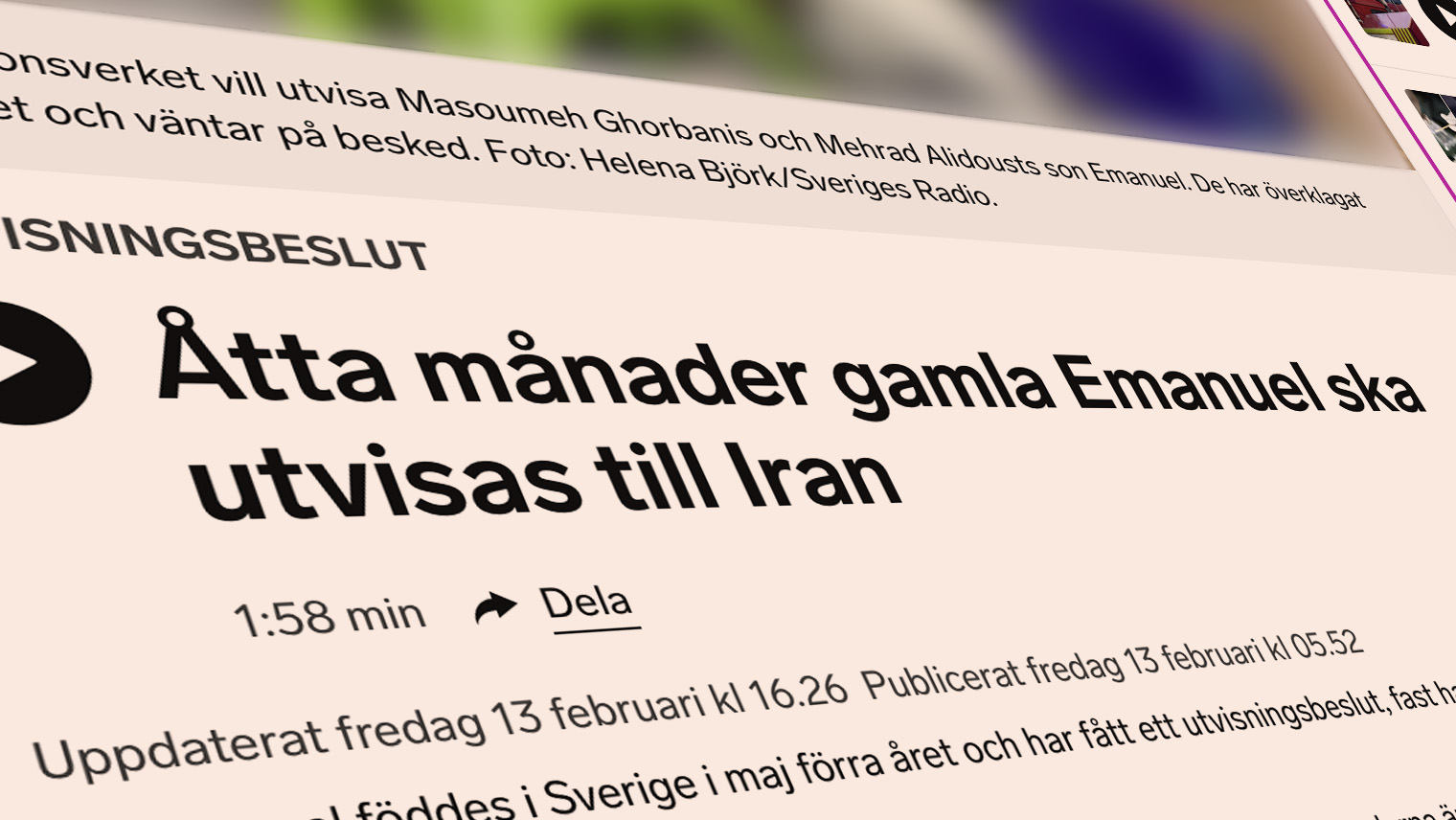
It was Sveriges Radio that first broke the story: an eight-month-old baby was to be deported to Iran. The headline was dramatic, the angle clear. Soon, other newsrooms followed suit. The case was used as a symbol of the consequences of the new migration policies put in place under the Tidö Agreement.
But several key facts were missing or overshadowed. The decision has been appealed and is therefore not enforceable. Even if it hadn’t been appealed, it couldn’t have been enforced anyway.
The Convention on the Rights of the Child, along with a number of other laws, rules, and basic ethics, prevents a baby from being torn from its parents and put alone on a plane to a foreign country. The case officers at the Migration Agency who made the decision know this; so do all the journalists who reported on it, and all politicians and opinion-makers who commented on it.
Pretending Not to Understand
But they pretend not to understand. And they do so for a reason: to paint the Tidö government in general — and the Sweden Democrats in particular — in the worst light possible and to set the bar for the decency of political debate at the lowest level from the outset of the campaign. Count on seeing more of this — much more.
The parents’ work permits are to be reviewed again within a few months. Under the new stricter rules, it will likely be denied, and the family will have to return home to Iran. If you read the history of their case, stretching back seven years, you’ll see they should have left Sweden a long time ago — and definitely before the child was born. Both parents separately received carefully considered deportation decisions as far back as 2020.
If the parents, against all odds, were to manage to remain in Sweden yet again through dragged-out proceedings, then of course little Emanuel would also get to stay. A separate deportation order for the baby was entirely unnecessary — unless there’s a hidden agenda.
One might think it was done as a formality, but that would only be the case after the parents’ cases had been processed and rejected. That the decision was made before, as if it really involved a separate baby deportation, can only be interpreted as bureaucratic activism at the Migration Agency in collusion with tax-funded media whose press ethics are sorely lacking — in general, but especially considering the impartiality requirement SR must uphold as a condition for being financed by forcing every Swede to pay for its operations through taxes.
The reporter behind the story, Helena Björk at Sveriges Radio, later admitted to Samnytt that the wording could have been different. That’s an understatement that is insufficient as an excuse or explanation from Public Service. The image has already taken root among many Swedes who still naively believe the media is honest: Sweden deports infants. Björk and her SR Ekot colleagues will in all likelihood not make any effort to undo the damage.
Narrative and Agenda Left Unchallenged
Everyone agreed it sounded absurd, but no one drew the correct conclusions. Christian Democrat leader Ebba Busch suggested that the legislation might need to be reviewed, as if she had been somewhere else when the government prepared the law. Sweden Democrat leader Jimmie Åkesson called it absurd to even imagine the government and lawmakers advocating a system where infants are deported on their own.
SD’s migration spokesperson, Ludvig Aspling, unintentionally but understandably acted as a useful idiot for the opposition by assuming no case officer at the Migration Agency could have made such a foolish decision and called the media reporting “deliberate disinformation.” His knee-jerk denial that the decision existed gave people like Aftonbladet’s Oisin Cantwell room to accuse the government of lying, since he had seen the document himself.
The decision is a public record, and Busch, Åkesson, and Aspling should have checked before commenting. Understand that it’s not unthinkable that such a decision was made, and then understand why it was made and leaked to the media. When it became clear that the decision really existed, total confusion ensued — and the narrative of ignorant lawmakers and dishonest government officials was amplified, quite unnecessarily.
But even at that stage, they failed to act proactively to disarm the opposition and take control of the situation. They simply pointed out that the Migration Agency had stated it could have waited, that it would have been more natural to await the parents’ upcoming residency review instead of making a separate rejection and deportation decision for the child.
They should have realized that the damage was greater and that attack is the best defense. They should have criticized the bureaucratic and media activism reflected in the decision and its attention. They should have summoned the head of the Migration Agency for a meeting to in turn call in their agency-abusing officials. The chief of SR Ekot should have been summoned for a similar conversation.
The Family’s History — The Forgotten Part
Reporting largely continued to focus on the baby, only scratching the surface of the parents’ application history. They missed the opportunity to show that these two are prime examples of why tougher laws are necessary.
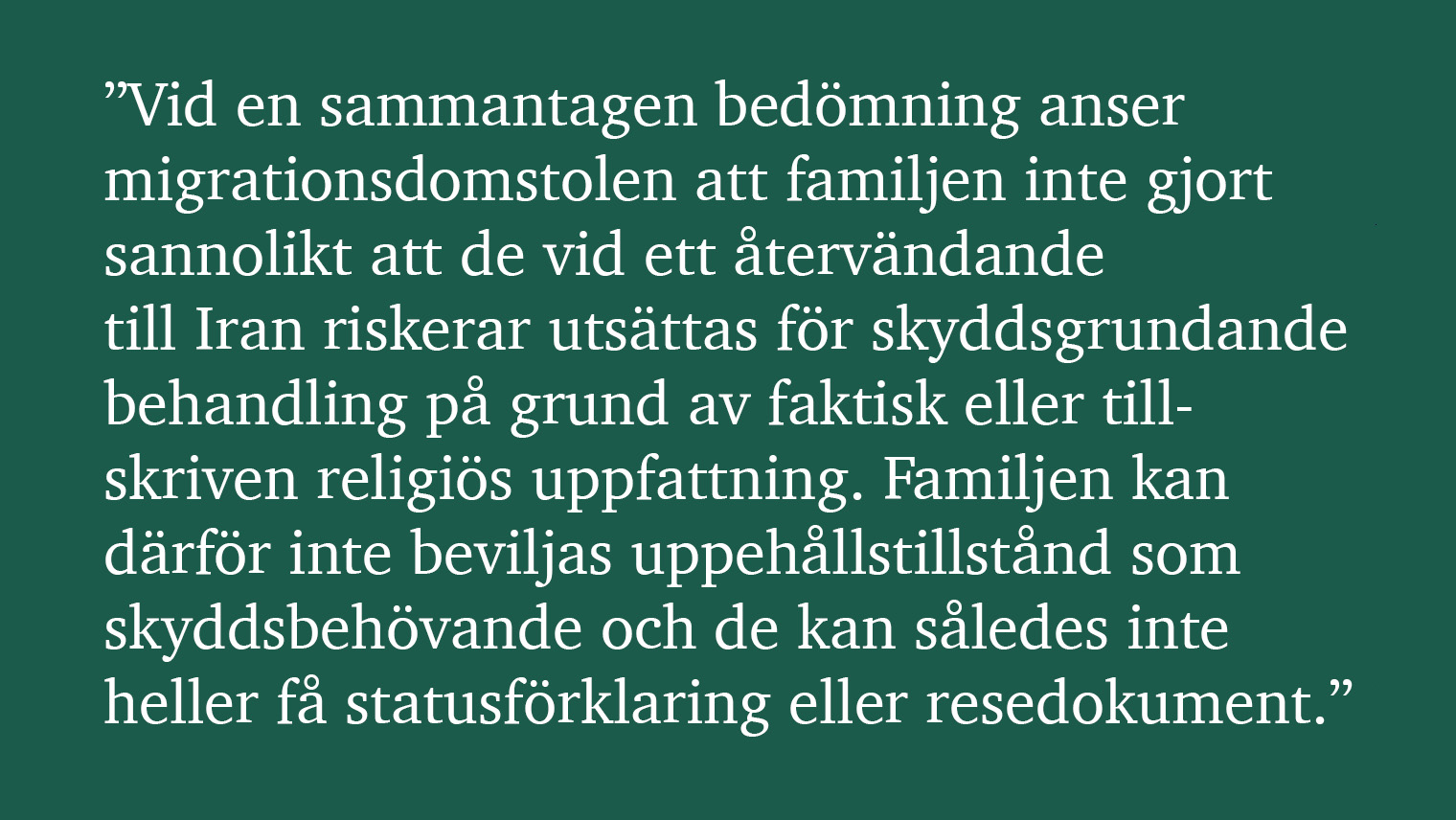
The mother applied for a residence permit in 2019. Rejected. The decision confirmed by all levels of the court system. The father has a similar story, including a revocation and a legally binding deportation order. Since then, new applications, switching of grounds, and time-limited work permits have prolonged their stay step by step.
Cases like this are not in any way unique; on the contrary, it’s more the rule than the exception. Just about every other migration case looks like this, not least because a cadre of activist lawyers has emerged who help migrants not to secure their rights, but to abuse the system by finding loopholes in the Aliens Act — while cashing in generous fees.
ALSO READ: SR Spreads Disinformation About Baby Deportation
This sort of scheme — endless chains of new applications and extensions — is exactly why the legislation was tightened. In this case, the Iranian couple should have packed up and left more than five years ago. This family is not a victim; they are abusers of the system, and the government in general and the Sweden Democrats in particular should have gone on the attack with that message to neutralize the sob-story journalism.
When the option to switch grounds was limited, many relatives’ eligibility for permits vanished too. The aim was to address abuse of labor migration, wage dumping, and a system where temporary permits in practice turned into long-term residence without protection grounds. It was not to send babies alone on flights to Tehran. The rhetorical counterattack that should have been at cannon level was instead nothing more than a cap gun.
Reading the Law “Like the Devil Reads the Bible”
Formally, many laws can be stretched in their interpretation. In theory, a prosecutor could charge minor negligent homicide as murder and demand life imprisonment instead of a fine. A court could, in principle, rule accordingly. But practice, proportionality, and professional integrity set limits on how the letter of the law is interpreted and applied.
The same applies to administrative decisions. Choosing the most drastic interpretation and application when another approach is more reasonable is not neutral bureaucratic procedure. If a Migration Agency case officer absurdly decides to deport an eight-month-old baby alone, there must be a motive. When the decision then receives maximum media exposure without the proper actors being questioned, that image intensifies.
At the taxpayer-funded Ekot newsroom, they are certainly not so stupid as to believe the Tidö parties intended to rip infants from their parents and deport them. Nor are they so dumb as not to grasp that the official who made the decision overstepped, as did any superior who approved it.
That is where the media scrutiny should have focused. Instead, they played dumb in conjunction with Migration Agency activists to discredit the Tidö parties as the election campaign began. Exploiting loopholes in the Aliens Act is not an outlier, and neither is this kind of bureaucratic and media activism.
A Serious Democratic Problem
This case reminds us that we have a major democracy problem in Sweden. When agencies fail to act impartially and the media do not report without bias, democracy is fundamentally undermined. Much debate centers on influence operations from foreign powers, but the real risk that this autumn’s parliamentary election will be manipulated, that voters will go to the polls misinformed instead of well-informed, comes from internal sources.
It is understandable that a picture of a baby provokes strong emotions. It is not the first time it has been exploited by cynical activists hiding behind a journalistic facade. We all remember the close-ups and the exploitation of Alan Kurdi’s tragic death for migration-liberal purposes. But the purpose of news journalism is not to maximize emotional reactions by exploiting children, but to give an accurate picture. This shouldn’t even need to be said.
No one seriously believes that Sweden would tear an infant from its parents’ arms and send it alone to Iran. And yet, that is exactly the perception that was allowed to dominate. Another aggravating factor is that those involved were well aware of how this could be exploited by actors who have for some time misled people about Swedish authorities taking Muslim children from their parents. But no level of irresponsibility is too much when there’s a chance to smear the Sweden Democrats and the other Tidö parties.
The real problem is not that Swedish laws aren’t airtight against idiotic and activist application. No law can be 100% secured against that. The problem is that we have decision-makers unafraid to abuse loopholes rather than deciding as the legislators clearly intended. The problem is not our press freedom — it’s that we have journalists who abuse every notion of press ethics and professional honor by allying with activist decision-makers.
The migration policy change was made to restore order, fight abuse, and rebuild trust in the system. You can agree or disagree with that direction. But the debate must be waged decently and by the right actors — not by government officials or news journalists, but by politicians and opinion leaders.
The dysfunctions in decision-making and news reporting laid bare by the case of eight-month-old Emanuel do not provide a sustainable foundation for either journalism or democracy.