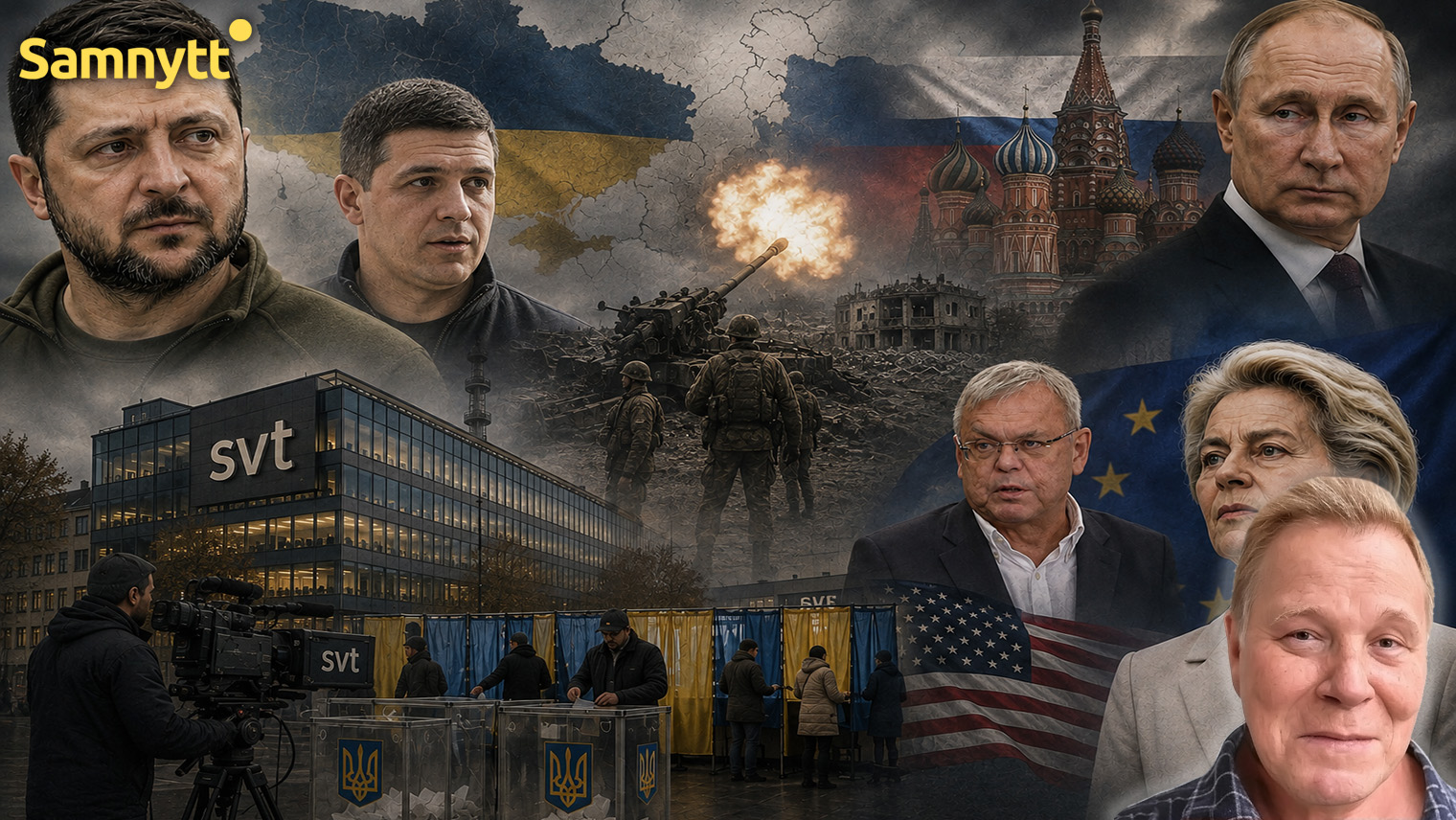
EDITORIAL • Volodymyr Zelenskyy has now responded to dismissed Defense Minister Mykhailo Fedorov’s demand for a path back to the ballot box even as the war continues. The president has several strong arguments against holding elections in the midst of a raging war, as I have previously noted in an earlier editorial. But perhaps his clearest argument is problematic—that an election would split Ukraine and indirectly benefit Putin.
This casts suspicion on Fedorov, accusing him of serving the enemy, when his main argument for holding elections is that Putin MUST NOT be allowed to decide over Ukraine’s democracy. The fact that people have different opinions about who should govern the country is not a problem that democracy should be protected from, nor something that should be suggested as benefiting Russia. That people disagree is the very reason democracy exists.
“If we want to destroy the country, we can move toward elections during a war like this,” said Volodymyr Zelenskyy when he met journalists on Sunday. He went further than that. According to the president, an election right now would be a “tsunami” for the state that would split Ukraine. His own strategy, instead, is to lead the country to the war’s end and preserve an independent and sovereign state.
These are Zelenskyy’s clearest comments so far in response to the recently dismissed Defense Minister Mykhailo Fedorov’s prominent demand that Ukraine must find a legal, safe, and realistic path back to the ballot box even if the war against Russia becomes protracted. There is much in Zelenskyy’s reply that is hard to dispute, but also things that can be questioned.
Elections Under Bombs Are a Real Problem
How do you conduct a fair presidential election when hundreds of thousands of voters are in uniform? How do you ensure soldiers at the front can actually vote? How do millions of Ukrainians living abroad participate? What about people near the frontlines and voters from areas occupied by Russia?
In addition, there’s a more fundamental concern: security. Ukrainian cities are still subjected to Russian missile and drone attacks. Polling stations, political meetings, and campaigns could become targets. Zelenskyy himself points out that soldiers, people in frontline areas, and Ukrainians abroad must be able to participate and that voters must simultaneously be protected from Russian attacks.
He also says that no one has yet presented concrete conditions that would make such an election safe, legitimate, and democratic. These are serious arguments. A democratic election does not merely consist of putting a slip in a ballot box.
READ ALSO: Dismissed Defense Minister Challenges Zelenskyy as President
The opposition must be able to organize. Candidates must be able to travel, debate, and criticize the government. The media must be able to scrutinize power. Citizens must be able to participate under reasonably equal conditions.
An election that large groups of Ukrainians may be excluded from risks creating as many legitimacy problems as it is meant to solve. But Zelenskyy doesn’t stop there. He also uses political division per se as an argument against elections. Here, his reasoning becomes much weaker.
Democracy Exists Because People Are Divided
The fact that an election might reveal that Ukrainians are divided on the country’s leadership is not a democratic argument against holding elections. That is the very point of elections.
Democracy is not necessary because a people already agrees. If everyone were of the same mind about the president, the government, and the country’s future direction, the democratic process would be almost unnecessary, and calls for an election would merely be a formality, hardly outweighing the counterarguments previously listed.
Elections exist because people are politically divided and therefore need a peaceful and legitimate way to determine who gets power. That the Ukrainian people are divided in their opinions is not an argument against but for elections.
READ ALSO: Dagerlind: Could the Ukraine War Have Been Avoided with Trump?
Zelenskyy also finds himself in a situation where his arguments must be examined particularly closely. He is not a neutral observer on the question of whether Ukraine’s current president (himself) should have to face the voters.
His normal term would have ended in 2024 under regular circumstances. He remains legally in office because martial law prevents elections and the Ukrainian constitution allows the president to remain until a successor takes office. This does not make him formally illegitimate.
But this does not change the obvious self-interest when the same president argues that an election would be dangerous because voters could be divided over who should govern them. And the longer he serves on a formally—but not democratically—renewed mandate, the more reason there is to be critical of his arguments about political division—and for him to refrain from making them.
Fedorov’s Arguments Point the Other Way
This also makes Fedorov’s demands all the more important. His argument has not been that Russia should dictate Ukraine’s future. To insinuate as much is dishonest. What he has said is the exact opposite. “We must not let Putin decide when Ukrainians can choose their government,” Fedorov said as he demanded that a model for future elections be developed.
The reasoning is straightforward. Russia invades Ukraine. Ukraine imposes martial law. Martial law suspends elections. As long as Russia continues the war, the suspension remains, preventing Ukrainians from choosing a president.
READ ALSO: Dagerlind: How Long Can Zelenskyy Govern Without an Election?
If this state of affairs continues indefinitely, Vladimir Putin indirectly obtains a veto over when Ukrainian democracy can once again use its most fundamental instrument for political accountability. This does not mean Ukraine must vote next month. But it does mean that Fedorov’s question deserves a better answer than that elections would create political division.
When Democracy Is Said to Benefit Putin
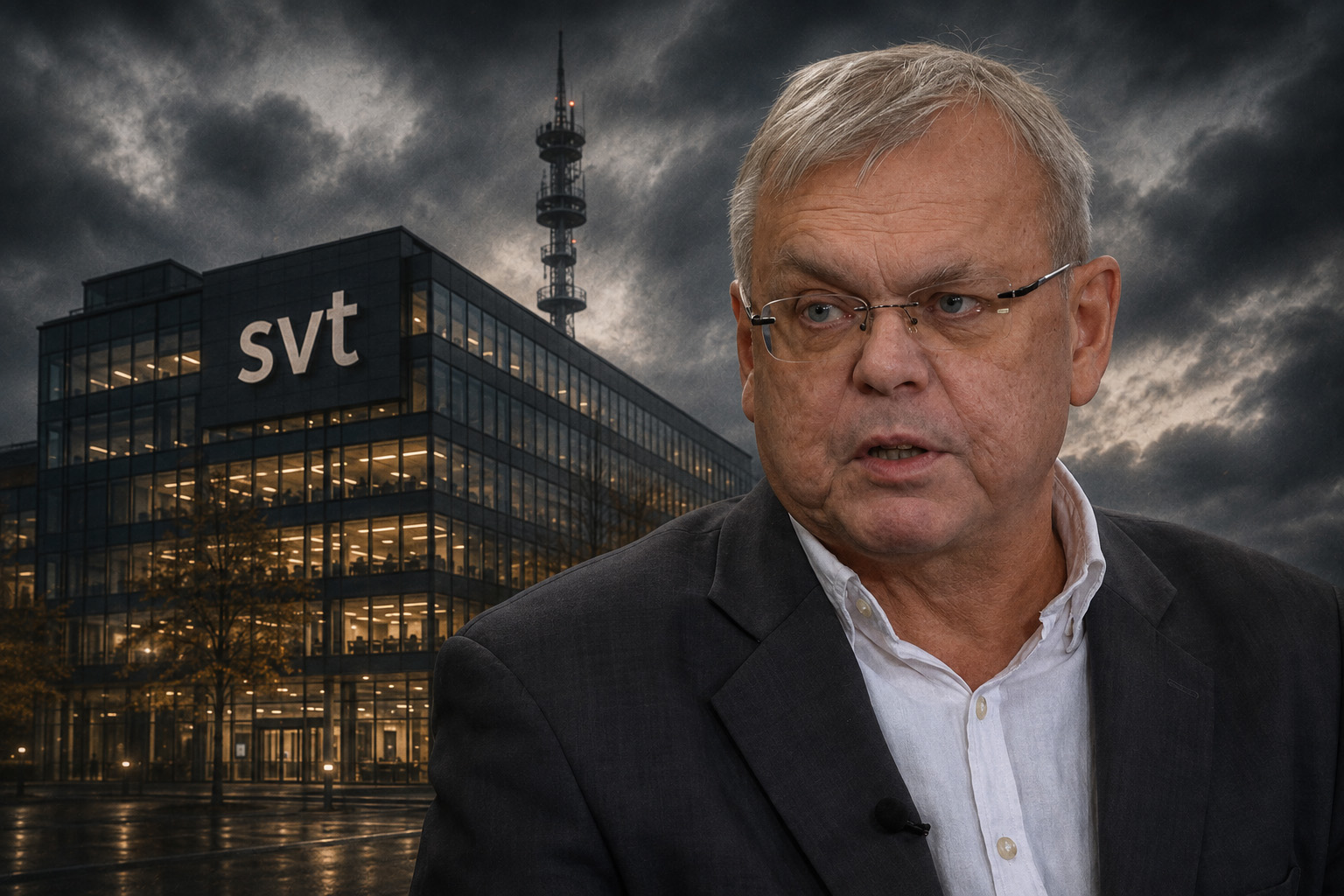
A strange paradox also arises in Western reporting. SVT foreign correspondent Bert Sundström stated after Fedorov’s move that political divisions in Ukraine would weaken the country and therefore be “very welcome” for Putin. SVT also headlined the article that division “may benefit Putin.”
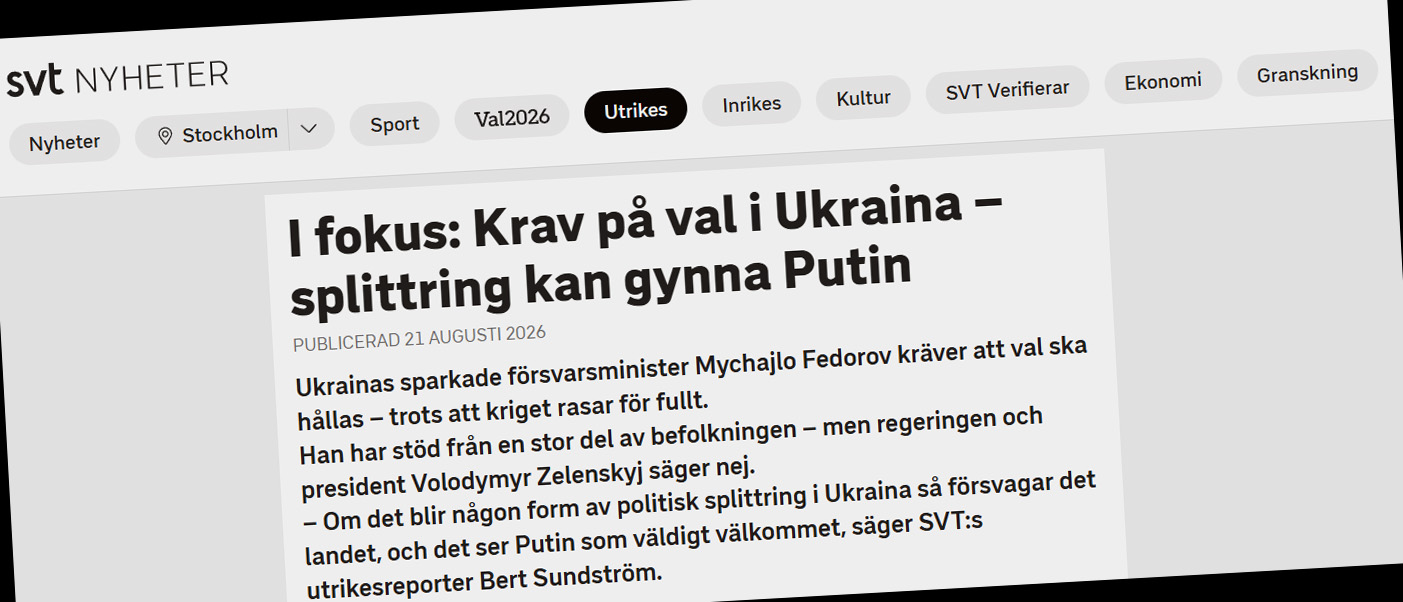
This is not an argument that a public service outlet with a special democracy clause should highlight as primary. Playing the “Russia card” is also heavily worn and abused, used for nearly everything the left-liberal establishment dislikes but lacks factual arguments to counter.
Applied to the issue of elections, a problematic logic emerges. Fedorov says: Putin should not get to decide when Ukrainians vote. The response is: But if Ukrainians vote, the result of the political process might benefit Putin.
READ ALSO: Albinsson: Ukraine – the Perpetual War?
By this logic, soon every political conflict, government criticism, or opposition to those in power could be described as objectively helping the enemy. This is a dangerous way to reason in a democracy but convenient for those lacking other rhetorical ammunition. That something could please Putin does not automatically make it undemocratic, illegitimate, or wrong.
The outcome of a Ukrainian election could just as easily make Putin dismayed, depriving him of the opportunity to claim the Zelenskyy government’s pro-West, EU, and NATO course is not anchored in the Ukrainian popular will. The longer Zelenskyy remains in office beyond his term, the easier it becomes for Putin to claim that Ukrainians want something other than the president.
The West Knows What It Has in Zelenskyy
Additionally, there is another interest that should not be ignored. The US and Europe have invested enormous economic, military, and political resources in Ukraine during the war. With Zelenskyy, Western governments largely know what they are getting.
He has been a consistent partner, anchored Ukraine’s future in the EU and NATO, and led the country through extensive military and political cooperation with the West. A change of leadership would bring uncertainty.
A new president could be just as Western-oriented as Zelenskyy. But he or she could also prioritize a quicker end to the war, want to make different compromises with Russia, or reconsider aspects of relations to Washington and Brussels. Thus, there is a Western political interest in continuity.
READ ALSO: Dagerlind: Should Ukraine Have Done as Hungary and Czechoslovakia?
This is not the same as saying there is evidence that the West is blocking elections in Ukraine. But Western preferences for political, pro-Western stability and a proven partner should also not be glossed over.
Democracy’s function in Ukraine is not to guarantee other countries get the government they prefer. A democracy must be able to choose “wrong”—even from its allies’ perspective. And we should therefore not be surprised when media such as SVT, officially impartial but in reality strongly tied to the set of opinions approved in the West, echo that democratic elections in Ukraine are something bad simply because it might benefit someone other than the EU and NATO.
Say What Actually Prevents Elections
That is why Zelenskyy’s strongest reply to Fedorov should also be the simplest. If a democratically legitimate election cannot be held because soldiers cannot vote, millions of people are abroad, parts of the territory are occupied, and Russia can bomb polling stations—then say that.
Explain the specific conditions that must be met. Explain how Ukraine is working to ensure the democratic process can be resumed even if the war drags on. And discuss how the country will prevent a temporary and legitimate state of emergency from gradually becoming a permanent state of affairs.
But don’t say the problem is that an election risks splitting Ukraine. Don’t present democracy as a problem. It is to defend democracy from Russian authoritarianism that Ukrainians are fighting.
READ ALSO: Dagerlind: The Scope for Reform Didn’t End on Its Own – Follow the Money to Ukraine
Fedorov has not presented the solution for how functioning elections during wartime should be conducted. But he has identified a real democratic dilemma—Putin cannot be allowed to continue the war year after year, thereby indirectly deciding that Ukrainians cannot test their political leaders at the polls year after year.
Ukraine is fighting for its independence and for the right to determine its own future. That right must sooner or later include the right to choose who will lead the country. That Ukrainians might then disagree—including having different views than Zelenskyy, the EU, or NATO—is not a threat to democracy. It is democracy.