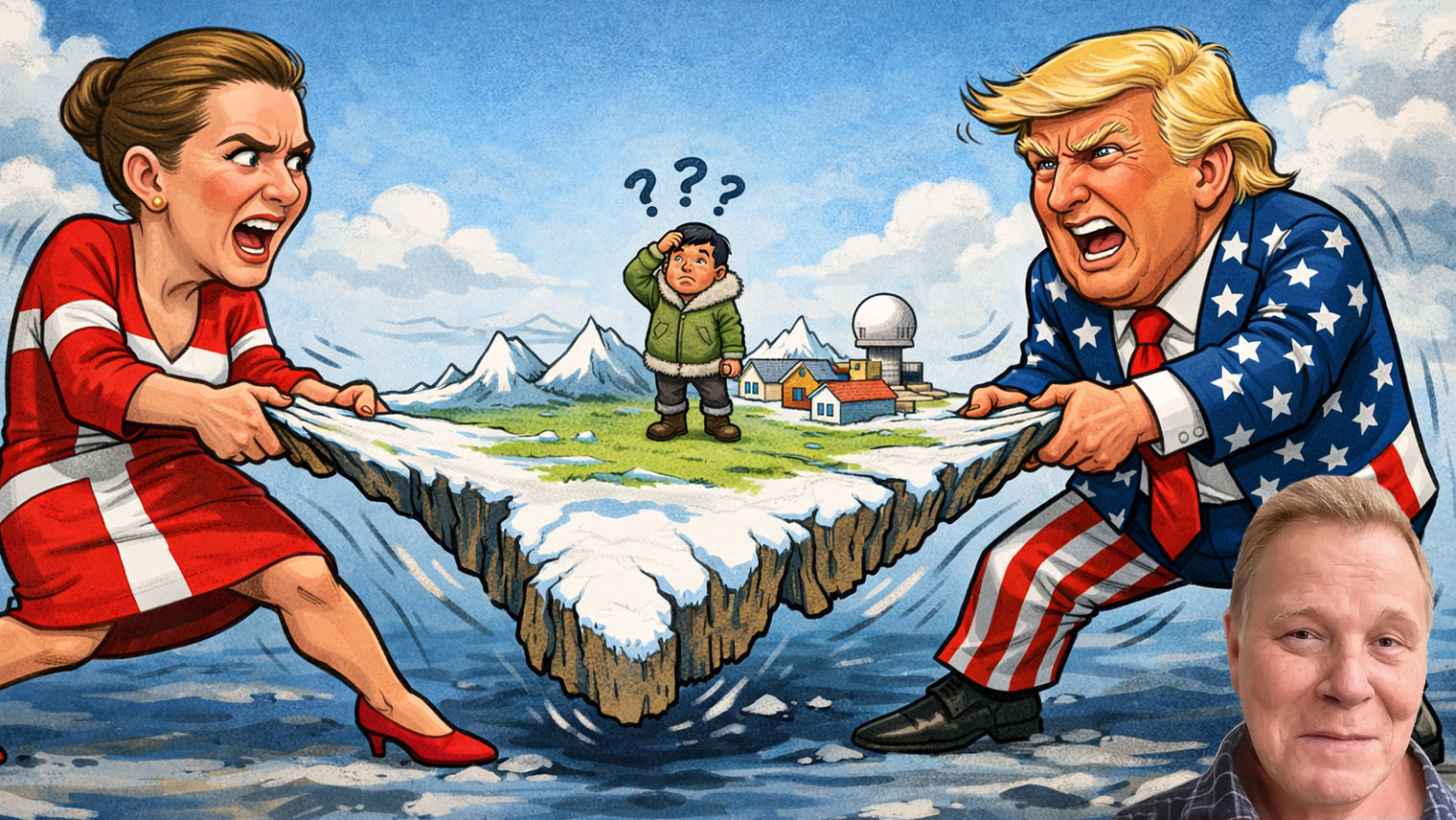
EDITORIAL • The debate about the US interest in Greenland has become stuck in a superficial moral drama: Donald Trump as a predatory imperialist and Denmark as the innocent victim. But this narrative obscures the real issue. The primary absurdity isn’t that the USA wants to take Greenland—but that Greenland is still owned by Denmark. And no one seems seriously willing to discuss what true independence would require, or who actually has the capacity to make it happen.
The thousand-year relationship between the Nordic countries and Greenland shows that presence is not the same as responsibility. Certainly, Nordic peoples have been present on Greenland in various waves—from Erik the Red’s settlements to eighteenth-century Christian missionaries led by Hans Egede—but the political and economic investment has always been minimal. Greenland has never been developed into an integrated part of a Nordic societal project.
This pattern continues into modern times. Despite self-government, Greenland still lacks a self-financed economy, a fully functional state administration, its own military defense, and the export industry and domestic production needed to sustain an independent nation-state.
Denmark has acted more as caretaker than as a developer, if even that. Block grants have replaced long-term institution building. The result is a society stuck in dependency—not by its own will, but by structural design.
The Danish presence in Greenland today amounts to just a few thousand individuals. The indigenous population can at least be counted at ten times that number. It isn’t much for such a vast territory, and many are socio-economically vulnerable and/or suffer from addiction issues. But they are a majority and have the rights of an indigenous people. It’s hard to call today’s Greenlandic situation anything other than a barely disguised colonial legacy and a failure after a thousand years of Nordic disinterest in actual responsibility.
Greenland—a Burden for the Nordic Region
There is a persistent Nordic illusion that Greenland is of strategic interest for the Nordic region or Scandinavia, or even an integrated part of such a ‘we.’ But the nearly total disinterest in developing the country into anything more than it is today reveals the opposite.
Even a unified Nordic region with its own military alliance would have enormous difficulty building up Greenland’s land and sea defenses—even if it wanted to. It doesn’t. Only now that someone else shows an interest in the island does this defense interest awaken.
Greenland has not been developed and cannot be defended by Denmark, and it costs Danish taxpayers a huge amount in subsidies. In a Trump-hostile debate climate, the focus is entirely on the USA’s illegitimate interest in Greenland, while no one questions whether it isn’t time for Denmark to finally deal with its colonial legacy.
The question should have a more pragmatic focus: What would benefit Greenland and the Greenlanders most—status quo under Danish negligence, mismanagement, and a lack of resources to do anything more, or some form of influence from the economic and military superpower, the United States?
Why the USA Cares—for Real
If Greenland is a burden for the Nordic region, why is it a strategic gem for the USA? A central answer is: because the USA is a seapower and an Arctic great power with the resources to actually make use of Greenland. For the USA, Greenland is about three things, in the following order:
|
Greenland’s Strategic Importance
• Geopolitics and Military Reach Control over the Arctic, air and space surveillance, missile defense, and the North Atlantic sea lanes. Russia’s war against Ukraine has not created this interest—but it has sharpened it.
• Great Power Logic, Not Treaty Formalities True, there’s already a 1951 military agreement between the USA and Denmark. But great powers are not satisfied with usage rights when they can obtain ownership, influence, or veto rights. Trump says it out loud, others say it quietly.
• Natural Resources—But Secondary Minerals, rare earth elements, and future exploitation play a role, but as a long-term bonus rather than the main driving force. However, it is clear that China has begun to enter this market, and this competition may eventually become about more than just Greenland’s natural resources. |
The USA’s reduced military presence in Greenland in recent decades does not contradict this. On the contrary: great powers scale up or down depending on the international climate. After World War II came the Cold War, which necessitated rearmament. Then the Warsaw Pact dissolved after the collapse of the Soviet Union, the fall of the Berlin Wall, and Eastern Europe’s transformation from communist dictatorships to democracies. Now, the :censored:6:cdd6bbaa89: situation is tense again.
Military Invasion or Hard Negotiations?
The idea of an American military invasion of Greenland is spectacular—but unlikely. Not because the USA lacks the capacity, but because it would be strategically and politically costly in ways that negotiations are not.
The more probable scenario is a combination of economic incentives, security guarantees, political pressure, and promises of investment and citizenship. All packaged as ‘Greenlandic self-determination.’ This would be nothing new. It is classic American use of power.
True Independence—the Issue Nobody Wants to Touch
The big blind spot in the debate is that almost no one seriously discusses real independence for Greenland from a post-colonial perspective, which one might think should be priority number one. Surely it can’t be more important to detest Trump than to reflect on how his proposal could put an end to the last remaining vestiges of the colonial legacy in the Nordic region?
Making Greenland—and also the Faroe Islands—truly independent would require decades of institutional support, massive capital transfers, security guarantees, and training of an entirely new state apparatus. Denmark lacks the resources. The Nordics lack the will. The EU lacks a unified capacity.
The USA, on the other hand, has done this before. A comparison with Israel may falter in many ways—not least in the absence of a strong independence movement in Greenland—but in one sense it is relevant: no other democratic actor has the same capacity to act as patron for a new state.
The question isn’t whether the USA can do it. The question is on what terms they would be willing to do it. The alternative is to continue letting Communist China develop Greenland, or for reasons of national pride let the country remain a developing state under Danish colonial rule—a stain which one has every right to ask why Denmark does not want to wash away.
Between Colonialism and Annexation
The central question is not whether the USA has the right to take Greenland from Denmark, but on what grounds Denmark still holds on to Greenland. The discussion should be about finally settling accounts with the colonial legacy.
Does the USA want to make Greenland its 51st state, with a new star on the flag? Alaska and Hawaii were incorporated into the North American federation as late as 1959—in terms of international law, that is not prehistory. This could happen with the blessing of the Greenlanders, if they are convinced of its benefits.
Another alternative is that Greenland becomes a more informal protectorate under the USA. Even this the White House could sell as considerably better than continuing as a mismanaged colony and welfare case under Denmark, which can’t even keep its population above the poverty line.
The third and most reasonable alternative, however, would be true Greenlandic national independence with internationally guaranteed support and a clear timeline away from dependency—not just a change of patron. If the USA can guarantee Denmark to make Greenland into a prosperous, independent state and present a plan for this, then there remain very weak and unconvincing arguments for Denmark to say no and for the international community to urge Danish resistance.
More Realism, Less Theater
Much of today’s debate is symbolic politics and cockfighting. Statements about solidarity, international law, threats of troops, fantasies about Nordic strength, and so on. In reality, everyone involved knows what the balance of power looks like.
Denmark cannot defend Greenland militarily. The Nordics cannot bear the economic burden. The EU will not enter into conflict with the USA. NATO will not drag itself into a civil war.
The USA knows this, and with Trump in the White House dares to say what everyone else also knows. The real choice is not between Denmark and the USA. It’s between continued colonial administration keeping Greenland at developing-world levels—and a perhaps humiliating but necessary change if Greenland is ever to be given the opportunity for more: for development, prosperity, and real independence.
Leading Questions and Scare Tactics
Has anyone asked anything but leading questions to the ordinary Greenlander about what he or she wants? And I don’t mean crudely rhetorical ones like, ‘Do you want to be militarily occupied and subjugated by the evil Trump?’
Has anyone honestly taken the trouble to inform Greenlanders about what the alternatives—continued Danish colonial status versus some form of agreement with the USA and/or true independence—could mean for the country’s future? Most of the answers one hears seem highly influenced by misleading scare tactics.
The discussion about Greenland is, as so often, conducted at a level far above the ordinary person’s head and entirely in the interests of other actors. Neither Denmark nor the USA have altruistic motives for their engagement with the great island—this is not a battle of good versus evil. The question that needs to be asked, rather, is whose self-interests best benefit Greenland and the Greenlanders.