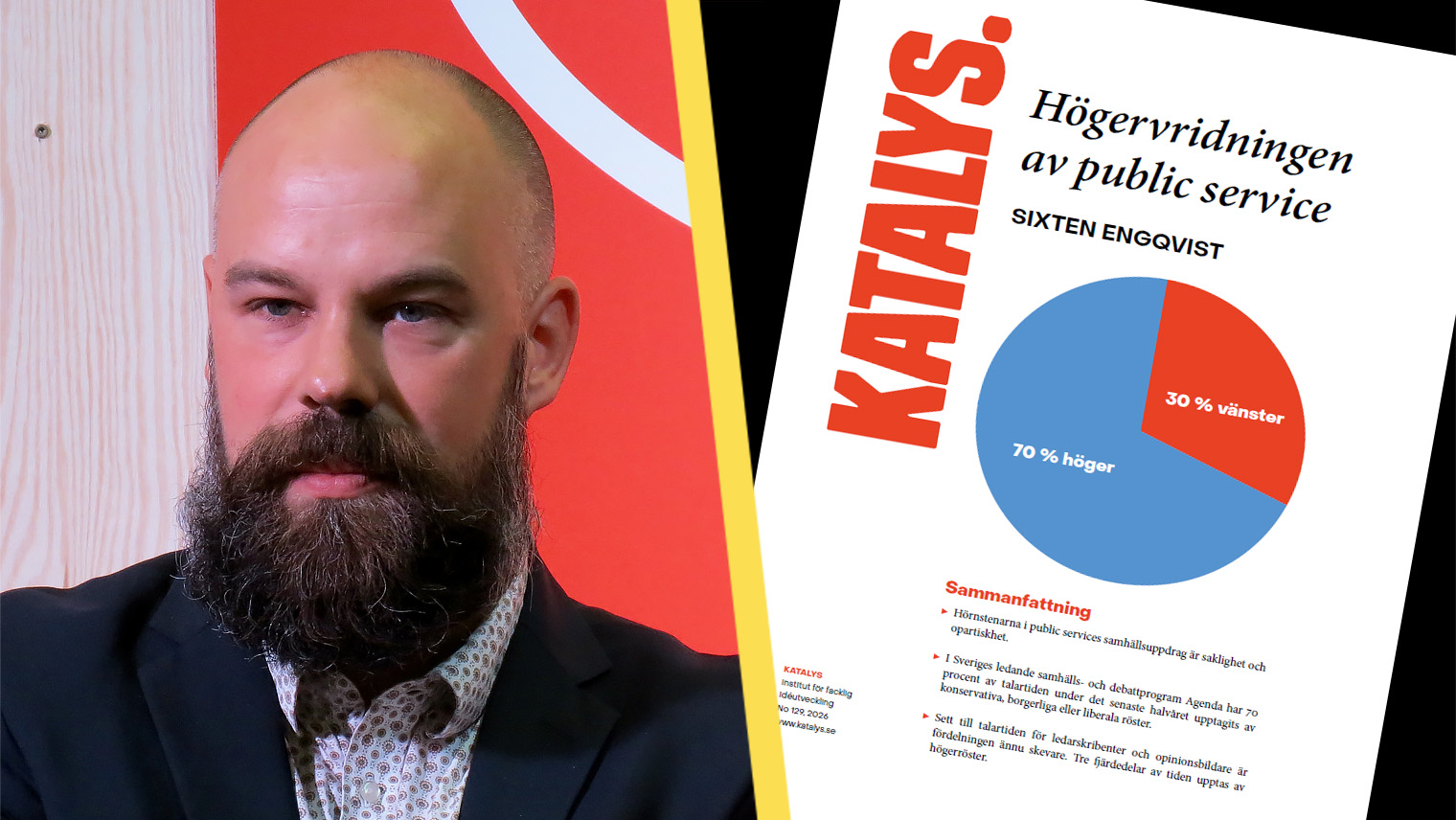
A new report from the left-leaning union think tank Katalys claims that SVT’s Agenda is dominated by “right-wing voices.” But the criticism has been fierce. Observers argue that the report is based on dubious definitions, narrow measurement methods, and an analysis that reflects the author’s own political viewpoints rather than reality.
When Katalys claims that public service has become “right-leaning,” it does not occur in a vacuum. The think tank is led by Daniel Suhonen and has strong ties to the Social Democrats and LO-affiliated unions. Katalys describes itself as independent but states that it works on behalf of trade union organizations with clear political affiliations.
READ ALSO: Morgan Johansson’s Researcher Brother: Immigration a Big Win for Sweden
Against this background, critics – including at Kvartal – argue that the report should be read more as a political contribution to the debate than as a neutral analysis. The fact that it is published in an election year reinforces the impression that it is intended to influence public opinion.
Controversial Classifications
A key objection concerns how Katalys defines “right-wing.” In the report, both the Center Party and the Dagens Nyheter editorial page are counted as right-wing.
This is far from uncontroversial. The Center Party broke with the traditional centre-right bloc in 2019 and began cooperating with the Social Democrats. At the same time, Dagens Nyheter’s editorial page has supported the January Agreement and repeatedly criticized the Tidö Agreement and cooperation with the Sweden Democrats.
READ ALSO: Confidence in SVT Plummets among Right-Wing Voters – Management Rejects the Criticism
Nonetheless, categorizing these actors as “right-wing” has, according to critics, a significant effect on the results. It helps to exaggerate the impression of a centre-right dominance in the program.
Measuring Speaking Time – Not Content
Katalys’ report is based on a quantitative review of 23 episodes of SVT Agenda, in which they counted how long various guests spoke. The results are presented as if approximately 70 percent of the speaking time goes to the “right.”
However, there is a fundamental methodological objection here: the report says nothing about the content itself.
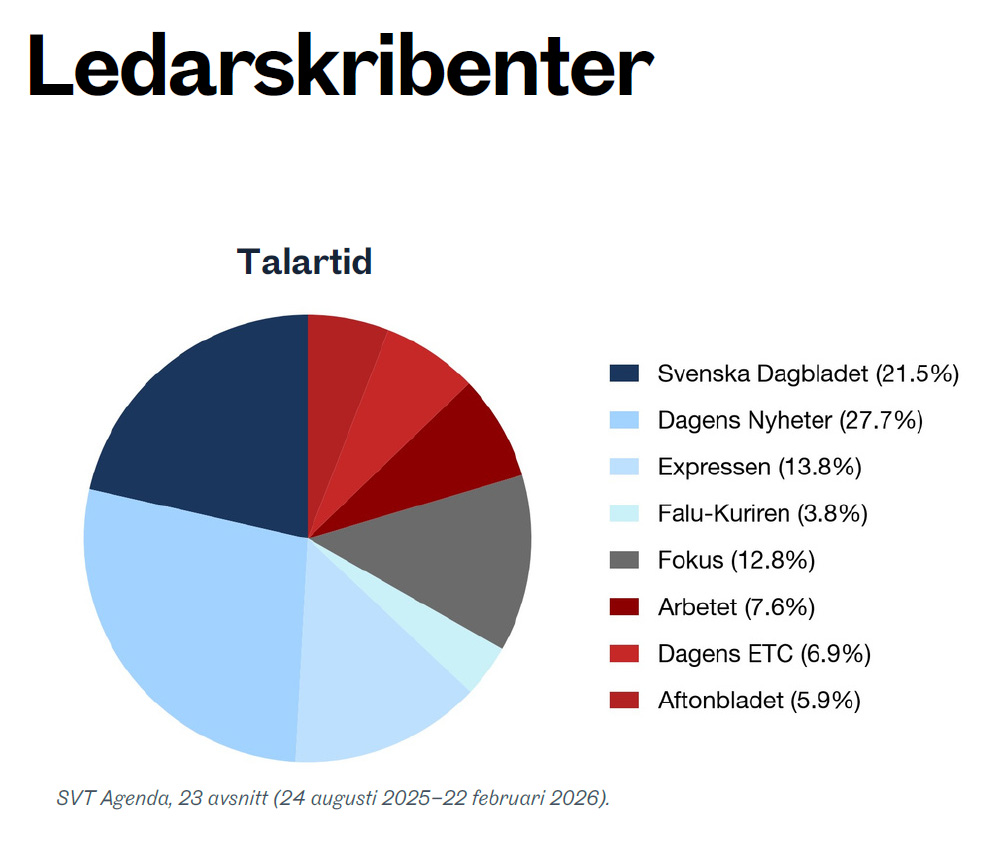
It does not account for whether guests are subjected to critical questions, how interviews are angled, which topics are chosen, or whether one side is challenged or not.
A politician speaking for a long time may just as well be because they are being scrutinized, which is a key part of journalism’s mission. This dimension is completely missing from the analysis.
Established Analyses Paint a Different Picture
Virtually all other attempts to measure political bias in public service point in the opposite direction. Analyses of published articles have shown that left-leaning segments are significantly more common than right-leaning ones.
READ ALSO: SVT Scandals Continue to Pile Up – Sweden Democrats Demand Culture Committee Summon the Management
This is also the public’s perception, whether they like it or not. It reinforces the view that the question of “bias” is complex – and cannot be reduced to just the amount of speaking time in a single program.
AI Analysis Raises Questions
Moreover, Katalys’ report is entirely based on data collecting and processing by AI. The material has been transcribed and analyzed using various AI tools. This raises questions. All major AI systems themselves warn that results may contain factual errors, misinterpretations, and/or bias.
When such a method is used to draw far-reaching political conclusions, the requirements for transparency and quality become particularly high. Critics argue that Katalys does not sufficiently disclose these uncertainties.
Old Debate – New Spin
The debate about public service is far from new. Since the 1970s, SVT and Swedish Radio have repeatedly been criticized for a left-liberal or even radical-left bias.
READ ALSO: SVT’s Language: Right-Wing Extremist Mentioned 79 Times More Often Than Left-Wing Extremist
This criticism has been so frequent and widespread that many consider it an established part of the media debate. Against this background, Katalys’ thesis – that SVT is in fact “regime-loyal” and right-leaning – appears as a deliberately provocative counter-position.
More Politics Than Analysis
Overall, the criticism comes down to the fact that Katalys’ report has significant shortcomings. The classifications of “right-wing” and “left-wing” are contested. The method measures quantity but not journalistic quality. The analysis is based on AI with inherent uncertainties. The source has clear political interests.
According to critics, the report rather contributes to obscuring than clarifying what the balance in Public Service reporting actually looks like. Instead of an objective review, it is seen, they argue, as a political statement in an already polarized debate.
READ ALSO: Ekeroth: “SVT Manipulates – and Calls It ‘Public Service’”