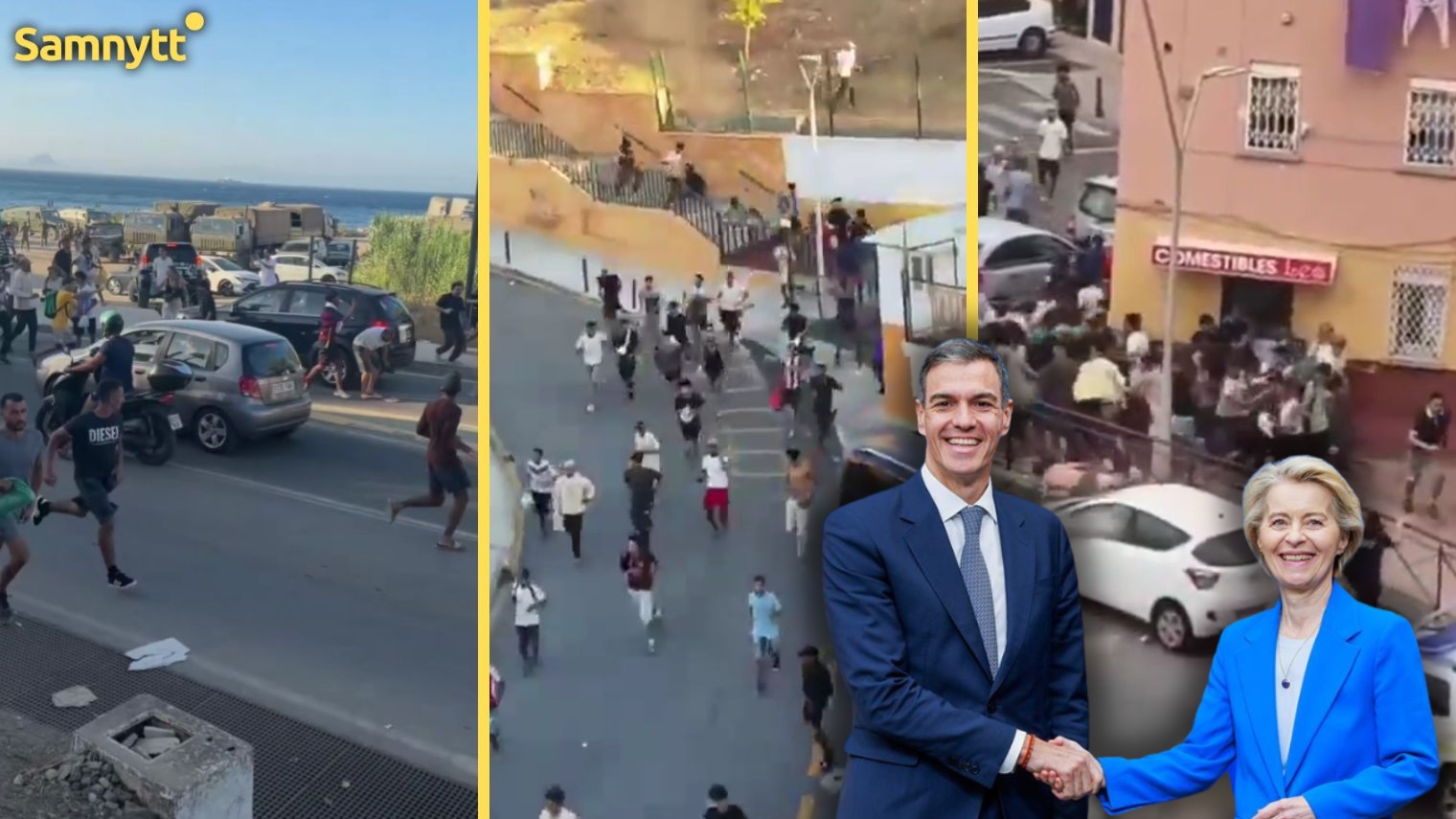
According to media reports, almost all migrants who stormed Ceuta have returned home. However, reports from the Spanish exclave indicate anything but calm. At the same time, the Spanish government wants more unaccompanied minors to be allowed to stay.
Despite Spanish authorities stating that almost all of the approximately 60,000 migrants who entered the Spanish exclave Ceuta last week have returned to Morocco, the situation in the city is far from normal.
Residents describe a society still marked by unrest, military presence, and deep insecurity after the largest border breach in Spain’s modern history.
According to the Spanish government, most migrants have returned, either voluntarily or through fast-track returns coordinated with Moroccan authorities. Reuters already reported last Friday that tens of thousands of people had left Ceuta again and that over the weekend the number continued to rise to nearly all of the estimated 60,000 who crossed the border.
But on the ground in Ceuta, residents and local authorities describe a city still in crisis mode. A number of migrants remain in the mountainous areas and along the coastlines, while police and military continue extensive search operations.
Rescue services are still searching for people believed to have perished at sea during the chaotic crossing of the border. The death toll has now risen to over 70 people, according to the latest reports.
Ceuta’s mayor has warned that the city’s normal life is still seriously impacted. Security forces patrol the streets, and many inhabitants feel that the sudden mass migration has left deep marks, even though most migrants are now reportedly gone.
LIVE: Hordes of migrants are storming the city of Ceuta while screaming “Allahu Akbar”.
The very migrants Sánchez said were all sent back to Africa.
Thanks to our @SaveEuropeAct men on the ground we now know the truth. pic.twitter.com/JzJnwIKmhS
— Eva Vlaardingerbroek (@EvaVlaar) August 2, 2026
Demands for Tougher Measures
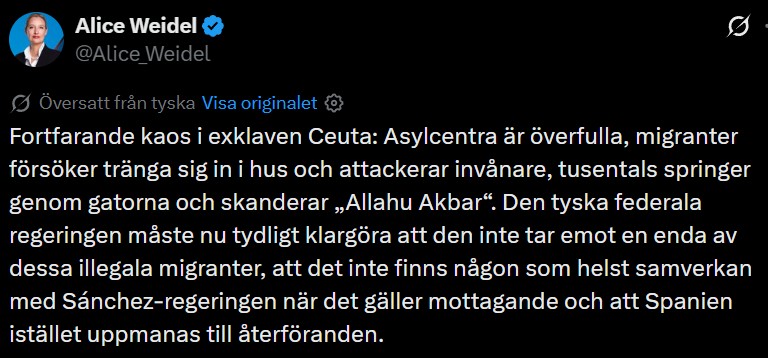
The crisis has also triggered an intense political debate in Spain and the rest of Europe. The opposition party Vox has demanded much stricter border protection and the immediate deportation of migrants still in Ceuta, while Prime Minister Pedro Sánchez’s government points to human traffickers and misinformation on social media as the main causes of the mass rush to the border.
The dramatic development has had repercussions even outside Spain. Several European governments have called for tighter measures to protect the EU’s external border, and the migration crisis in Ceuta has again put the Schengen cooperation and the union’s common migration policy in focus.
This is Ceuta last night.
So much for “almost everyone is returned back to Morocco and things are back to normal”.
Pedro Sánchez, you are a corrupt liar. pic.twitter.com/t0dJ9ACEKG
— Ada Lluch (@AdaLluch) August 2, 2026
Multiple Causes
There is still no clear explanation for the massive storming of Ceuta. Several factors, however, are being pointed out as possible causes, and both Moroccan and Spanish authorities describe the event as a result of a combination of misinformation, human trafficking, and changing legal conditions.
Morocco’s Ministry of the Interior claims that false information on social media played a crucial role. According to authorities, rumors spread that the road to Ceuta was open and that those who managed to cross the border no longer risked immediate deportation. At the same time, human smugglers are said to have exploited this information to lure people into trying to make it to the Spanish exclave.
READ ALSO: The migrant storming may put a stop to EU free movement: “Invasion”
Another often-cited factor is a recent ruling from Spain’s Supreme Court. The ruling has been interpreted to mean that migrants arriving by sea can no longer be summarily removed through the simplified procedures previously used. According to both Moroccan and Spanish representatives, the ruling was quickly misinterpreted on social media, giving many the impression that those reaching Ceuta would have far greater chances to stay in Spain.
The opposition in Spain, meanwhile, points to the government’s migration policy as a possible so-called pull factor. Critics refer among other things to the amnesty that makes it possible for over a million illegal migrants to apply for residence and work permits.
Para los políticos hijos de puta que se atreven a decir que en Ceuta ya hay normalidad. A 3 minutos de mi casa, dime cómo salgo yo ahora sin pensar que me va a pasar algo mientras que campan a sus anchas estos delincuentes, porque los que quedan ya son delincuentes pic.twitter.com/2fUBEspO4e
— CaballaCarnavalero (@AngelOlmo_) August 2, 2026
More Will Be Allowed to Stay
At the same time, a political battle is raging over the thousands of alleged minor migrants who have made it to Ceuta. Prime Minister Pedro Sánchez’s government wants about 7,000 unaccompanied children and youth to be cared for within Spain’s reception system and distributed among the country’s autonomous regions, instead of being returned to Morocco.
The proposal has met with strong criticism from several regional governments and opposition parties, who warn that the decision risks acting as yet another pull factor and encouraging more minors to try to enter Spain.
The government, in turn, refers to the fact that minors are covered by special legal protections under Spanish and international law and therefore cannot be deported in the same way as adult migrants.

DN: No Risk
In Dagens Nyheter, political scientist Peo Hansen explains that the reactions to the storming of Ceuta have been exaggerated and that there was never any chance Sweden would have had to receive any of the illegal migrants.
Hansen’s theory is that Morocco allowed people to cross the border to the Spanish exclave, which in turn is said to be due to Spain recently extending a hand to Algeria, a rival to Morocco.
– I can’t imagine that 60,000 migrants set off at the snap of a finger without someone organizing and allowing it, he told DN.
READ ALSO: Spain’s amnesty for illegals growing: 3 million migrants
Hansen also rejects criticism of Spain’s liberal immigration policy as a factor. He argues that Spain’s policy in this area today resembles Sweden’s in 2015, but that this does not indicate a migrant crisis is looming.
– The similarity, if any, lies in the fact that Sweden for a period used humane language and acknowledged refugees’ rights.

Praising the 2015 Migrant Crisis
Peo Hansen has been hired as a lecturer by both the Social Democrats and the Left Party. For several years, he has also promoted the thesis that the 2015 migrant crisis was not an economic burden but, on the contrary, had positive effects for Sweden and constituted “an economic success story.”
This is the main message of his book The Migration Myth and further developed in the scientific article “A Modern Migration Theory” from 2024. There he argues that the established view of refugee immigration as a fiscal cost for the state is based on faulty economic assumptions and that refugees should instead be seen as a real economic resource.
READ ALSO: Ekeroth: “The consequences of the migrant invasion must be reversed”