
The same young woman accuses several men of sexual crimes within a relatively short period and gets two of them convicted. In both legal proceedings, the same former social worker appears as a supporting witness—while a BUP (Child and Adolescent Psychiatry) therapist states that the woman already had a ‘hatred of men’ before the first incident. Former Supreme Court Justice Göran Lambertz reacts when Samnytt presents the cases: “It rings a small warning bell.”
The consent law was introduced in 2018, which meant that the boundary for rape was shifted to the question of whether participation in the sexual act was voluntary.
In many such cases, there are neither outside witnesses nor technical evidence that can determine what actually happened between two people behind closed doors.
This means that narratives, behaviors, and the courts’ assessment of ‘credibility’ and ‘reliability’ become highly significant. In the two verdicts reviewed by Samnytt, two young men were convicted following accusations from the same woman.
The two verdicts finally awarded the woman a total of 405,000 SEK in damages, plus interest. But that is far from the only similarity between the cases.
Same Woman – Same Supporting Witness
The first verdict was delivered by the Nyköping District Court in October 2023. The man was prosecuted for rape but was convicted of sexual assault, sentenced to one year in prison, and ordered to pay 140,000 SEK in damages.
The woman stated, among other things, that the man inserted two fingers into her genitals through her pants and underwear. The district court accepted her account and found the man guilty.
READ ALSO: Judicial scandal in silence: Young men convicted of rape without evidence
The process also featured a woman who had been the claimant’s social worker. She had not witnessed the alleged sexual act but testified about things the claimant later told her. Nevertheless, her testimony carried significant weight.
“The strongest support for the claimant’s account comes from [the former social worker’s] testimony,” writes the Nyköping District Court.
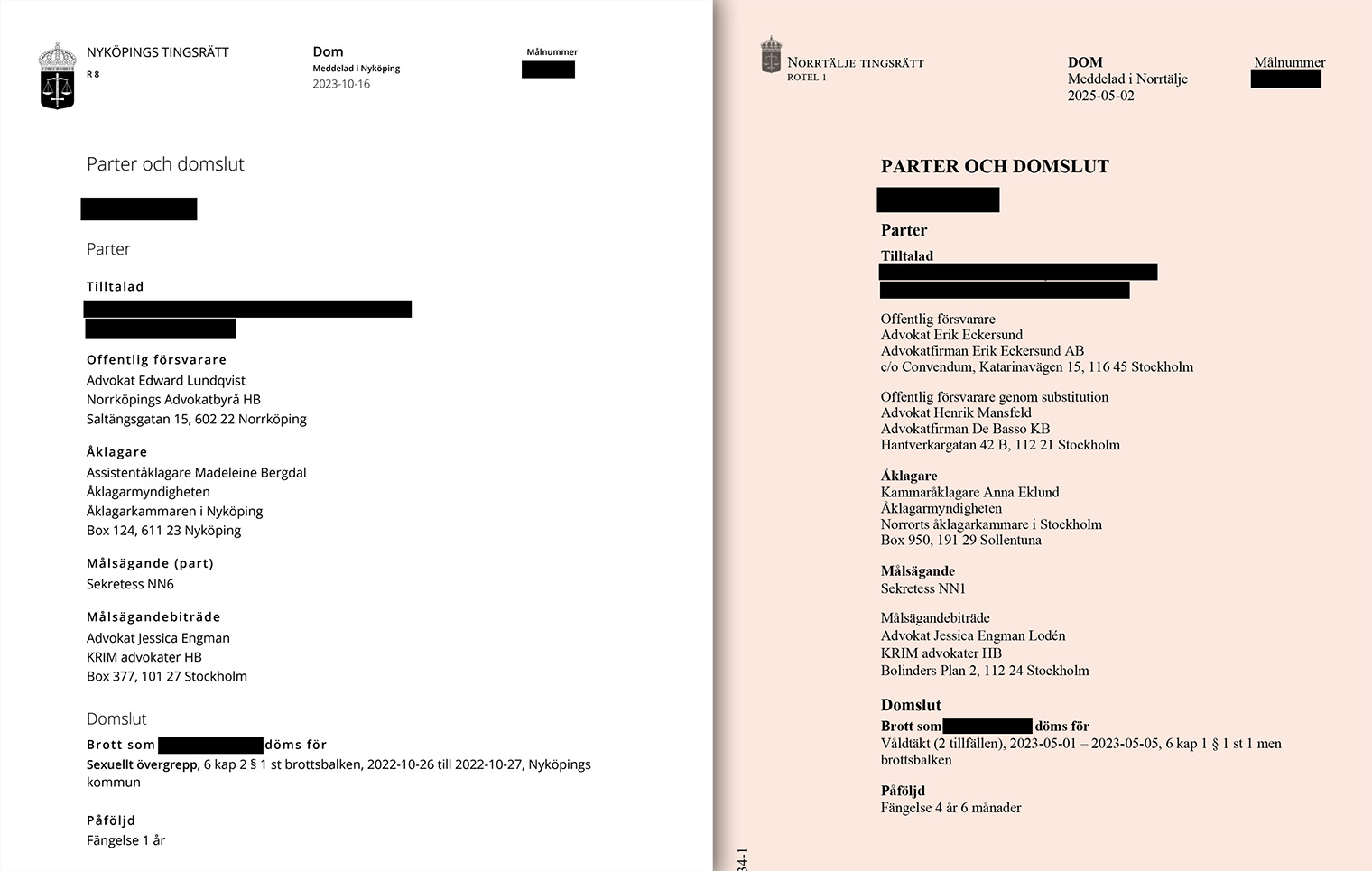
When another young man, less than two years later, faces trial after accusations from the same woman, the former social worker appears again.
READ ALSO: Mother of man convicted of rape: 4.5 years in prison and 750,000 in damages—for someone’s story
This time, the Norrtälje District Court convicts the man of two rapes, sentencing him to four years and six months in prison. The district court initially sets damages at 315,000 SEK, but the amount is later reduced in the Court of Appeal to 265,000 SEK.
Together with the 140,000 SEK from the first verdict, this means the woman was finally awarded 405,000 SEK from the two men.
From Social Worker to Close Friend
Meanwhile, something changed in the relationship between the claimant and her former social worker between the proceedings. The professional contact developed into a close private friendship.
The former social worker stated in the second case that after the official relationship ended, their contact became “mostly private and a friendship.” According to her own testimony, they were in contact “around the clock via SMS and Snapchat.”
So, the same person who in the first trial acted as a former social worker—and whose testimony the district court described as the strongest support for the claimant’s account—reappears in the next process after developing a very close private friendship with her.
If someone testifies twice, you have reason to be especially alert and critical in the assessment. That much is clear.
Göran Lamberts, former Supreme Court Justice and Chancellor of Justice
The supporting witness’s own situation also raises questions. The former social worker revealed in the later trial that she had previously been called as a witness in another case but had not testified because she was using cannabis and experiencing a drug-induced psychosis.
At the time of the alleged rapes, she said she had alcohol problems—issues she claimed to have had “her whole life.” She also states she never questioned the claimant and speculates in court about whether, due to her autism, the woman could even lie at all.
BUP Therapist: “Harbors Hatred of Men”
Another detail in the first verdict stands out. The woman’s responsible therapist at BUP had treated her for about a year and a half and was called to testify.
The verdict relays the therapist’s statements:
“The claimant harbors a hatred of men. The hatred she had before the incident was mostly directed at her father.”
This information thus concerns hatred of men, which according to the therapist, existed already before the first of the incidents now reviewed by Samnytt. This does not in itself mean the woman gave false information about sexual crimes.

But, along with the other circumstances, it raises the question of how carefully alternative explanations were explored when her stories were weighed against the accounts of the accused men.
Another circumstance is that, according to information Samnytt has accessed, the claimant was involved as an activist in the Fatta – Consent network, which advocates for consent in sexual crime legislation.
This activism itself says nothing about the truthfulness of her accusations, but it is part of the background in a case where consent and the courts’ evaluation of evidence are central.

Claims to Have Been Raped by Three Men
In the later verdict, the woman stated she had been raped by three different men—two she met via Tinder and one in a relationship. The most recent alleged rape, according to her own information, occurred about eight months earlier.
READ ALSO: The Mannaminne Network leads the protests against the collapse of the rule of law
It is fully possible for the same person to be subjected to multiple sexual crimes. A previous rape in no way means that the next accusation is untrue.
But when several accusations against different men follow relatively closely, while the same supporting person recurs in the proceedings, a legal certainty issue arises—should the earlier pattern prompt the justice system to scrutinize the next accusation particularly critically?
When Samnytt presents the circumstances to Göran Lambertz, former Supreme Court Justice and Chancellor of Justice, he reacts.
We have reviewed two separate sexual crime verdicts against two different young men, where the same young woman is the complainant in both cases—and where the same former social worker, later close friend, testifies in her support in both cases. She has also been awarded just over 400,000 SEK in damages in these two cases. What is your reaction from a legal certainty perspective when you hear such a thing?
– If someone has reported several sexual crimes, you need to be extra careful when reviewing the evidence. He continues:
– It could be true. But it rings a small warning bell and you really need to thoroughly check the evidence.
How strong is the evidence really from a witness who has not seen the alleged act but can mainly recount what the complainant herself said afterwards?
– Not particularly strong, actually—and my impression is that courts attach too much importance to such witnesses. As everyone understands, a good friend will likely be loyal to their companion. A story and a friend’s testimony should not be enough.
When Samnytt explains that the same former social worker reappears as a supporting witness in the second case, Lambertz is clear:
– If someone testifies twice, you have reason to be especially alert and critical in the assessment. That much is clear.
READ ALSO: Sought out men on dating sites to accuse of rape—now she is convicted herself
Lambertz also believes that a prosecutor should inform the court of a previous similar case if it may have significance for the assessment of the evidence.
– I think the prosecutor is wrong if they do not disclose the existence of such a prior case, as it is a reason to examine the matter extra carefully.
Otherwise, relevant information could be omitted from proceedings, he argues.
– In such a case, you’re leaving out something that could have real significance for the evaluation of evidence.
The Mother: “Jaw Dropped”
The mother of the man sentenced to four and a half years in prison told Samnytt that the family only realized the same former social worker appeared in both proceedings after later comparing the verdicts.
– That was when I connected the name and realized it was the same witness in both cases.
READ ALSO: Unfaithful woman falsely accused date of rape—sentenced to prison
When she started reading the earlier verdict, she reacted to the similarities as well.
– I just gasped and my jaw dropped when I read the first line that they met via Tinder and were going to the movies.
She also points to similarities in how the events unfolded at the men’s homes and how the claimant communicated with people in her surroundings.

The mother is particularly critical of the fact that the professional relationship between the social worker and the client developed into a close friendship.
– I don’t think that feels at all right to me. Contact around the clock, and emphasizing that you previously held the role of social worker.
READ ALSO: Consent law: Prosecutions and convictions for rape have increased markedly
Affectionate Messages After the Alleged Rapes
The later case also includes a series of messages sent after the events the woman later described as rapes. On the morning of May 6, after the second alleged rape, the woman wrote to her former social worker and close friend that she could not sleep and:
“We cuddled”—and simultaneously sent a heart emoji.
At district court, the woman was asked why she did not write that she had been raped. She replied that she didn’t know. The next day, she sent a new message, this time directly to the man she later accused of rape. She wrote that she wanted to: “talk to her kiss-cucumber.”
The woman stated in court that she and the man called each other “kiss-cucumber.” The message was sent as they were planning to meet again.

The man himself referred in court to this message as evidence that the atmosphere between them was still good. The woman thus maintained contact with the man after the sexual acts she later said were involuntary and planned to meet him again.
READ ALSO: “Careless rape” after Tinder date—court upholds 54 months in prison
Such behavior does not prove that a sexual crime did not happen. People may react very differently after an assault. But in a case where a court must retrospectively determine what happened between two people without outside witnesses, contemporary communication becomes an important part of the body of evidence.
When Samnytt describes to Lambertz that the man was sentenced to four and a half years in prison while the police report was made months later and affectionate messages were sent after the events, he reacts:
– That should raise red flags.
READ ALSO: 4 years in prison after Tinder date—the mother: “It was her word against his”
Reported Months Later
The police report against the man was not filed until about five and a half months after the alleged rapes. In the first police interrogation, the woman also did not mention vaginal or oral intercourse in the first of the two situations later included in the indictment.
The district court found she had given acceptable explanations for these circumstances.
The handling of digital communication is also interesting. The woman stated in the verdict that many of the messages presented were screenshots she took herself. She also inserted dates herself to aid clarity. The verdict then states:
“The police did not go through her communications.”
Generally, one can see that the evaluation of evidence in sexual crime cases is problematic. It does not meet the requirements of legal certainty. It is very hard for courts to say it is possible this person is lying. That consideration is remote—they rarely make it.
Göran Lamberts, former Supreme Court Justice and Chancellor of Justice
The man’s mother reacted to the same thing after reviewing the preliminary investigation.
– It’s only fragments of the entire conversation that are included.
“Therefore Appears to Be Lived Experience”
In the end, the decisive factor is how the district court assesses the people’s narratives. The Norrtälje District Court described the woman’s statement as lengthy, fairly detailed, and restrained. It was considered to contain distinctive details.

The court then concluded that the story “therefore appears to be lived experience.”
This line of reasoning provokes a reaction from Göran Lambertz.
The concept of the ‘mark of lived experience’ is often used to justify a verdict in these cases. What is your view on this?
– It’s a problematic concept. We tried to get rid of it when I sat in the Supreme Court because it was often sufficient for courts to convict—and we said that you can’t assess credibility based on that, it’s not enough. Lambertz continues:
– It’s often very difficult to judge whether it’s true on that basis, so it’s a problematic formulation without a doubt.
READ ALSO: Wanted to “teach the man a lesson” and accused him of rape—now the woman is convicted
Lambertz’s criticism goes beyond the two cases Samnytt is describing for him.
– Generally, one can see that the evaluation of evidence in sexual crime cases is problematic. It does not meet the requirements of legal certainty.

He specifically points out the courts’ difficulty in seriously considering the possibility that a complainant is not telling the truth.
– It’s very difficult for courts to say that it is possible this person is lying. That consideration is remote—they rarely make it.
READ ALSO: Here are the women who lie about rapes—“They want money”
According to Lambertz, there is also a psychological difficulty because courts risk criticism if they question a claimant.
– The examination isn’t conducted in the way it ought to be.
– It’s hard to say anything without reading the verdict, but it’s very important in a case like this that the court does a very thorough examination. My experience is that courts often do not.
When Doubt Must Exist
Nothing in the two verdicts proves the woman made false accusations. Nor does the fact that she claims to have been assaulted by several men mean that any of the assaults did not take place.
But legal certainty does not require a defendant to prove that the complainant is lying. It is up to the prosecutor to establish the defendant’s guilt beyond reasonable doubt.
READ ALSO: “Sweden will be ashamed of this”—Mannaminne calls for a new review commission
In the two cases reviewed by Samnytt, the same complainant and the same supporting witness appear. The supporting witness moves from being a social worker to a close friend with around-the-clock contact.
The woman’s BUP therapist states she already had a ‘hatred of men’ before the first incident. The woman herself claims to have been assaulted by a total of three men.
In the later case, there are also affectionate messages after the alleged rapes, plans to meet the man again, a police report filed several months later, and digital communication which, by the woman’s own admission, was not fully reviewed by police.
Each of these circumstances may have an explanation. The key question for legal certainty is what happens when circumstances pointing against the prosecution are explained away and accepted, while those supporting the complainant’s account are compiled as supporting evidence. For the accused, the difference can mean several years behind bars.
The young man sentenced to four years and six months in prison tried to have his verdict reviewed by the Supreme Court. However, the Supreme Court recently decided not to grant leave to appeal, meaning the ruling of the Court of Appeal stands. Thus, the possibility to obtain a new review of guilt through ordinary court proceedings is exhausted.
READ ALSO: The court believes—and your future is lost
silence us.
– and reports directly, without a PC-filter.
Support Samnytt – become a subscriber
123 083 33 50