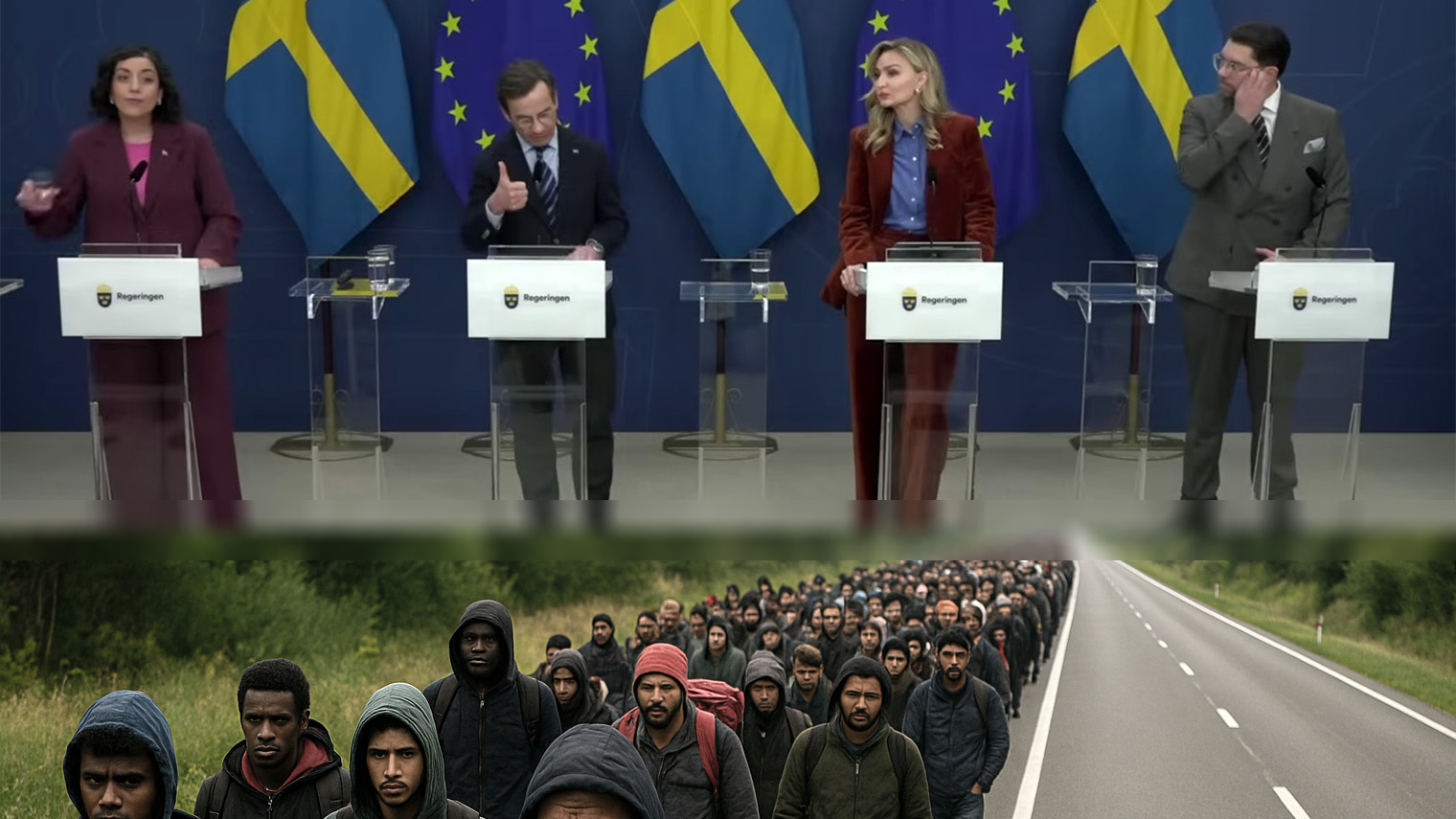
The Tidö parties are making migration and integration two of the clearest lines of conflict ahead of the election. In a joint opinion piece in Aftonbladet, the government coalition highlights its policy shift so far and warns against a return to previous practices. In a longer interview with Svenska Dagbladet, Prime Minister Ulf Kristersson explains his view of the next term – where, according to him, Jimmie Åkesson can naturally take primary responsibility for immigration issues.
In Aftonbladet, Ulf Kristersson, Jimmie Åkesson, Ebba Busch, and Simona Mohamsson describe previous migration policy as a failure marked by exceptions, a lack of demands, and insufficient integration. They argue that the consequences have been growing social exclusion, poverty, and gang crime, with high costs for the Swedish people, both economically and otherwise.
The four party leaders emphasize that their government cooperation has gradually reversed the policy, claiming that Sweden now has the lowest level of asylum immigration since the mid-1980s. Their message is that this course change must be defended and that the parliamentary election this autumn will be decisive as to whether it will be maintained or everything built up will be dismantled.
The backdrop is also an uncertain :censored:6:cdd6bbaa89: situation. The leaders refer to the war in the Middle East and warn that conflicts outside Europe could generate new migration pressure toward both the EU and Sweden. Therefore, they write, the “migration crisis of 2015” must not be repeated, and measures are being taken to prevent such a scenario.
Two Main Arenas: The EU and Sweden
The Tidö parties highlight two decisive areas, with the first being EU policy. According to them, Sweden should continue to pursue a more restrictive migration line within the union, with stronger external borders and more efficient return of people whose asylum applications have been denied. They also want to see changes in international regulations so that foreigners who commit serious crimes can be deported more easily.
READ ALSO: Tidö Government: Afghans Should Return Home to the Taliban
The leaders also warn that more generous decisions in other EU countries could undermine a joint line. They specifically mention a recent decision by the left-wing government in Spain to allow people residing illegally in Europe to stay.
The second track concerns Sweden. Here, the parties state that more European countries are now tightening their rules, which could make Sweden more attractive again if Swedish policy is softened. Therefore, the Tidö parties want to continue setting higher requirements for those who come here.
Citizenship, Language, and Benefits in Focus
The party leaders raise several reforms they intend to build upon. Swedish citizenship should have a higher status and demand more from the applicant. Those permitted to stay in the country should learn Swedish and acquire basic knowledge about Sweden.
They also want to introduce a cap on benefits to ensure that working is always more profitable than relying on welfare, as well as a clear activity requirement for those receiving financial support – passive benefit collection should not be possible. Additionally, the parties want to use language-focused preschools as a tool against segregation and weak language development among children.
A central principle is summarized as follows: “Those who are approved should be integrated; those who are denied must leave the country.”
Sharp Contrast with the Opposition
The opinion piece is clearly election-focused. The Tidö leaders claim that the red-green parties want to move in the opposite direction, with increased asylum immigration, more generous family reunification rules, and reinstated permanent residence permits.
READ ALSO: Tidö Government: No Benefits for Criminals
They describe the election as a choice between continuing responsible tightening and a return to previous irresponsible migration policy.
Kristersson: Natural for SD to Take on Immigration Issues
In an interview in Svenska Dagbladet, Ulf Kristersson goes deeper into how power could be distributed after the election. He says it is only natural for Jimmie Åkesson and the Sweden Democrats to bear major responsibility for migration and integration in a new blue-yellow government.
He compares this to how the Liberals have traditionally held weight in education and the Christian Democrats in healthcare. Likewise, he argues, SD has the competence and a natural focus on immigration policy.
At the same time, he emphasizes that ministerial posts are not distributed ahead of an election and that negotiations take place only after a potential election victory.
Integration Zones and a “Sweden Contract”
Kristersson describes integration as one of the most central issues of the election campaign. He highlights his own party’s idea of so-called integration zones – special areas where new methods can be tested to break exclusion.
However, he plays down the image of a finished system, calling it rather an open model for local trials. Examples he mentions include more preschool hours for children who need to improve their Swedish.
READ ALSO: Tidö Parties to Stop Child Soldiers: Lowering the Age of Criminal Responsibility to 13
Another proposal is a “Sweden Contract” for new arrivals, in which the individual confirms that Swedish rules, values, and social norms must be followed. According to him, anyone who does not participate or does not live up to the requirements could lose access to benefits and support.
Swedish Values, Equality, and Self-Sufficiency
In the interview, the Prime Minister repeatedly refers to integration as mutual obligations. He says that anyone moving to Sweden must accept the country’s laws, equality, and individual freedoms and rights. Honor-related norms are highlighted as incompatible with Swedish law.
He adds that those who dislike an equal and secular society perhaps should not choose Sweden as their destination.
Benefit Reforms as Integration Policy
According to Kristersson, the government’s benefit reforms are among the most important integration measures. He particularly highlights the benefits cap and requirements to participate in labor market initiatives.
The explicit objective is to ensure more foreign-born women work and become self-supporting – currently, very few are. He makes clear that people are, of course, free to live their lives as they wish, but taxpayers should not finance long-term welfare for those who are able to work.
Thus, the message ahead of the election is clear: work, language skills, requirements, and adaptation to Swedish social norms should outweigh the right to support without reciprocity.
READ ALSO: Tidö Government Moves Ahead With Information Duty