COLUMN • For decades, Swedish media have increasingly prioritized a left-wing narrative over facts and reality. Emotional stories, political premises, and ideological filters have come to replace the critical scrutiny that journalism is meant to carry out. The result is a growing trust gap between the media and the public – and an ever more pronounced conflict between activism and independent journalism. As the election year approaches, this contradiction intensifies. The question is not only about the political direction, but also about who gets to describe reality, and on what terms.
I have returned to this many times, and I do so again – the professional group that bears the single greatest responsibility for Sweden’s development – and decline – is the journalistic corps.
Without functioning journalism, no democracy can survive. The media’s task is to scrutinize power, highlight problems, and provide citizens with as true and complete a picture of reality as possible. When that task is abandoned and replaced by activism, value-driven reporting, and deliberate filtering of reality, the very foundation of democratic discourse begins to crumble.
READ ALSO: Ekeroth: ‘SVT manipulates – and calls it ‘public service”
Sweden will likely be a future textbook example of what happens when journalism stops functioning as a check on power and instead becomes part of the exercise of power.
The problem is not only about what isn’t reported, but about what is actively distorted. Facts are omitted, perspectives are slanted, and contexts are left out to fit a predetermined narrative. Critical voices are called into question, labeled, and in some cases exposed until they fall silent. In such a media landscape, society can be driven in the wrong direction much faster than political decisions alone could accomplish.
When those in power start defining what journalism should be allowed and what should be stopped, it is no longer about media policy but about the limits of freedom of expression. In practice, the pressure is directed towards the free and power-critical journalism that examines what others choose to exclude – the type of independent publishing that today challenges the story and that for that very reason has become uncomfortable for those who prefer control to scrutiny.
Jonas Andersson
The examples are many – but journalism rarely scrutinizes its own systematic mistakes. When an established media narrative finally collapses, often years later, a few subdued, self-critical articles are published. Accountability is seldom demanded and the attention is short-lived. Then the news cycle moves on, new issues take center stage, and new simplified narratives are established. The cycle repeats.
The Sickening Case of the Apathetic Children – Again
One of the most telling and at the same time most disturbing examples in modern Swedish media history is the story of what came to be known as the apathetic children. For a long time, the image was established of children who, in connection with asylum processes, fell into a state of total apathy, incapable of eating, speaking, or reacting.
READ ALSO: SR figure Helene Bergman: ‘I’m not the one who left democracy – Public service did that’
The story had enormous resonance and quickly became a moral reference point in the migration debate. Those who questioned the extent or causes of the phenomenon risked being seen as insensitive or cynical.
In hindsight, the reality has proven to be much more complex, and in some cases deeply troubling. Testimonies and investigations have pointed to cases where children were put under heavy pressure at home to appear sicker than they were, where isolation, control, and in some cases outright abuse occurred.
What is most remarkable is not just what happened, but how long the narrative could be maintained without the established journalism seriously testing alternative explanations.
But the madness surrounding the so-called apathetic children is not a one-off – and since the tactic has worked politically for left-wing parties, the dramaturgy of lies continues again and again in reporting on migration and asylum.
READ ALSO: Public service singled out as the greatest threat to Sweden’s democracy
For years, the media have filled columns and broadcasts with tear-jerking reports about the deportation of ‘children’ – lately even babies, which I myself have reported on – where individual destinies are presented in strong emotional stories while court decisions, identity issues, previous rejections, and legal circumstances are often relegated to the background or omitted entirely.
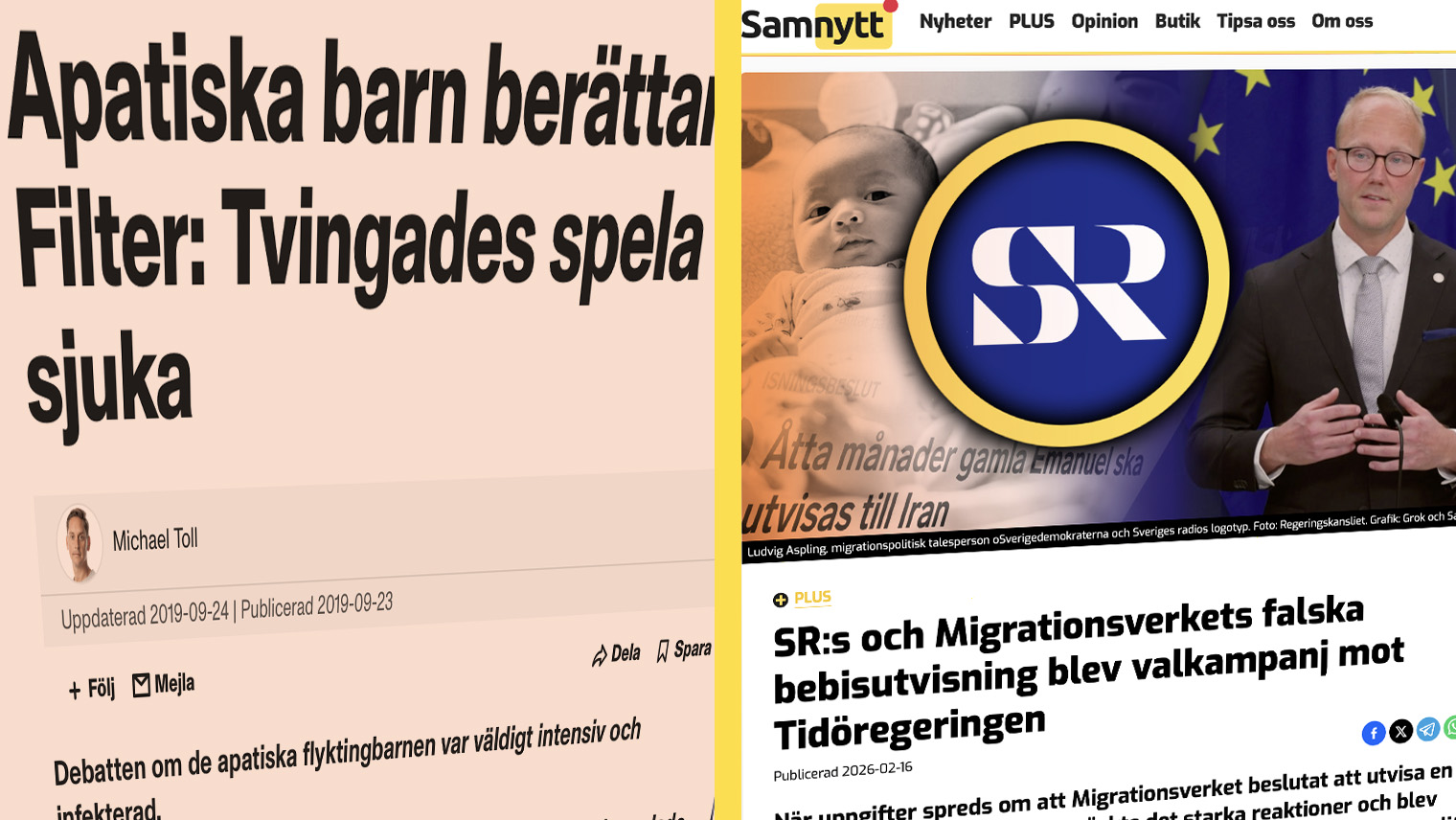
The headline is recurring and effective – ‘it’s about children’!
Anyone attempting to bring in facts about age, reasons for asylum, legislation, or systemic effects is portrayed as harsh, inhuman, or cynical. The pattern is the same in other matters and around people whom the journalistic corps either supports or abhors.
Sweden’s development in recent decades cannot therefore be understood solely through political decisions. It must also be understood through the media landscape that shaped the narrative about reality – what was a problem, what was not, and which questions could even be posed.
Jonas Andersson
Some are highlighted through an almost saintly media treatment where critical questions are absent and complexity disappears – as in the reporting on climate activist and later Hamas apologist Greta Thunberg.
At the same time, other political actors may be subjected to the opposite treatment, where coverage has for a long time been characterized by one-sidedness, moralizing and openly negative tone, which has been evident not least in the embarrassing coverage in Swedish media about the USA’s democratically elected President Donald Trump.
When Is It Time to Demand Accountability?
When a narrative fits the prevailing worldview, the critical reflex disappears. Journalism stops investigating and instead starts reinforcing. Emotional mobilization replaces analysis, moral signaling replaces fact-based discussion, and some perspectives are simply not considered legitimate to present.
READ ALSO: Janne Josefsson: Public service full of Green Party and Left Party members
There are nowadays those who try to nuance criticism of journalists. They say many are driven by idealism, that working conditions are tough, and therefore mistakes are inevitable. I doubt that today. Good intentions do not change the consequences, in any case.
When an entire profession over time filters reality through ideological prisms, when scrutinizing power is replaced by activism, and critical perspectives are systematically marginalized, something fundamental in the social contract is damaged. Trust is eroded, and without trust, both the media and democracy lose their function.
The election this autumn is therefore not just about politics, but about whether citizens should have access to reality as it is – or to yet another filtered narrative. That is where the battle will be fought.
Jonas Andersson
What is most concerning is not individual misjudgments, but the absence of accountability. When narratives turn out to be wrong or heavily simplified, deeper soul-searching rarely follows. The same news desks, the same perspectives, and the same reflexes continue to shape the coverage. Much of this deadlock is also connected to the dominance of public service and the journalistic collapse that has followed in its wake.
Journalism is often described as the third estate of democracy. That role is built on trust and responsibility. When power is exercised without self-criticism and without consequences, it risks instead becoming part of the very problem it was intended to counteract.
Sweden’s development over recent decades can therefore not be understood solely through political decisions. It must also be understood through the media landscape that shaped the narrative about reality – what was a problem, what was not, and which questions could even be posed.
READ ALSO: When public service and DN rot – and are replaced by the free word
When journalism stops reflecting society as it is and instead describes it as it ought to be, a gap emerges between reality and narrative. When that gap becomes large enough, it is not only the credibility of journalism that collapses – trust in the institutions of society follows.
At the same time, the development has triggered a counter-reaction. As trust in established newsrooms has fallen, new actors and reporters have stepped forward to do the work that has long been neglected – to ask the uncomfortable questions, follow up on what others avoid, and describe reality even when it is politically or morally inconvenient.
It is about returning to the core of journalism – to scrutinize power, not protect it.
At the same time, perhaps the most serious aspect of the development is that parts of the political power now openly want to limit precisely the kind of independent journalism that has grown outside the established media houses. Several left-wing politicians have talked about the need to stop or regulate what they describe as ‘harmful’ or practically ‘illegal’ media – a distinction that risks being less about breaking the law and more about content and political convenience.
READ ALSO: Aron Flam on public service media: ‘A catastrophe for culture and democracy’
When those in power begin to define what journalism should be allowed and what should be stopped, it is no longer about media policy but about the boundaries of freedom of expression. In practice, the pressure is directed at the free and power-critical journalism that examines what others choose to leave out – the type of independent publishing that today challenges the narrative and that for that reason has become uncomfortable for those who prefer control to scrutiny.
In the run-up to the election year, this conflict will become increasingly clear. The battle will not only be between political alternatives, but between two views of journalism – between reporters who want to inform citizens and activists who use journalism as a tool for advocacy.
The election this autumn is therefore not just about politics, but about whether citizens should have access to reality as it is – or to yet another filtered narrative. That is where the battle will be fought.