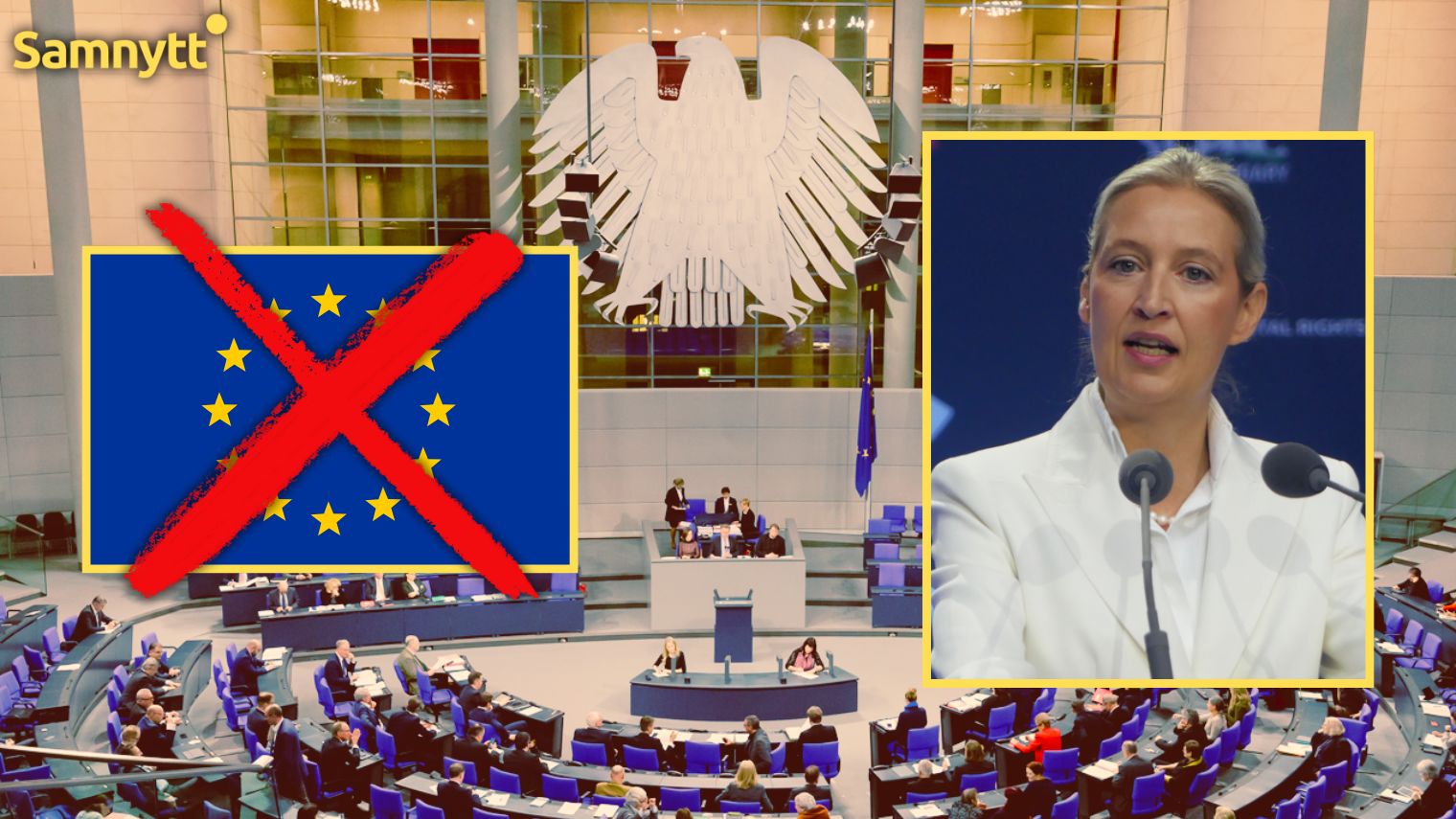
Alternative for Germany (AfD) wants to withdraw Germany from both the eurozone and the Schengen Area if the party forms a government. At the same time, support for the party is rapidly growing ahead of several key state elections, and AfD is now polling at levels that could make it Germany’s largest political force.
AfD party leader Alice Weidel presented these demands in an interview with the German TV channel ZDF. She claims that Germany’s economy was stronger before the introduction of the euro and believes that the common currency has weakened the German economy and reduced households’ prosperity.
The party also wants to leave the Schengen Area and reinstate significantly stricter controls at Germany’s borders. Weidel stated that an AfD government would close the borders and exit Schengen. Additionally, the party seeks to increase the number of deportations and reduce opportunities for citizenship. For instance, AfD wants Syrians whose reasons for protection have ended to return to Syria.
Climate and energy policies would also change drastically. Weidel reiterated AfD’s opposition to the planned ban on new cars with combustion engines and rejected measures targeting climate change caused by humans.
SEE ALSO: Alice Weidel: AfD to Take Power – Here Are the Reforms the Party Leader Wants to Implement
These statements come as AfD surges in the opinion polls. In the latest national survey from Forschungsgruppe Wahlen, the party receives 27 percent, compared to CDU/CSU’s 22 percent. This makes AfD bigger than the conservative union in the poll.
Support is even stronger in Saxony-Anhalt, where state elections will be held on 6 September. In several surveys, AfD polls at around 40 percent or more. Reuters recently reported on a poll where the party received 41 percent compared to CDU’s 24 percent.
Such a result could give AfD an opportunity to form a state government on its own—something that would be a historic breakthrough for the party.
Refusing to Cooperate
The successes have simultaneously intensified the conflict between AfD and the established parties. CDU has maintained the so-called “Brandmauer,” meaning the party refuses to cooperate with AfD. Weidel claims that this strategy instead strengthens her party and has said that AfD will first take power in states and thereafter at the federal level.
At the same time, there are calls to go even further and attempt to ban AfD. The issue of a party ban has gained renewed momentum in Germany, where supporters argue that the party threatens the democratic and constitutional order. Over 1,000 lawyers have called on the government and parliament to take action.
The Social Democratic SPD has also supported a legal case arguing that AfD seeks to undermine the democratic order.
At the same time, opposition to a ban is significant, even within the established parties. The CDU has, for example, warned that a failed attempt to ban the party could strengthen AfD’s self-image as a political victim and thus benefit the party.
The discussion is therefore no longer merely legal but also strategic: the question is whether a ban would weaken AfD or, on the contrary, give the party even more support.
Dispute Over Labels
The debate has also become more complicated after a court in February blocked the German intelligence services from classifying AfD as a “confirmed far-right” organization, pending a final decision. AfD saw this decision as a victory for the rule of law.
At the same time, a recent ZDF poll shows that a majority of Germans still oppose an AfD-led state government in eastern Germany. 64 percent said they do not want to see an AfD politician as minister-president, while 23 percent were in favor. Additionally, 61 percent considered CDU’s refusal to cooperate with AfD to be correct.
AfD thus faces a decisive political test. In a short time, the party has gone from being isolated by the established parties to topping several polls. If the poll numbers hold, the election in Saxony-Anhalt on September 6 could become the first step toward AfD actually having the opportunity to govern a German state, while the debate about a possible party ban continues.