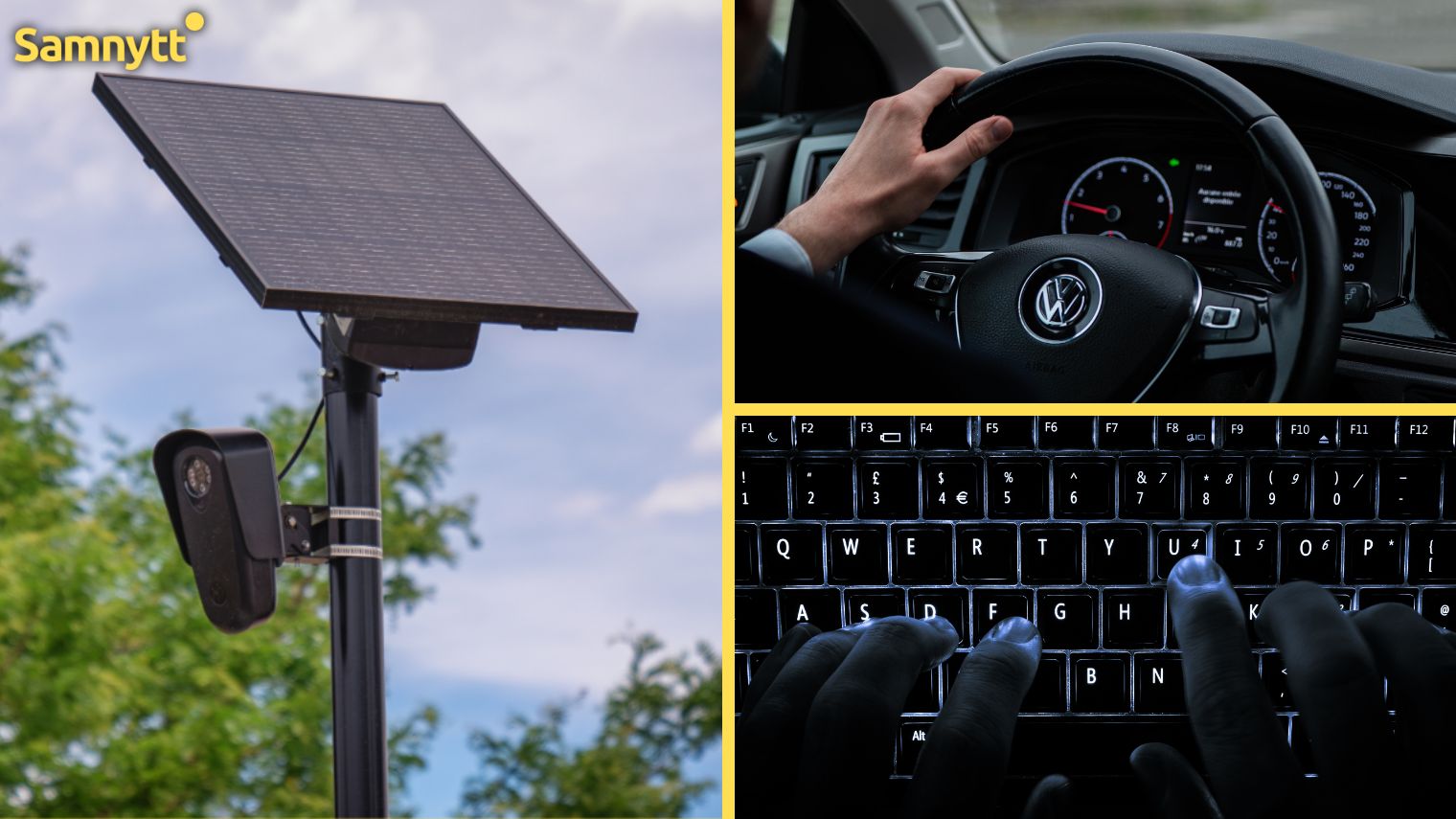
Often referred to as “Flock cameras,” these devices have quickly become one of the most controversial surveillance technologies in the U.S. Flock Safety’s network includes about 120,000 automated license plate cameras used by thousands of American police organizations. Now, criticism is mounting from both the right and left as several cities terminate their contracts, politicians demand new laws, and high-profile cases highlight how the technology can be abused.
The cameras, usually mounted on poles by roads and entrances, photograph passing vehicles and read license plates. The system records, among other things, the time, location, license number, and various characteristics of the vehicle.
The information can later be searched by the police. The idea is that an investigator should, for example, be able to find a car seen near a crime, track its previous movements, or receive an alert when a wanted vehicle passes a camera.
Flock Safety emphasizes that the system does not use facial recognition and that it is vehicles—not people—that are being registered. The company also states that information is normally deleted after a limited period. At the same time, during August, Flock changed its recommendations and reduced the default storage time from 30 days to seven days.
READ ALSO: After mass immigration came mass surveillance
The company has also introduced stricter requirements for officers to provide a case number when conducting searches and says it has expanded automated controls to detect suspicious use.
However, it is precisely the ability to retrospectively track vehicle movements that is at the heart of much of the criticism. A person does not have to be suspected of any crime for their car to be registered. Instead, large databases are being built, tracking which vehicles have been at which locations at various times. Flock states that around 7,000 police organizations use its technology and that the cameras exist in more than 6,000 communities.
The criticism gained new momentum after a high-profile investigation by Wired. The magazine reviewed Flock’s new AI tool, OS Investigate, and reported that the technology goes far beyond traditional license plate reading.
Abused by Police Officers
The tool can combine vehicle data with, among other things, police case files, 911 data, commercial databases, and identity details. An investigator can thus search for people and links based on locations, behavioral patterns, or descriptions—without initially knowing the person’s name or license plate number.
This has become particularly controversial as a series of incidents have emerged where police employees have been accused of using the systems for private purposes. In Georgia, four former employees at the Savannah Police Department were arrested last Friday after an internal review.
Three former officers and one civilian employee are accused of running searches in the Flock system unrelated to law enforcement. The investigation is ongoing, and the allegations have not yet been tried in court.
The Savannah case is not isolated. In July, five former officers in Albany, Georgia, were arrested after an internal check showed they had repeatedly searched stored Flock information without legitimate police reasons.
Elsewhere in the country, police officers have been accused of using license plate data to track former or current partners and other people they know privately.
Incorrect matches have also raised concerns. In San Diego, a man spent about a month in jail after Flock technology wrongly linked him to an attempted violent carjacking. The case has become an example for critics who warn that an automated match can have very serious consequences when police treat the technology as reliable evidence rather than an investigative lead.
Republicans and Democrats Unite
The issue is now developing into a rare cross-party phenomenon. Republican Tim Burchett from Tennessee has introduced a bill that would ban the federal government from purchasing automated license plate readers and from using federal funds to support the systems at the state level.
He has described the need to ban the cameras, noting that, post-pandemic, people have suddenly started to notice how widespread they’ve become and that clear limits are needed.
On the Democratic side, California Senator Adam Schiff has also warned about the trend. In a video clip to his constituents, he stated that the cameras are bringing people across party lines together in deep concern about the technology, asking: “Are we in a surveillance state?”
READ ALSO: The Social Democrats want police to monitor your online comments
Los Angeles Mayor Karen Bass, in turn, has opposed a possible deal between Flock and the Los Angeles Police Department. She demands that police instead find a company that does not share information.
There is also harsh criticism from the Republican side. Texas Agriculture Commissioner Sid Miller, a Republican and former state representative, has called for Texas to halt the expansion of Flock cameras. He argues that, in practice, the state is creating a system where ordinary Americans’ movements are registered even though they are not suspected of any crime.
Miller has called for a stop to new purchases and advocated requirements for court orders, shorter storage times, regular audits, and tough penalties for misuse.
Intense Debate
The debate has exploded further in recent days. In Troy, New York, a new review presented by the city council showed that the police Flock system had logged more than 25 million vehicle sightings in just the first six months of the year. More than 5,000 external authorities had also accessed data from Troy.
Among the organizations requesting information were, for example, the Houston Police Department, the U.S. Border Patrol, and Homeland Security Investigations. The municipality is therefore considering limiting the storage time to 48 or 72 hours.
Meanwhile, in Pennsylvania, state lawmakers are preparing legislation that would limit how information can be used, increase transparency, give local communities the power to refuse the systems, and impose penalties for misuse. The issue has won support from politicians on both sides of the aisle.
Opposition is also evident at the local level. In Hood County, Texas, three Flock cameras have been deactivated after the county ended its contract. Local constable John Shirley filmed the cameras being disconnected and called them “garbage.”
In other municipalities, residents have protested, demanded referendums, or vandalized cameras. Over the past week, demonstrators also gathered in Flock’s home city of Atlanta during the company’s annual conference.
According to the grassroots organization DeFlock, about 100 municipalities in 2026 have deactivated, cancelled, or rejected contracts with Flock.
Meanwhile, opposition is not only coming from activists. The American Civil Liberties Union (ACLU) has described Flock’s system as part of the rise of a national mass surveillance system and claims that people can be tracked and that information can be shared between agencies without the individual even being aware of it.
The organization argues that Flock’s new safeguards do not solve the fundamental problem: that the state is able to record ordinary people’s movements on a large scale.
Defending the Technology
At the same time, Flock defends the technology, pointing to its use in major criminal investigations, tracking wanted vehicles, and cases where missing persons were found. The company claims the technology contributed to more than a million criminal investigations and incidents in 2025 and that its products assisted in about 20 percent of solved cases in jurisdictions where the technology is used.
The company also emphasizes that the information is owned by the local customer and that its use should be limited to law enforcement purposes.
This is why the issue has now landed squarely in a broader American debate about where the line should be drawn between security and surveillance. For proponents, Flock is an effective tool enabling police to solve crimes faster. For critics, it is the beginning of a system where the state can, in practice, reconstruct people’s movements after the fact without the individuals themselves having done anything to fall under suspicion.
READ ALSO: Confirmed: Police to get AI-powered real-time surveillance of the people