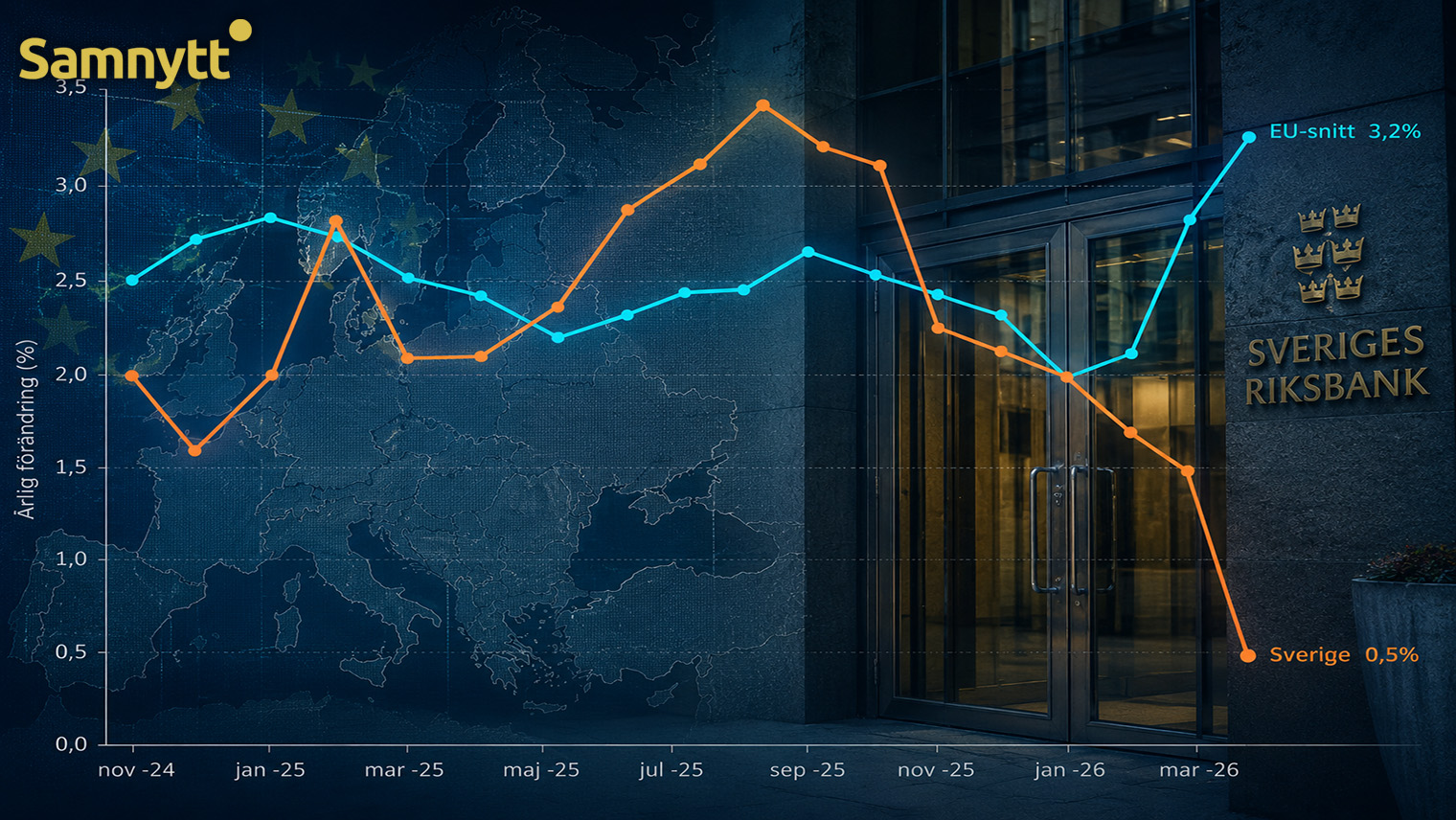
Inflation in Sweden continues to fall, and the country now has the lowest inflation rate in the entire EU. According to the harmonized measure of inflation, HICP, Swedish inflation was at 0.5 percent in April 2026 – the lowest among all 27 member states. At the same time, inflation across the EU as a whole moved upward during the first months of this year. The data is based on statistics from Eurostat and Statistics Sweden (SCB), compiled by Trygga.
At the end of 2025, Sweden was close to the EU average when it came to inflation. Sweden’s HICP was then 2.1 percent, while the EU average was 2.3 percent. Since then, the development has gone in completely different directions.
Between December 2025 and April 2026, Sweden’s inflation has fallen by 1.6 percentage points to 0.5 percent. At the same time, the EU average has risen to 3.2 percent.
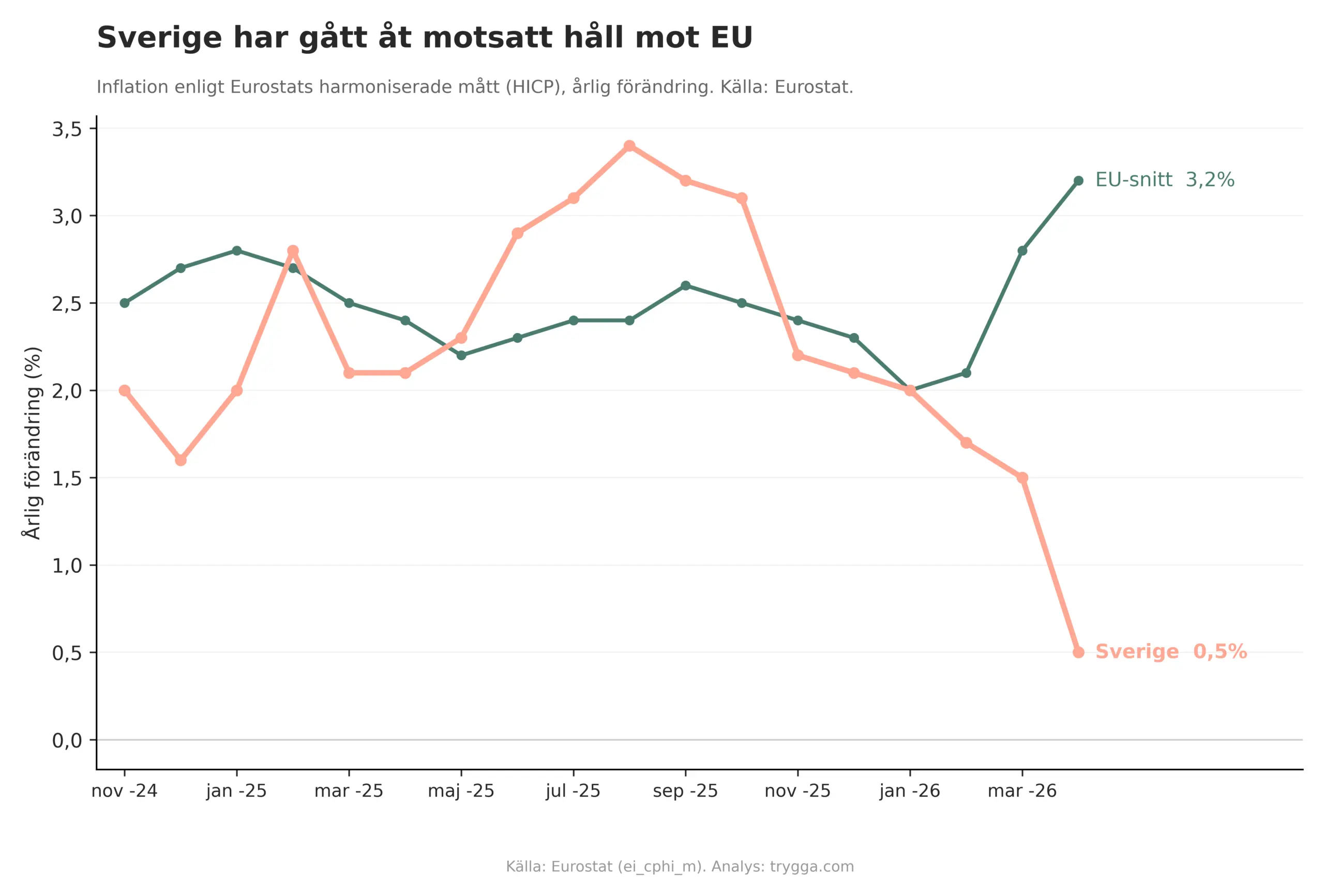
This means that the difference between Sweden and the EU is now 2.7 percentage points. No other member state has seen as large a drop in inflation during this period.
Four Different Inflation Measures
In the media, inflation is usually reported with the unit CPI – Consumer Price Index including mortgage rates. CPIF is the Riksbank’s (central bank’s) preferred measure, which is similar to CPI but uses a fixed interest rate so that changes in rates don’t affect the index. CPIF-XE is CPIF with energy prices excluded—referred to as “core inflation.”
ALSO READ: Inflation dropped sharply in April
HICP (Harmonised Index of Consumer Prices) is the harmonized index used by Eurostat, and in Sweden, it is called HIKP. Here, mortgage rates and some other costs of home ownership have been excluded. The reason is to make it easier to directly compare figures between different member states.
Figures for Sweden’s Four Inflation Measures in April
• CPI: -0.1 percent (the most common measure in the media)
• CPIF: 0.8 percent (Riksbank’s target is 2 percent)
• CPIF-XE: 0.0 percent (core inflation, excluding energy)
• HIKP/HICP: 0.5 percent (Eurostat benchmark measure)
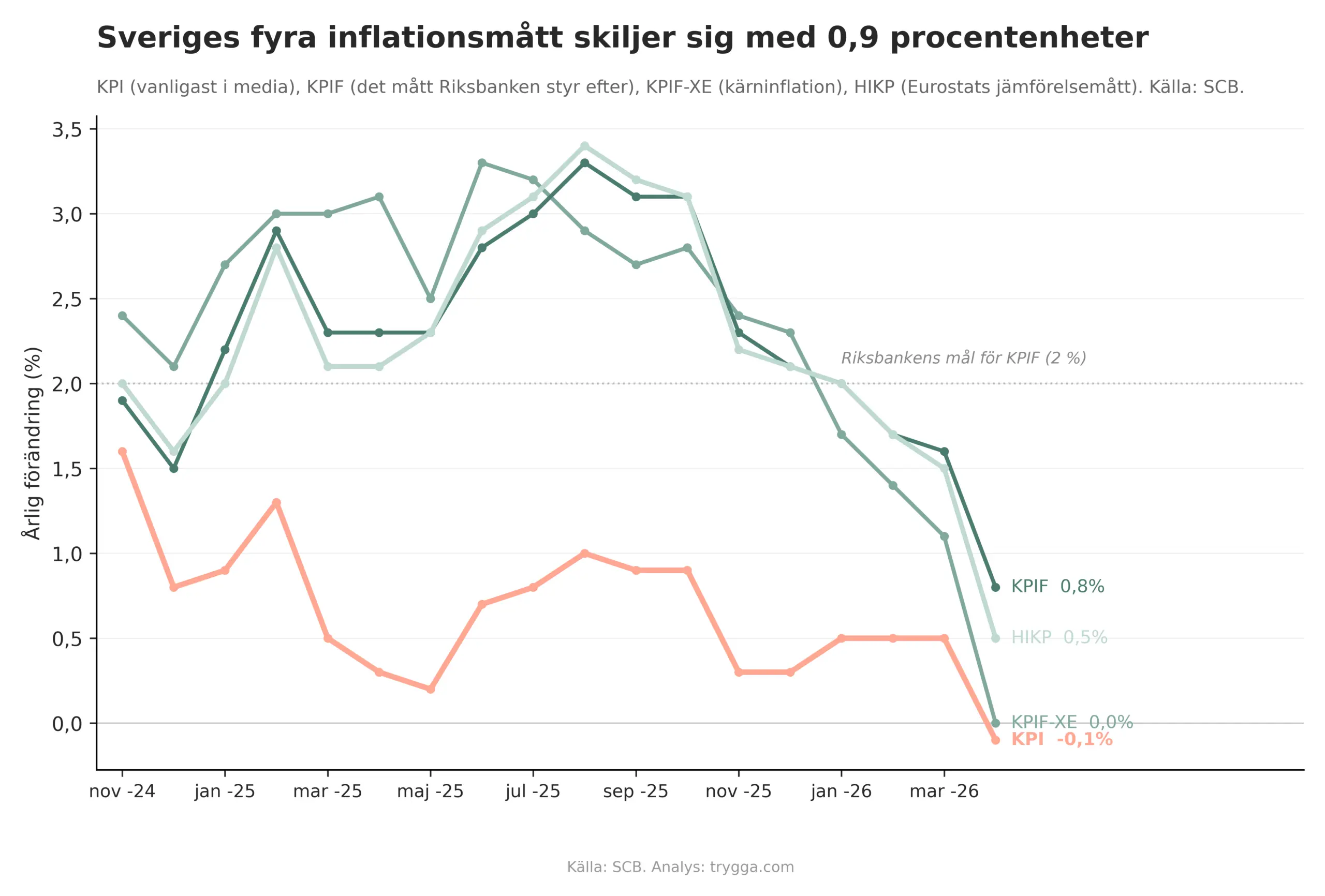
The differences between the measures are significant. For example, CPI shows weak deflation, while CPIF is much higher. This is mainly because of how mortgage rates are included. CPI is directly affected by falling interest rates, while CPIF uses a fixed rate and HICP completely excludes mortgage rates.
Lowest and Highest in the EU
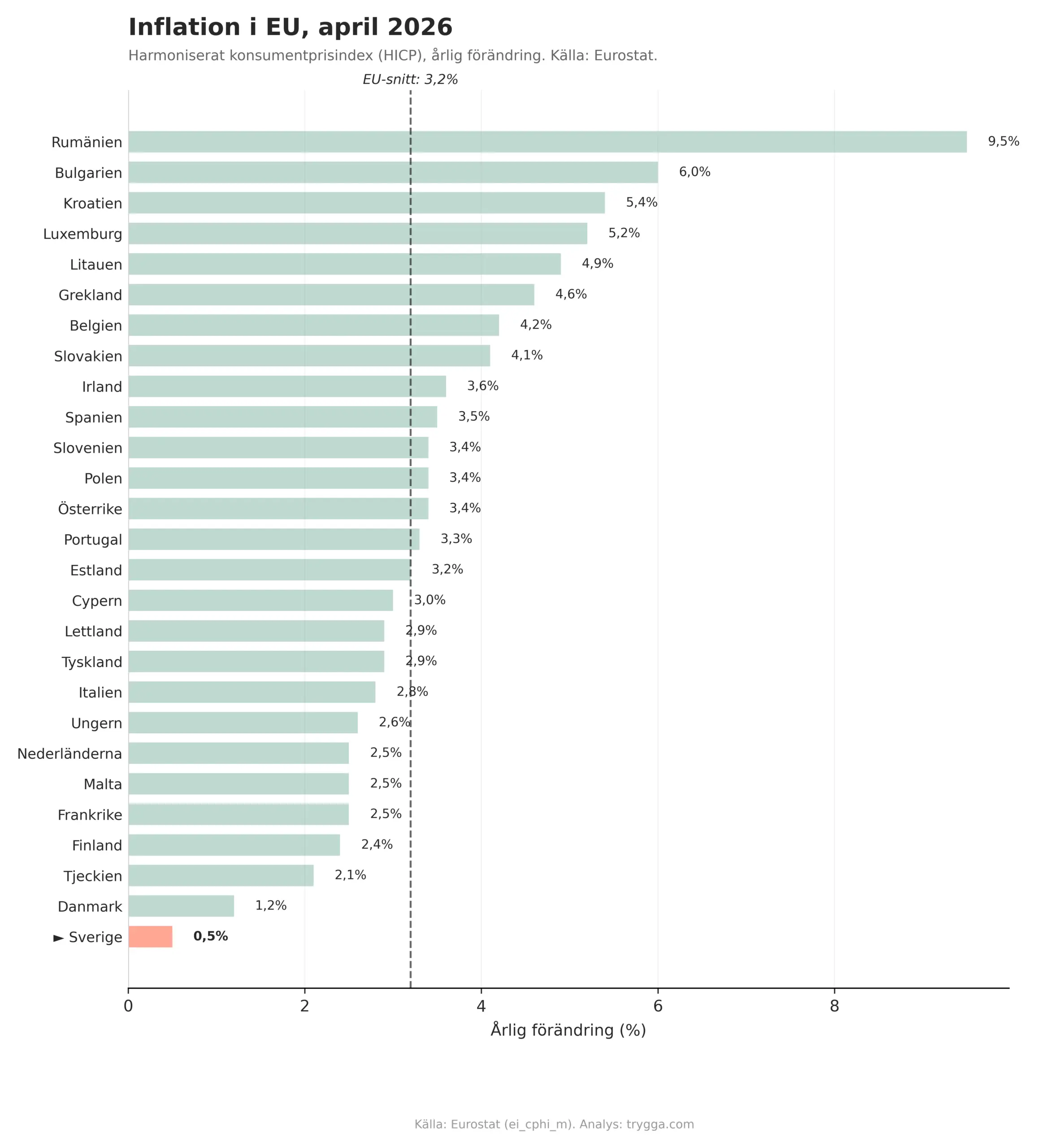
Countries with the lowest inflation:
• Sweden: 0.5 percent
• Denmark: 1.2 percent
• Czech Republic: 2.1 percent
• Finland: 2.4 percent
• France, Malta, Netherlands: 2.5 percent (shared position)
Countries with the highest inflation:
• Romania: 9.5 percent
• Bulgaria: 6.0 percent
• Croatia: 5.4 percent
• Luxembourg: 5.2 percent
• Lithuania: 4.9 percent
EU average: 3.2 percent
Sweden Lowest Also in the Nordics
Compared to the other Nordic EU countries, Sweden clearly has the lowest inflation. Denmark is at 1.2 percent, while Finland is at 2.4 percent.
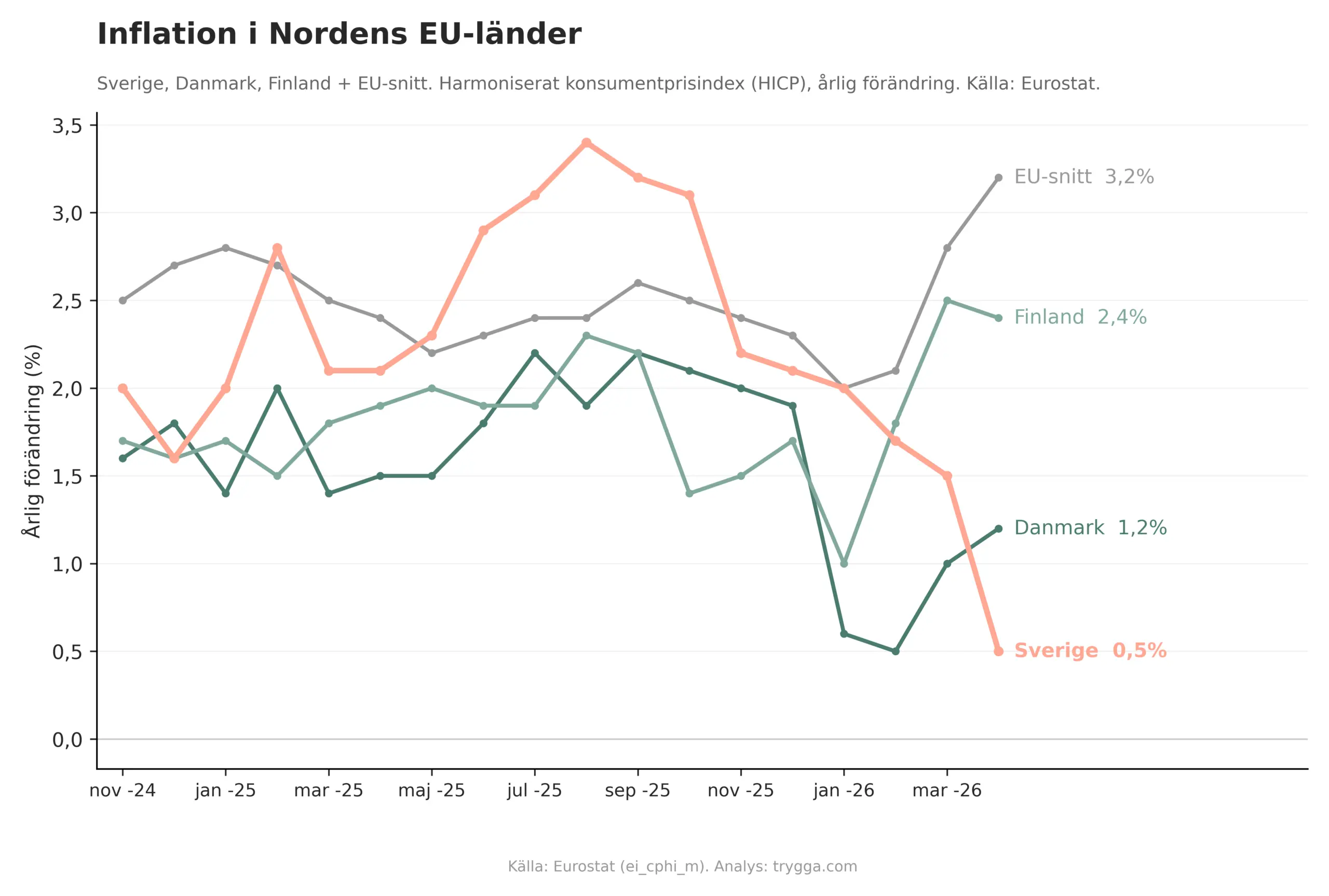
Both countries are below the EU average, but still clearly above Sweden’s level. The difference is 0.7 points compared to Denmark and 1.9 percentage points compared to Finland.
Data from Eurostat and SCB
EU data is sourced from Eurostat’s dataset ei_cphi_m (Harmonised indices of consumer prices, monthly data, annual rate of change), where the latest available period is April this year.
The domestic Swedish figures for CPI, CPIF, CPIF-XE, and HIKP have been collected from SCB’s official statistics (PR0101). HIKP is how SCB refers to HICP. The values are the same.