A recent survey on full-face veils in public places shows a clear pattern: the Swedes who want to see a ban are significantly more numerous than those who oppose one. At the same time, major differences between the right and left political blocs are revealed—along with a discrepancy between parties’ feminist rhetoric and their voters’ actual opinions.
The polling institute Verian, in a survey commissioned by SVT, finds that those who want to ban women-oppressing Muslim full-face veils—burka and niqab—are many more than those who want the oppression to remain permitted.
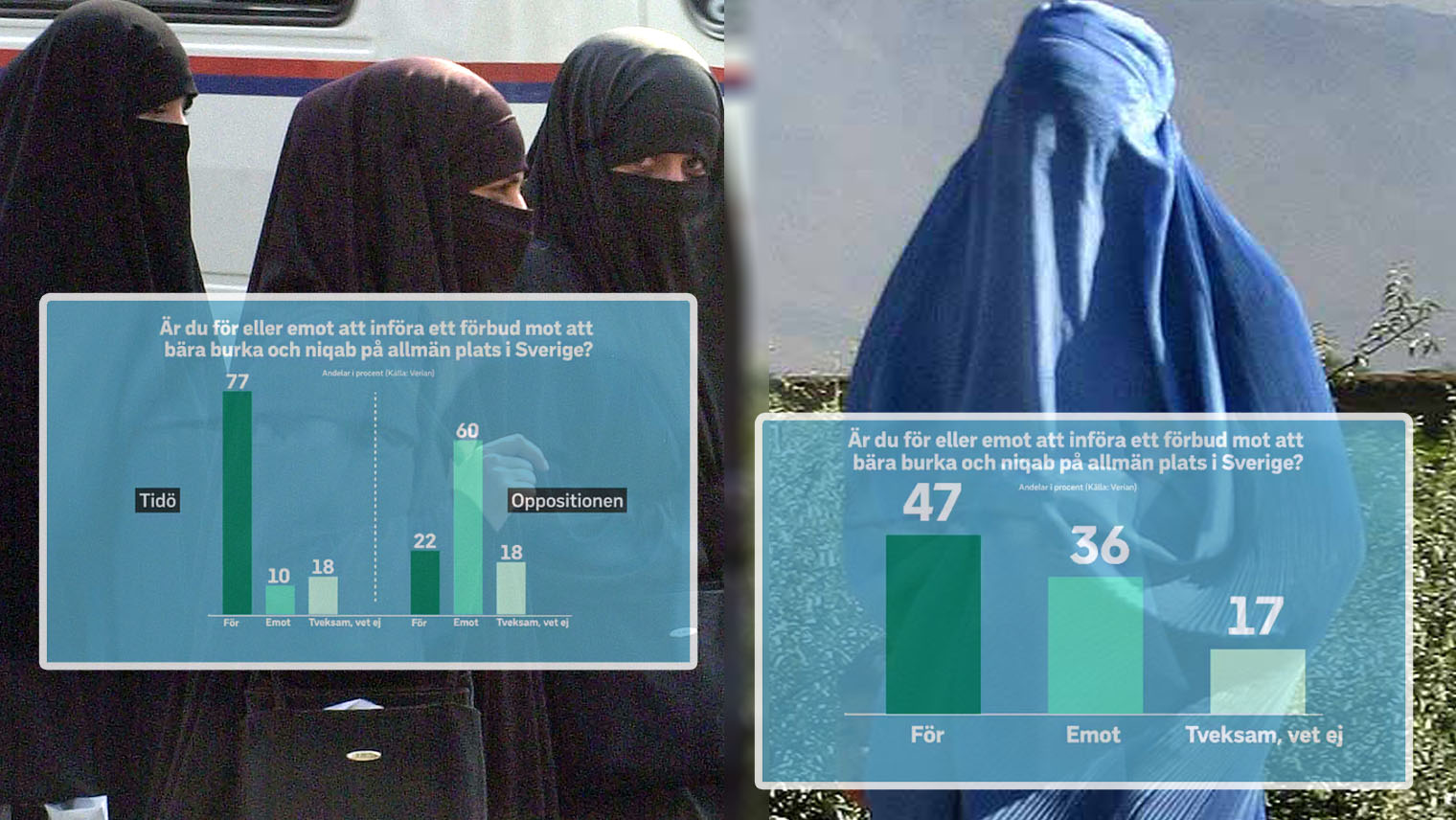
The survey shows that 47 percent are clearly in favor of a ban, while 36 percent are against. 17 percent are ambivalent or do not wish to state their position on the issue.
Sharp Political Bloc Differences in the Electorate
When the results are broken down by political sympathies, clear differences emerge—of a kind many may not have expected. Among the voters of the Tidö parties, as many as 77 percent want a ban, while only 10 percent are against. Among the left opposition, the picture is the opposite: only 22 percent are for a ban, whereas 60 percent believe that Muslim oppression of women should remain allowed in the future.
The figures stand in contrast to the fact that right-wing parties—and especially the Sweden Democrats—are often criticized for not being sufficiently feminist, sometimes even accused of being directly misogynistic. Nevertheless, it is among these voter groups that opposition to oppressive attributes against women is the strongest.
At the same time, it can be noted that the left parties’ voter base consists to a greater degree of people with a Muslim immigrant background, which likely affects the outcome. However, this does not entirely explain the difference—the gap is too large to be dismissed with that explanation alone. Why otherwise radical feminists hold double standards for Swedish versus immigrant women remains an open question.
Party Leaders on the Ban
Before the Christian Democrats’ national convention, party leader Ebba Busch stated clearly that she wants to ban the burka and niqab in public spaces. “Islam must adapt in Sweden,” she told Aftonbladet at the time.
Busch has since developed her argument and emphasized that a full-face veil is an expression of oppression against women that does not belong in an equal society—if you want to practice Islam in Sweden, you cannot do it in the same way as in Iran or Afghanistan.
Prime Minister Ulf Kristersson and Social Democratic leader Magdalena Andersson have also left the door open for a ban, though without making any firm commitments.

Andersson has at the same time expressed concern that women in fundamentalist environments could be negatively affected.
– If such a ban were to risk women instead being locked up at home, then you have to consider whether it is the best way forward.
However, the Green Party’s spokesperson Daniel Helldén is completely dismissive of helping oppressed women in the suburbs with gender equality-norming laws.
– You do not ban certain types of clothing in a democracy, he argues.
Critics claim that this reasoning ignores the fact that the full-face veil is not a neutral piece of fabric, but a symbol for a view of women that conflicts with fundamental principles of equality. Few would express themselves in the same way about, for example, Nazi armbands.
Voters’ Voices
Among those SVT interviewed in connection with the survey’s presentation, there are clear arguments on both sides. Voter Nedo Dervisevic sees a ban as reasonable:
– It is important to know who you are talking to. That you can see the eyes and face.
Anita Eriksson, who is against a ban, believes that freedom of religion is more important than equality:
– Who else among the parliamentary parties should stand up for religions, if not the Christian Democrats? she wonders
Fact Box: Full-Face Veil and Women’s Situation
Where is the full-face veil most common?
Burka and niqab mainly occur in countries with strongly religious legislation or social control, such as Afghanistan, parts of Iran, Saudi Arabia, and certain regions of Pakistan. In several of these countries, women’s rights are severely restricted in terms of education, work, freedom of movement, and legal independence.
International comparisons:
Several European countries—including France, Belgium, and Denmark—have already introduced bans on full-face veils in public places, often citing equality, security, and social cohesion.
Women’s rights:
International human rights organizations point to a connection between being forced to wear a full-face veil and structural oppression of women. At the same time, opinions differ as to whether legislation or other societal measures are the most effective way to promote greater emancipation.