
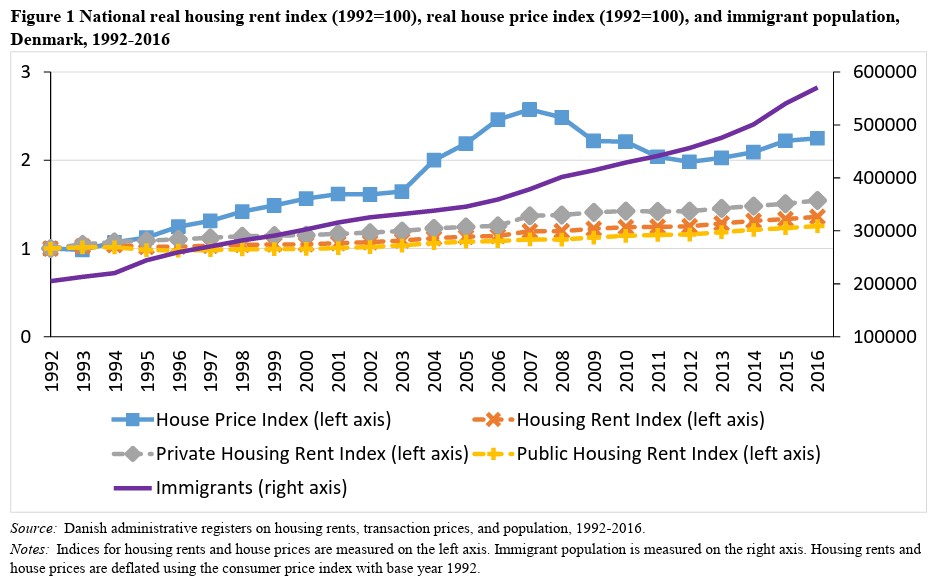
A study examining the effects of immigration on the Danish housing market shows that nearly 90 percent of the rising housing costs since 1999 have been caused by mass immigration.
If it were not for immigration, one could still buy homes and pay rent at virtually 1999 prices today. That is the conclusion of the study Medium-Run Impacts of Immigration on the Housing Market: Evidence from a Quasi-Experimental Shift-Share Instrument.
The authors Anna Piil Damm, Ahmad Hassani, Anil Kumar, and Juan Carlos Parra-Alvarez write that the results indicate significant effects of immigration on private rental prices and house prices at the municipal level.
More specifically, they find that a one percentage point increase in local immigration over a five-year period relative to the local population in the base year 1995 leads to an average increase of about six and eleven percent in private rental prices and house prices respectively at the municipal level during the same period. These effects are accompanied by an inelastic housing supply and no out-migration of natives.
At the district level, significant effects are also observed, though more modest, with private rents and house prices increasing by about 1–2 percent on average. In contrast to the evidence at the municipal level, the slower growth in rents and prices is associated with an expanded supply of public housing and out-migration of natives.
In summary: More immigrants meant more people needed housing, which in turn created greater demand, and as construction lagged behind, prices soared.
READ ALSO: Bridge to multicultural area caused housing prices to fall