In a new survey, respondents were asked to what extent they feel various behaviors are accepted in the area where they live. This includes, among other things, living openly as homosexual, drinking alcohol on weekdays, and openly displaying one’s religious faith. The results show significant differences between so-called vulnerable areas and Swedish areas.
While only 62 percent of residents in vulnerable areas feel that it is acceptable to live openly as homosexual, the corresponding figure for the rest of Sweden is 84 percent. Another major difference concerns attitudes toward drinking alcohol on weekdays. Here, 61 percent consider it acceptable compared to 46 percent in vulnerable areas.
When it comes to religious attributes such as the hijab, 64 percent in vulnerable areas feel it is accepted compared to 53 percent in the rest of Sweden. In immigrant-dense areas, twice as many see it as acceptable for parents to forbid their children from having a boyfriend or girlfriend—29 percent compared to 14 percent.
READ ALSO: Immigrants: We’ve Made Sweden Better
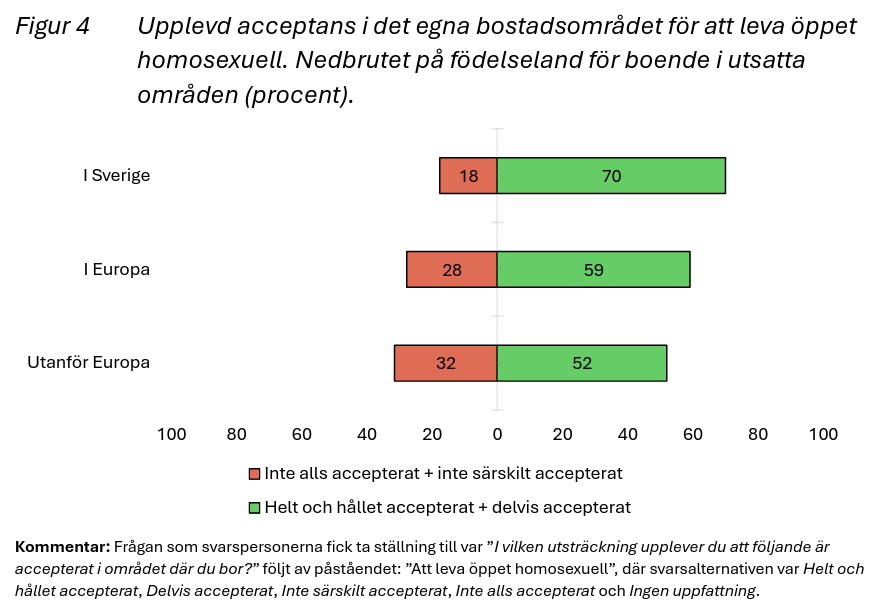
At the same time, it is emphasized that even within vulnerable areas, the differences can be significant depending on the country of origin. For five out of six behaviors studied, there is a clear pattern where acceptance within the neighborhood is perceived as lower among residents of vulnerable areas who were born outside Europe.
An exception concerns the view on parents forbidding their children from having a boyfriend or girlfriend. The proportion who perceive this as fully or partially accepted in their residential area is somewhat higher among respondents born outside Europe, at 33 percent, compared to 24 percent for respondents born in Europe and 27 percent for those born in Sweden.
Alcohol and the Hijab
The most striking difference based on country of birth is found in the perceived acceptance of alcohol consumption on weekdays. Among residents in vulnerable areas who were born in Sweden, 58 percent feel this is accepted in their area, while the corresponding share among those born outside Europe is 33 percent.
READ ALSO: Widespread Support for Return Migration Within Certain Immigrant Groups
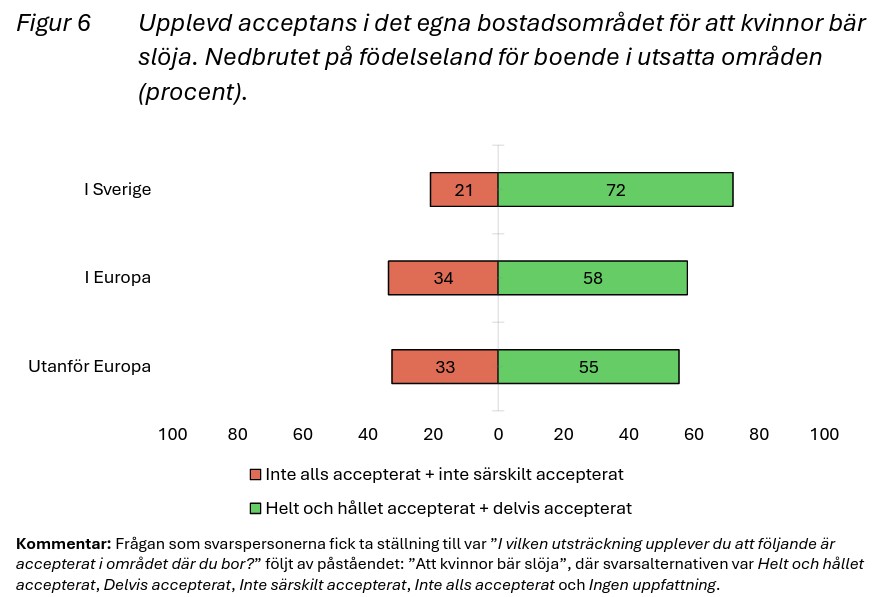
Clear differences also exist in views about women wearing the hijab and women staying at home with the main responsibility for the children. Among respondents born in Sweden, 72 percent state that it is fully or partly accepted for women to wear the hijab in their area, and 55 percent feel that it is accepted for women to stay at home and take the main responsibility for the children. Among people born outside Europe, the corresponding figures are 55 percent and 38 percent, respectively.
Different Age Groups
Additional large differences emerge when looking at different age groups. Among people aged 18-29 in the rest of Sweden, 90 percent believe it is accepted to live openly homosexual in their area, while for those in the same age group within vulnerable areas the figure is considerably lower, at 58 percent.
For people for whom religion is important, the perceived acceptance of living openly homosexual is lower regardless of where they live.
“Humans are complex, and we need more knowledge to understand how norms are formed and change. Questions about how we create more encounters between people and what responsibility we have as a society are central, requiring more perspectives and further research,” says Ahmed Abdirahman, CEO and founder of the Järvaveckan Foundation.
READ ALSO: Tougher Laws Against Gang Crime Popular Among People with Foreign Background