Only 3–4 percent see Russia in relation to the war in Ukraine as one of the major threats to democracy – meanwhile, concerns are growing about fake news in the media, immigration-driven gang crime, and an increasing distance between citizens and those in power.
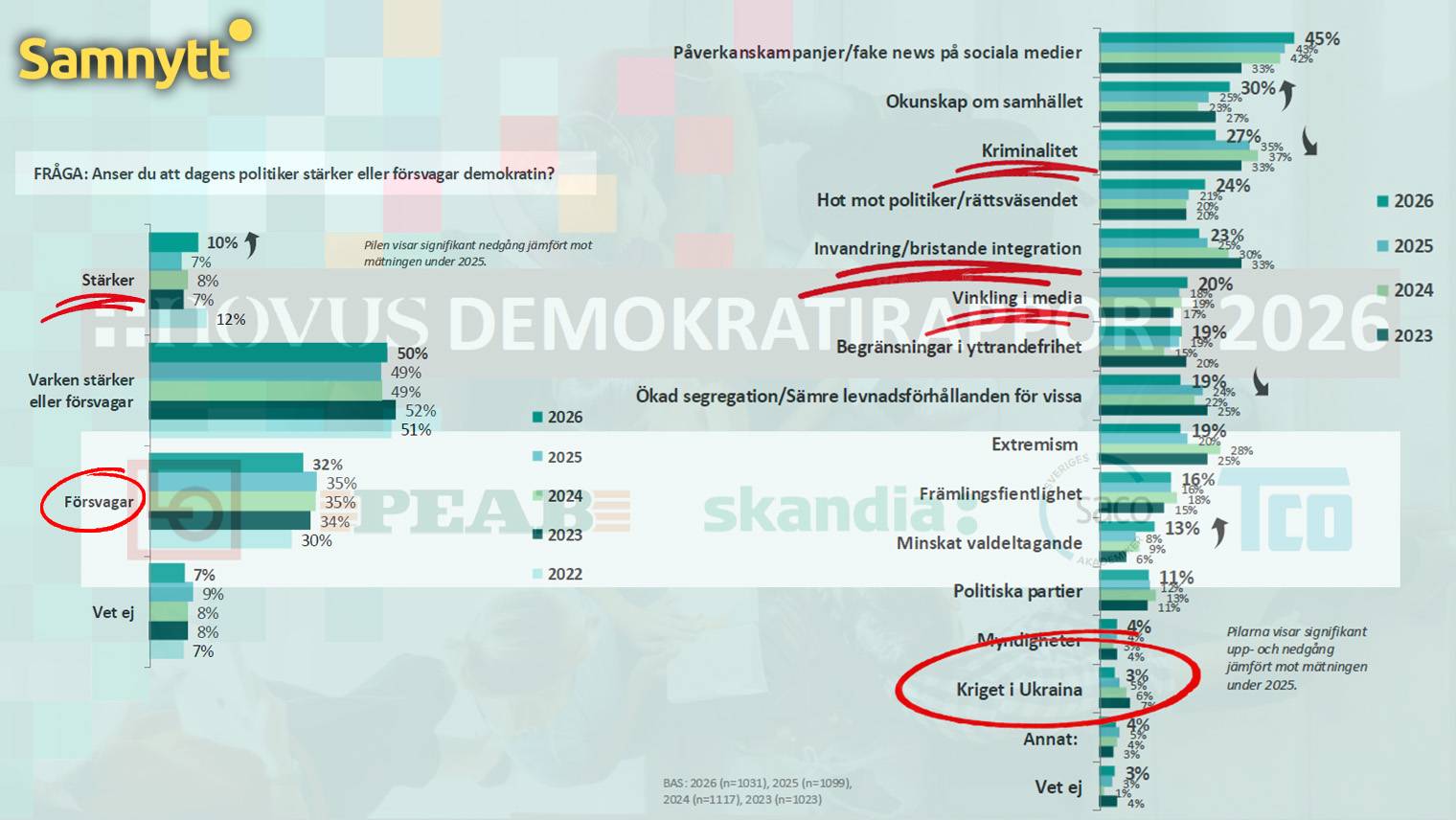
In stark contrast to how Russia and the war in Ukraine have dominated Swedish political debate and have been highlighted as the main security and existential threats to democracy and freedom, the Novus Democracy Report 2026 shows that very few Swedes share that view. Instead, the public points out fake or slanted news in the media, immigration-linked gang crime, and the growing gap between citizens and decision-makers as much bigger problems.
Ukraine Ranks Low as a Threat to Democracy
When Novus asks Swedes to name the three greatest threats to democracy, Russia and the war in Ukraine land at the very bottom of the list. Only around 4 percent of respondents cite the war as one of the biggest threats to democracy in Sweden. The number has remained low for several years and is roughly the same regardless of political orientation, between 3 and 4 percent.
The results stand in stark contrast to the picture often painted by leading politicians, government agencies, and major media, where Russia’s war on Ukraine is repeatedly portrayed as one of the most decisive threats to Sweden’s future and security.
The Novus survey shows that the Swedish people instead focus their concern on other social issues that feel more concrete and present in daily life. General problems related to immigration and integration rank high on the list.
Fake News and Media Spin Seen as Greater Threats
The top threat to democracy, according to Swedes, is fake news in the media and social media. A full 45 percent cite this as one of the three main threats to democracy. Meanwhile, 20 percent say that political bias in the media is one of the biggest democratic problems.
The report also shows growing distrust toward established media. As many as 56 percent of Swedes believe that Swedish news media deliberately slant the news to fit their own agendas. This is the highest level measured since the question was first asked.
This perception of the media’s role emerges as one of the report’s most remarkable conclusions. While politicians and media figures often warn about disinformation from external actors, many citizens believe the problem also exists within the established domestic media landscape.
Gang Crime Remains One of the Biggest Problems
Crime also ranks high among perceived threats to democracy. 27 percent of respondents cite organized and immigration-related serious crime as one of the three biggest threats to democracy.
SEE ALSO: Over 67,000 People Linked to Gang Crime in Sweden – Government: ‘Serious Situation’
Even though the level has dropped slightly compared to previous years, crime is still a significantly greater worry than Russia and the war in Ukraine. For many voters, organized crime, shootings, and bombings appear to be a more tangible threat to society’s functioning and the rule of law’s legitimacy than geopolitical conflicts outside Sweden’s borders.
Widening Gap Between People and Power
A recurring theme in the Democracy Report is the feeling that the gulf between citizens and decision-makers is growing. Six out of ten Swedes feel that politicians do not respect voters. Three out of ten also believe that today’s politicians weaken democracy rather than strengthen it.
At the same time, the report shows that many Swedes have more trust in democracy as a system than in those who govern it. Support for democracy is virtually unanimous – everyone surveyed believes democracy is worth defending – but trust in how those in power manage democracy is considerably lower.
Decisions Moving Further Away from Citizens
The report also highlights a growing problem that frequently comes up in public debate – the feeling that important decisions are being made farther and farther from the people they affect.
SEE ALSO: EU’s ‘Democracy Shield’ Criticized as Censorship Machine: ‘Ministry of Truth’
While 71 percent say they would prefer to engage for democracy through local associations or other local initiatives, trust in the EU’s democratic process is much lower than in Swedish democracy. Novus notes that many perceive a democratic deficit in the EU system, and the distance between voters and decision-makers risks weakening the sense of popular influence.
For many Swedes, the future strength of democracy is therefore not primarily about international conflicts, but about the possibility to restore closeness between citizens and those in power. As decisions are increasingly transferred from municipalities and national parliaments to supranational institutions, the feeling grows that one’s own voice matters less.
Strong Support for Democracy – But Trust Is Challenged
The Novus Democracy Report 2026 paints a picture of a people united in support of democracy but at the same time increasingly anxious about its current trajectory.
The most striking result is perhaps the contrast between the political elite’s and the public’s priorities. While debate often revolves around the war in Ukraine and the threat from Russia, only a small fraction of Swedes say they see this as one of the major threats to democracy.
Instead, concern is focused on fake news, media bias, serious crime, and a growing sense that power is moving further away from ordinary citizens. That, according to the Swedish people, is where some of democracy’s greatest challenges are found today.