A new comprehensive technical investigation from the Baltic Marine Technical Investigation Group (BMTIG) establishes that the damage to M/S Estonia can only be explained by a collision with a larger vessel – not by bottom contact as previous investigations have claimed. At the same time, it is revealed that witness accounts of metallic scraping sounds were never taken into account, and one of the country’s leading marine technical experts criticizes how the official analyses were conducted.
The nearly 200-page report is based on a series of technical studies of hull damage, movements, and energies from the capsizing to the bottom position. According to the group, the energy required to cause the 22-meter-long damage on the starboard side is so great that only a collision with a heavy moving vessel can explain it. Calculations show that 140–180 megajoules would be needed – a level that the bottom position cannot generate.
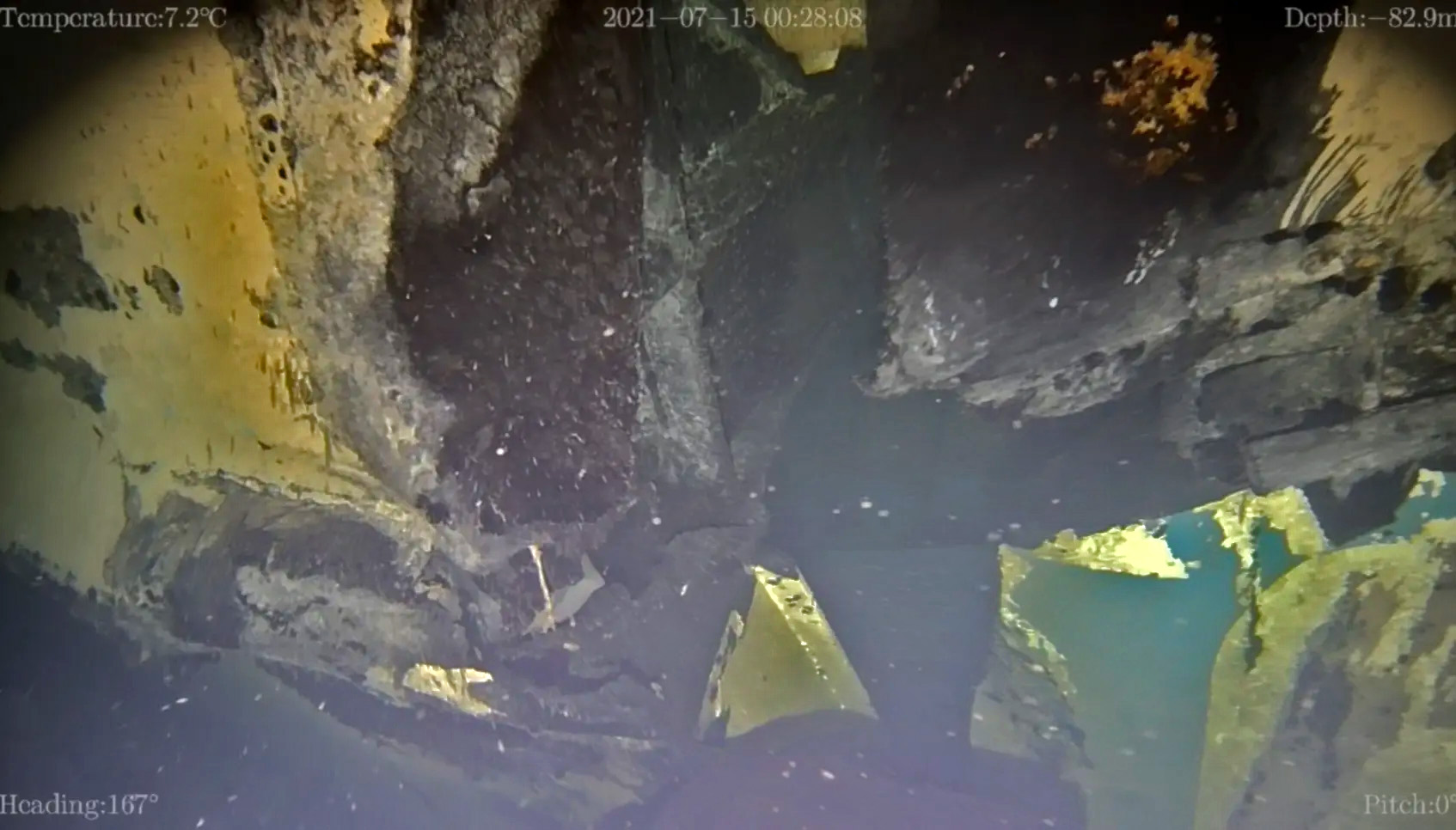
The investigators conclude that previous theories that the hull was damaged upon impact with the bottom do not align with later documentation from ROV inspections and photogrammetry. These new data made it possible to establish that the energy at bottom contact was far lower than what is required to cause both the holes and the prolonged, overlapping deformations on the starboard side.
The main author of the report, Johan Ridderstolpe, points out that even extensive rock formations would not be able to cause damage of this kind. This confirmation is supported by Professor Emeritus Anders Ulfvarson, who has made his own energy calculations. They find that the initial bottom contact at the port stern dampened the movement so significantly that the subsequent movement could not have caused the starboard damages.
The investigators present three major damage regions on the hull: two large holes – the front one first documented by Henrik Evertsson – and a middle zone with several types of structural deformations indicating a longer contact in motion.
READ MORE: Straight to the point #15: Estonia’s sinking – cover-ups and lies
All basic data and mathematical models are published openly, and BMTIG is now sending the report to universities, accident investigation boards, and parliaments internationally. The group claims not to draw conclusions about the type of vessel or nation, but argues that it is now the responsibility of the relevant authorities to investigate what Estonia collided with.
In the presentation of the report, it is emphasized that what they have concluded is not a hypothesis but the only possible conclusion based on hard facts: “It is clear that this is not a theory but an actual consequence of the new state of knowledge.”
Ignored witness accounts of metallic scraping
In parallel with the technical conclusions, older witness accounts are once again drawing attention. Several survivors described in 1994 how they heard loud bangs and metallic scraping shortly before the listing occurred.
Despite this, central witnesses were not interviewed by the accident investigation board, and the interviews conducted 27 years later are, by decision, only to be saved as summaries – something that has led one of the interviewees to report the State Accident Investigation Authority to the Parliamentary Ombudsman.
Witness expert Bengt Schager, who summarized the early interviews, chose to leave the commission when his report was classified as secret and he did not want to sign the final version.
Recurring in police interrogations and in the work of family groups are stories of a bang followed by a prolonged scraping sound. “It sounded as if metal was being dragged along the ship’s bottom.”
READ MORE: Documentary reveals: Four-meter hole in Estonia – previously dismissed as a conspiracy theory
Several witnesses describe how they were thrown out of their bunks and how water began to enter shortly after the sounds. BMTIG emphasizes that the consistent picture from witness accounts has not been the basis of the investigation – but that they are consistent with the conclusions of the report.
Relatives and psychological support personnel from the time after the disaster testify that survivors felt that no one listened to their stories. In the aftermath, there were also protests against the decision not to salvage more bodies and against plans to cover the wreck with concrete, which was later withdrawn.
Professor critical of deficiencies in accident report
Professor Emeritus Anders Ulfvarson, who also participated in BMTIG’s review, has for decades expressed concern about deficiencies in the original accident report’s summary analysis, although he emphasizes that the partial investigations were of high quality. He already argued in the late 1990s that the investigation needed to be supplemented.
READ ALSO: Every other Swede: How Estonia sank not clarified
Ulfvarson agrees with the report’s conclusion that the primary damages occurred at the surface and further discusses possible causes, even though BMTIG themselves do not draw any such conclusions. However, he emphasizes in a comment to Världen Idag that the collision does not have to have been intentional, as has been speculated from various quarters. He mentions that a civilian vessel collision would likely have led to a maritime declaration, which makes it possible – but not proven – that the event may have involved military activity.
The new BMTIG report highlights that previous explanatory models do not hold when new data and modern calculations are used. Witness accounts that have long been in the background are also given new weight when the technical analyses point to an event at the surface rather than at the bottom. The criticism from experienced marine technicians strengthens the picture that the Estonia disaster still holds unanswered questions – questions that the report authors now want authorities to address in a new investigation.
READ MORE: Armed Forces: Estonia used for military transports