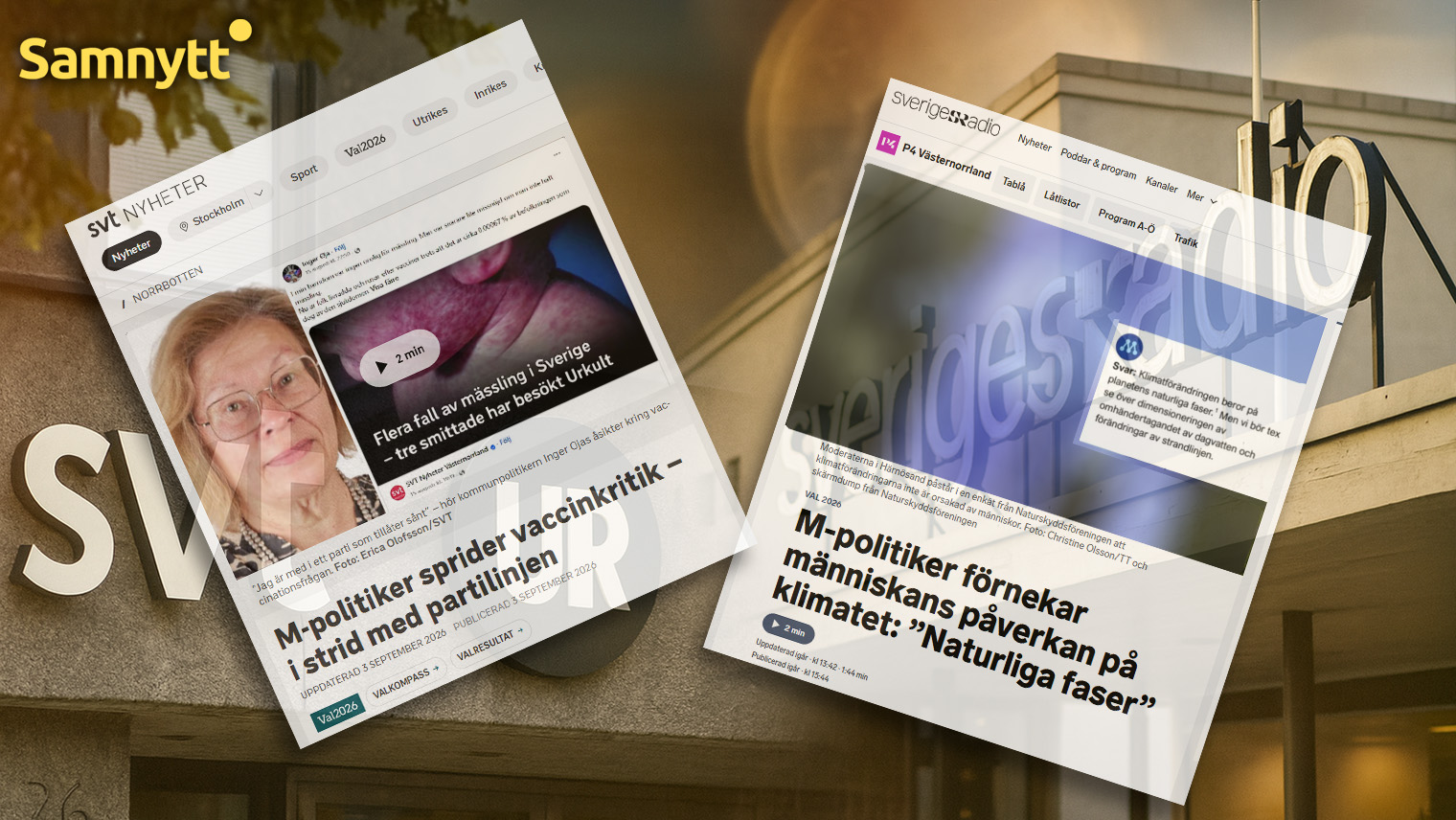
Sveriges Radio asserts that “the Moderates in Härnösand” deny human impact on the climate. At the same time, SVT investigates a moderate local politician’s private criticism of vaccines. In both cases, these involve individual politicians whose views are explicitly not the official policy of the Moderate Party – yet they are given significant attention in public service’s special election coverage.
With only days left before the election, both Sveriges Radio and SVT have turned their spotlight on local Moderate politicians who, on two completely different issues, have expressed opinions that deviate from the party’s official stance.
In the case of P4 Västernorrland, the matter concerns the climate. The headline reads, “M-politician denies human impact on the climate: ‘Natural phases’,” while the reporter in the segment states that “the Moderates in Härnösand” claim that climate change is not caused by humans.
Similarly, SVT has decided, ahead of the election, to scrutinize a part-time politician in Luleå who, on her private Facebook page, has expressed skepticism towards several vaccines and has declared that she herself will not vaccinate again.
READ ALSO: Dagerlind: SVT engages in Greta-washing
What these cases have in common is that public service has found a local Moderate whose personal opinions differ from the party’s official policy – and made this deviation into an election news story.
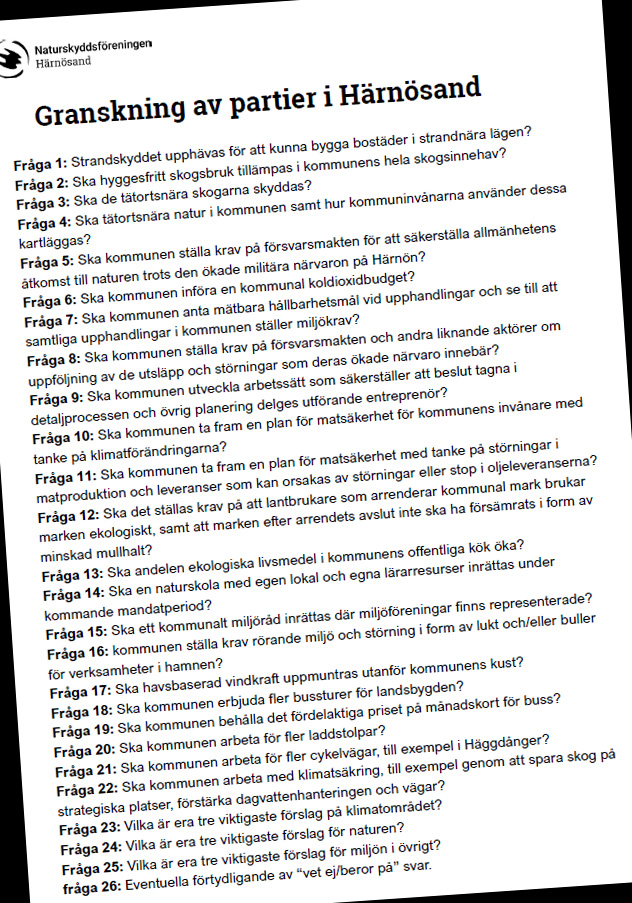
An Answer in a Survey with 26 Questions
P4 Västernorrland’s review is based on a survey sent by the Swedish Society for Nature Conservation in Härnösand to the municipality’s political parties. It consists of 26 questions about, among other things, shoreline protection, forestry, public transport, wind power, charging stations, environmental requirements, and climate adaptation.
The response highlighted by SR is from question 23, where parties are asked to state their three most important climate policy proposals. Under the Moderates’ symbol it says:
“Climate change is due to the planet’s natural phases. But we should, for example, review stormwater management capacity and changes to the shoreline.”
The Swedish Society for Nature Conservation itself added a footnote to the response, stating that climate change is clearly linked to increased emissions of greenhouse gases.
READ ALSO: SVT’s “attack on democracy” segment when SD informed observers about alleged election fraud
P4, however, does not settle for stating that the wording contradicts the established scientific assessment of the cause of ongoing global warming. Already in the introduction, the reporter says that the wording “is often used by climate deniers” and “completely contradicts current research.”
Climate professor Torsten Mauritsen at Stockholm University is then given the opportunity to assert that the warming over the last hundred years is “entirely” due to human activities and emissions from fossil fuels.
That the climate also varies for natural reasons is in itself not controversial. The mainstream scientific position, however, is that such natural variations do not explain the rapid global warming in modern times. Thus, it is fully journalistically justified to confront the claim with climate research for nuance.
The question, rather, is why a single answer from a local politician is turned into a statement by “the Moderates in Härnösand” in public service’s election coverage, when the person who wrote the answer explicitly says the opposite.
“My personal views”
The Moderates’ top candidate, Eva-Clara Wiklund, states that she neither knew about nor supported the wording.
– I don’t stand behind that, let’s put it that way, she tells P4.
It turns out that the survey was answered by the party’s number two, Christian Vassell. He declines to be interviewed but informs P4 in writing that the answers are his personal views and not the party’s. The reporter then objects:
– It only says Moderates, so I think it should be the Moderates’ stance, right?
Wiklund replies that the question is not something the party has discussed and that she herself has not answered it at all.
The person who actually wrote the answer says it is his personal opinion. The party’s top candidate says it is neither hers nor a discussed party line. Nevertheless, P4 chooses to present the matter as the stance of “the Moderates in Härnösand.”
The Full Survey Tells a Different Story
The slant of the report becomes even more evident when reading the rest of the survey. The Moderates’ column does not contain a general rejection of environmental or climate efforts. The party, for instance, answers yes to protecting urban forests and mapping urban nature. In other parts of the survey, the Moderates also say yes to environmental requirements for businesses, more charging stations, and municipal climate adaptation.
READ ALSO: SVT whitewashes far-left ETC during Åkesson’s interview: “Independent red-green”
And even in the very response P4 highlights about natural climate phases, it is followed by reasoning and specific proposals for climate adaptation – the capacity for stormwater management is to be reviewed, as are the consequences of shoreline changes.
This does not make the claim about the cause of today’s warming scientifically correct, or at least not complete. But it does make the public service’s portrayal of a moderate municipal organization that entirely dismisses the climate issue far less evident or even false.
SVT Scrutinizes Local Politician’s Private Vaccine Views
A few days earlier, SVT had chosen a similar angle towards the Moderates in Luleå. There, the subject of scrutiny is Inger Oja, sixth on the party’s municipal list and a part-time politician.
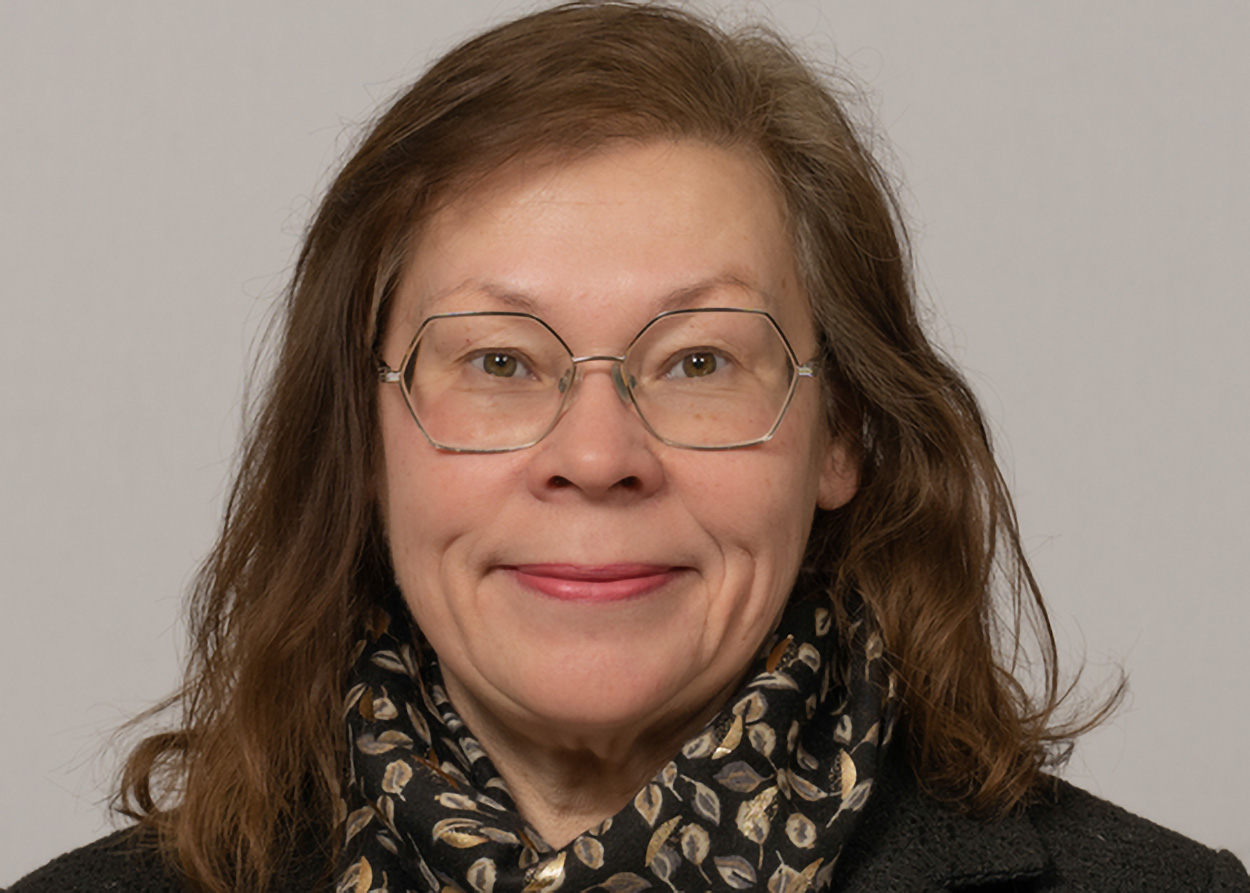
On social media, she has repeatedly voiced vaccine-skeptical views which SVT correctly notes deviate from the Moderates’ official stance. Oja has, for example, written that she will never take a vaccine again and has questioned the current concern about measles.
In response to SVT’s question, she says:
– On this point, I have decided that I do not want any more injections in my body. Period.
When the reporter asks about measles, Oja answers:
– Was it a problem in the 1960s? No, it wasn’t.
This is, in fact, an accurate observation. Virtually all children in Sweden contracted measles in the 1960s, and fatalities were practically zero. A single child may have died from the disease during the entire decade, but then with underlying health issues as a contributing factor. Mortality in Sweden remains today almost nonexistent, even in groups that, like the children of the 1960s, are unvaccinated and contract the disease.
READ ALSO: SVT’s language use: Far-right mentioned 79 times more often than far-left
When Oja’s views are compared to those of the Moderates, she says:
– I belong to a party that allows such things. We are for free people.
There are arguments both for and against vaccination against measles as part of the vaccination program. But the right of an adult to personally refrain from medical treatment is a different issue than what a political party advocates as public health policy. Moreover, Oja is not responsible for healthcare or vaccination issues within the Moderates.
“This isn’t North Korea”
Still, SVT repeatedly returns to the contradiction between Oja’s personal statements and the party line. When the reporter points out that she is voicing these opinions on social media while being an elected official, Oja reacts:
– Good thing we live in a democracy where people can have different opinions. This isn’t North Korea. If public service wants to silence politicians so that they can’t have private opinions, you’re developing a culture of silence.
The local Moderate group leader, Matti Björk, also makes clear that the party’s policy is not vaccine-skeptical. The Moderates stand behind a well-functioning vaccination program and consider vaccines in Sweden safe. However, he also distinguishes between Oja’s private opinions and her political responsibilities.
– She wrote on her private page. Inger is a municipal politician, does not address healthcare or medical topics in politics, and has never really considered it relevant, says Björk.
When SVT presses him on whether an elected official can truly have a private life, Björk answers that a distinction must be made between a part-time politician who is involved in politics occasionally and a full-time professional politician.
Björk expresses understanding that people who have had bad experiences with vaccination or medication in the form of severe side effects can and must be allowed to have different opinions on these issues. He also says he continues to have confidence in Oja.
– I don’t see how this would in any way affect her ability to continue her political work as a part-time politician.
Two Outliers Become Election News
Neither SR nor SVT hides the fact that the opinions being reported deviate from the Moderate Party’s policy. On the contrary, the deviation is the very basis for both reports. This raises questions about news judgment.
In Härnösand, one person has answered a comprehensive survey and then explicitly explained that the statements are his own and not the party’s. The Moderates’ top candidate distances herself from the response, which, however, is taken out of a larger context that does not indicate the person in question would deserve SR’s label “climate denier.”
In Luleå, the matter concerns a part-time politician in sixth place on the municipal list, who has expressed private opinions about her own vaccination and shared vaccine-critical posts. The group leader simultaneously makes it unequivocally clear that the Moderates support vaccination.
Nevertheless, Sveriges Radio and SVT make both cases into features of their election coverage.
READ ALSO: SVT launches SD-ridiculing feature film shortly before the election
Public service has long been the subject of political debate about impartiality and accusations of left-liberal bias. Of course, these two features alone do not prove any such general bias. But they do illustrate a journalistic method that risks blurring the line between what a party actually campaigns on and what an individual candidate happens to believe in private.
And when precisely such deviations are selected and amplified during an election campaign, questions of selection and proportionality become at least as relevant as the opinions of the two politicians in question.