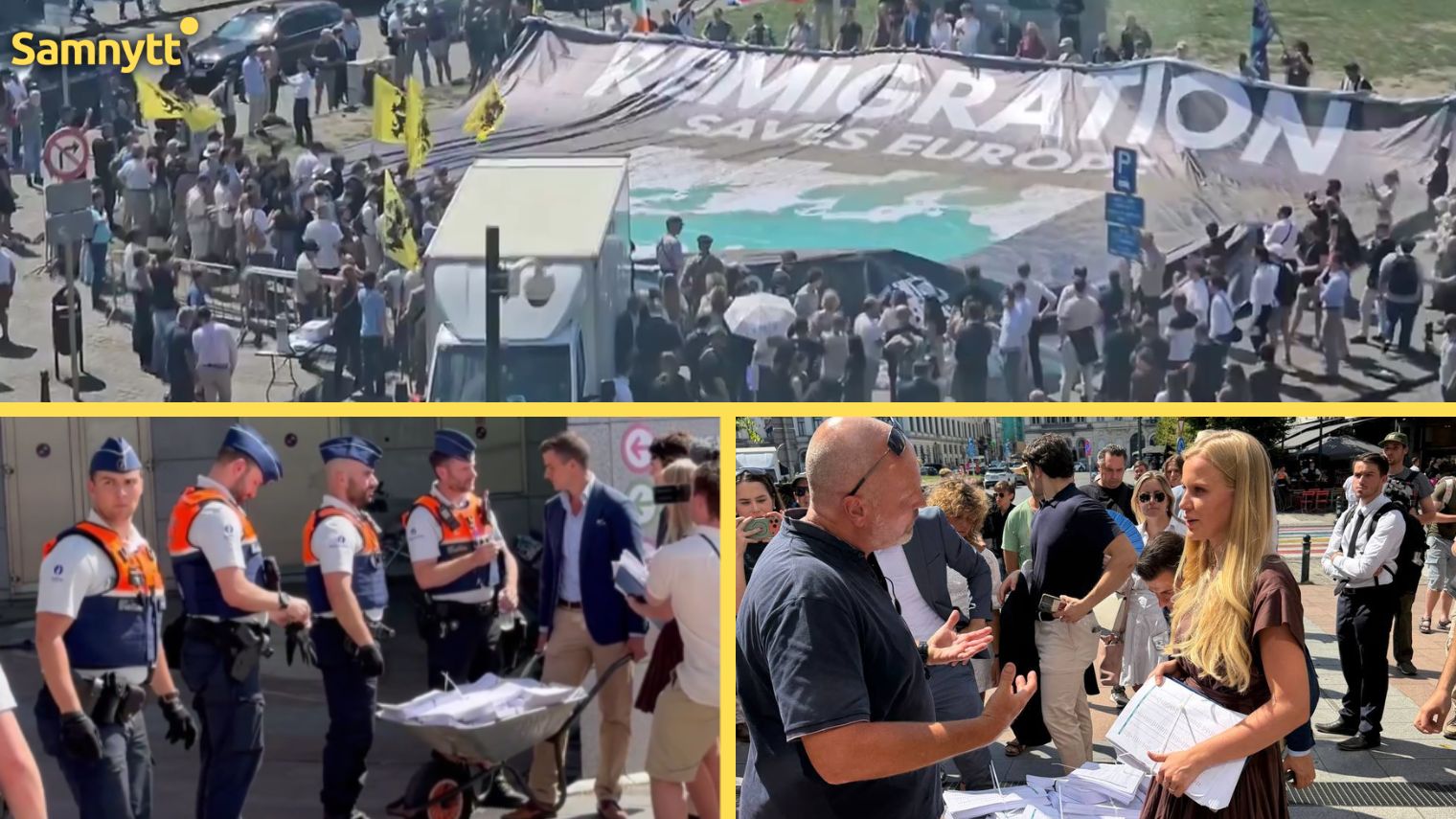
The planned demonstration for the Save Europe Act campaign in Brussels got off to a dramatic start. After Brussels’ mayor initially banned the demonstration, a court decision allowed the event to go ahead. On Wednesday, activists and several politicians gathered outside the European Parliament to highlight the campaign’s petition for remigration and reduced migration to Europe.
According to the campaign’s representatives, among them Dutch commentator Eva Vlaardingerbroek as one of the initiators, problems also arose when attempting to deliver the signatures to the European Parliament. However, after some delay, the handover could be completed.
The day before the demonstration, Save Europe Act announced that Brussels’ mayor had banned the demonstration on Place du Luxembourg, the square outside the European Parliament. The organizers immediately appealed the decision, arguing that the right to assemble and demonstrate had been disregarded.
Ahead of Wednesday, the campaign announced that the legal process had been successful, and the demonstration could proceed as planned. The rally was then held with several invited speakers, including Members of the European Parliament.
Fantastic news!
We won our battle in court against the Mayor of Brussels! The @SaveEuropeAct event is now officially allowed!
A huge thank you to everyone who supported us.
We won and we will keep winning! https://t.co/PV0D36tkI0
— Eva Vlaardingerbroek (@EvaVlaar) July 15, 2026
Wants to Put Remigration on the EU Agenda
Save Europe Act describes itself as the first “patriotic European citizens’ initiative.” The campaign’s goal is to collect one million signatures to force the European Commission to formally address the matter and hold a meeting with the initiators, according to the rules for a European Citizens’ Initiative.
Among the demands are a halt to illegal immigration, strengthened border controls, and a policy for remigration for people who lack the right to stay in Europe. The campaign also argues that EU member states should be granted greater possibilities to protect their national and cultural identity.
READ ALSO: Brussels’ Mayor Bans Demonstration Against Immigration
Earlier in July, the campaign announced it had passed 500,000 signatures—halfway to the one-million goal. At the same time, the European Commission has indicated that it may refuse to register the initiative as an official European Citizens’ Initiative, arguing that parts of its content may violate the EU’s fundamental values.
The organizers have stated they intend to continue the campaign regardless of the Commission’s assessment.
????️They made it inside!
The 530k signatures and the printed Save Europe Act mandate got delivered by @EvaVlaar and @DVanLangenhove .
We will never give up and keep on fighting for remigration and the 1 million signature mark.
A full documentary about our event and the delivery… pic.twitter.com/rxPByWDhEk
— Save Europe Act (@SaveEuropeAct) July 15, 2026
Immigration Has Increased Sharply
Over the past two decades, migration has been one of the most hotly debated issues within the EU. The number of people with non-European backgrounds has increased in many member states while the Union has received large numbers of refugees from, among other places, Syria, Afghanistan, and Ukraine, as well as significant labor and family immigration.
Immigration peaked during the 2015–2016 migration crisis when over a million asylum seekers arrived in the EU in a short period. Even since then, migration has remained at historically high levels, while several member states have reported record net immigration.
The issue has become central in national elections across Europe and has contributed to increased support for anti-immigration parties in several countries.
????⚡️@EvaVlaar : « Si vous pensez que la situation est terrible, pensez à ce qu’elle sera pour nos enfants. […] Nous utilisons les armes de l’Union européenne contre elle ! » pic.twitter.com/zmS7DddHhO
— Ligne Droite • La matinale de RC (@Ligne__Droite) July 15, 2026
Divided Opinion
Opinion polls in recent years show that Europeans in general distinguish between different forms of migration. There is often stronger support for receiving people fleeing war and persecution, while a significant proportion believe so-called irregular migration should be restricted and that the EU’s external borders should be reinforced.
In several member states, many voters also report that immigration levels are too high, while others see migration as important for the labor market and Europe’s demographic development. As such, the issue remains one of the most polarizing in European politics.
Watching the @SaveEuropeAct rally of patriots in Brussels as the kinko bearded Trannies of the #EU institutions protest angrily in favour of mass immigration. The looney Left are caught off from biology, numbers, soap and reality. @EvaVlaar @IrexitFreedom @europarl pic.twitter.com/gELWfIRTbA
— Hermann Kelly IFP (@hermannkelly) July 15, 2026
READ ALSO: Petition to Force the EU to Raise the Issue of Remigration