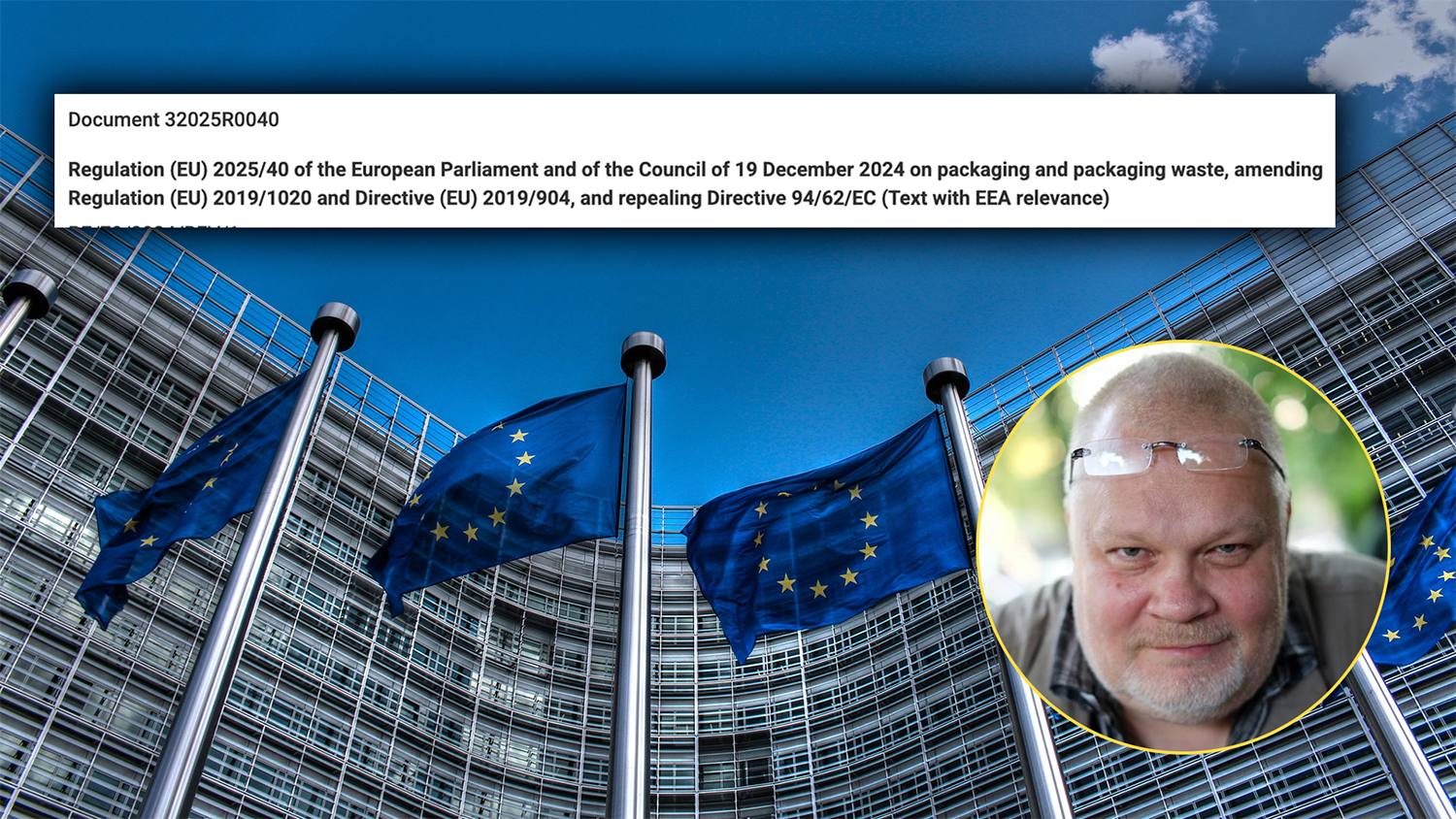
The EU’s new Packaging Regulation has now come into force. For smaller businesses selling goods directly to customers in other EU countries, the rules may mean registration, reporting, fees, and local representatives in every country where they have customers. Critics warn that the legislation risks making the internal market significantly less accessible for small online retailers – at the same time as the EU Commission has already proposed delaying one of the most criticized requirements.
On August 12, the bulk of the EU’s new Packaging Regulation, PPWR, came into effect. The regulation was adopted with the explicit aim of reducing the amount of packaging waste, increasing recycling, and harmonizing rules in the European market.
But when it comes to producer responsibility, the result could instead be extensive national administration for companies selling across borders.
The liberal public debater and blogger sharply criticizes the consequences in a post at Femte juli. He describes the rules as a potential “death blow” for parts of cross-border e-commerce.
A System in Every Country
The problem is that producer responsibility is not handled through a single common EU system. Producers may instead have to register in the producer registry of the member state where they are first placing packaging on the market, and will be covered by that country’s system for extended producer responsibility. The EU Commission’s own informational material describes the obligation to register producers nationally and that registration may need to take place in every member state where packaging is placed on the market.
For a smaller Swedish company selling directly to consumers in several EU countries, this could mean dealing with several different national systems, reporting quantities and materials, fees, and other administrative requirements.
One further rule has drawn particular criticism. According to Article 45.3, a producer established in one EU country and selling directly to end users in another member state must appoint an authorized representative for producer responsibility in the country where the goods are sold.
There is also no general exemption from producer responsibility just because a company is small. The EU Commission has previously stated that there is no horizontal exemption for micro-businesses from EPR requirements, even though smaller companies are exempt from some other parts of the regulation.
Alexandersson points out that this can make even occasional sales to other EU countries disproportionately costly administratively. In practice, a company may thus decide it is simply easier to stop delivering to certain countries.
The Commission Already Wants to Backtrack
The problem of administrative burden has also been recognized by the EU Commission.
In December 2025, the Commission submitted a proposal to postpone the requirement for nationally authorized representatives for EU-based producers until January 1, 2035. The Commission explicitly justifies the change by citing the need to reduce companies’ administrative burdens and make the internal market easier to operate in.
However, the proposal has not yet been finalized by the European Parliament and the Council of Ministers. This means that the regulation as already adopted remains in force as written for the time being. The European Parliament’s legislative work on the amendment is still ongoing.
This creates a situation where companies may need to adapt to a requirement that the Commission itself wants to suspend in the coming years.
Industry organizations have also warned that the obligation to appoint separate representatives in different member countries creates fragmented and costly administration, and particularly affects smaller companies operating in multiple countries.
Risks Favoring the Largest Players
The EU’s stated ambition with the regulation is, among other things, to harmonize rules on the internal market. When the European Parliament approved the agreement in spring 2024, packaging reduction, recycling, and common rules were highlighted as central goals. The regulation was then approved by 476 votes to 129, while 24 members abstained.
However, the practical effect of producer responsibility risks going in the opposite direction when administration is still divided among member states.
For a large international corporation, the cost of national registrations, reporting systems, and legal administration is relatively easy to bear. For a small Swedish online shop that may only sell a few dozen products per year to, for example, France, Germany, or Italy, the same fixed costs weigh much heavier.
This is the effect Alexandersson warns about. He argues that the rules could concentrate the market by benefiting large companies and certain firms selling so-called compliance services, while smaller retailers are given a strong economic incentive to withdraw from parts of the European market entirely.
“Astonishingly Backwards”
When the rules were adopted, they were presented as a way to both reduce packaging waste and improve the internal market’s functioning. The question now is whether the administrative setup instead risks creating new national barriers for those small companies that the internet and the EU’s free movement have previously enabled to sell across all of Europe.
– This is astonishingly backwards, even by EU standards, writes Alexandersson.
Alexandersson notes that the Commission’s attempt to subsequently ease the representative requirement shows that the problem has at least been acknowledged in part. But until a change has actually been decided, companies must comply with the rules.
According to Alexandersson’s summary, S+V+MP+L voted for the final agreement while C, SD, and the then Folklistan voted no, and M and KD abstained. When the regulation was finally adopted by the EU Council of Ministers, the Swedish government also supported it. The Council gave its formal approval in December 2024.